
Clone Robotics unveils humanoid with 1,000 water-powered muscles
PLUS: Hyundai's robot tariff strategy, Beijing's manufacturing hub, and Nvidia's new physical AI world models

Welcome back to your Robot Briefing
Clone Robotics just showed off Protoclone, a humanoid powered by over 1,000 water-based artificial muscles instead of conventional motors. After eight years in development, the robot is still mastering balance, but its biological movement approach represents a fundamental break from the motor-heavy designs from Tesla, Figure, and others.
As radically different humanoid architectures emerge, the question for businesses isn't just when to deploy robots, but which underlying technology to bet on. Do you wait to see if biomimetic designs deliver on their dexterity promise, or commit to today's motor-driven platforms that are closer to commercial deployment?
In today's Robot update:
A Humanoid With 1,000 Water-Powered Muscles
Snapshot: Clone Robotics unveiled Protoclone, a humanoid that replaces traditional motors with over 1,000 hydraulic artificial muscles, marking a sharp departure from the motor-driven designs dominating the humanoid market.
Breakdown:
Takeaway: The emergence of fundamentally different humanoid architectures means businesses evaluating robotics need to match platform design to use case rather than assuming a single approach will dominate. This biomimetic path suggests potential advantages in dexterity and human-environment fit, but the extended development timeline signals commercial deployment is still years out.
Hyundai's Plan to Offset Tariffs With Robots
Snapshot: Hyundai Motor Group plans to deploy Boston Dynamics humanoid robots in its U. S. manufacturing plants starting in 2026, using automation as a strategic response to government tariffs.
Breakdown:
Takeaway: Tariffs are creating a forcing function that makes the business case for humanoid robots more compelling right now, not in some distant future. Executives should watch whether other manufacturers follow Hyundai's playbook of using automation to absorb regulatory costs rather than passing them to consumers.
Beijing Launches Humanoid Manufacturing Hub
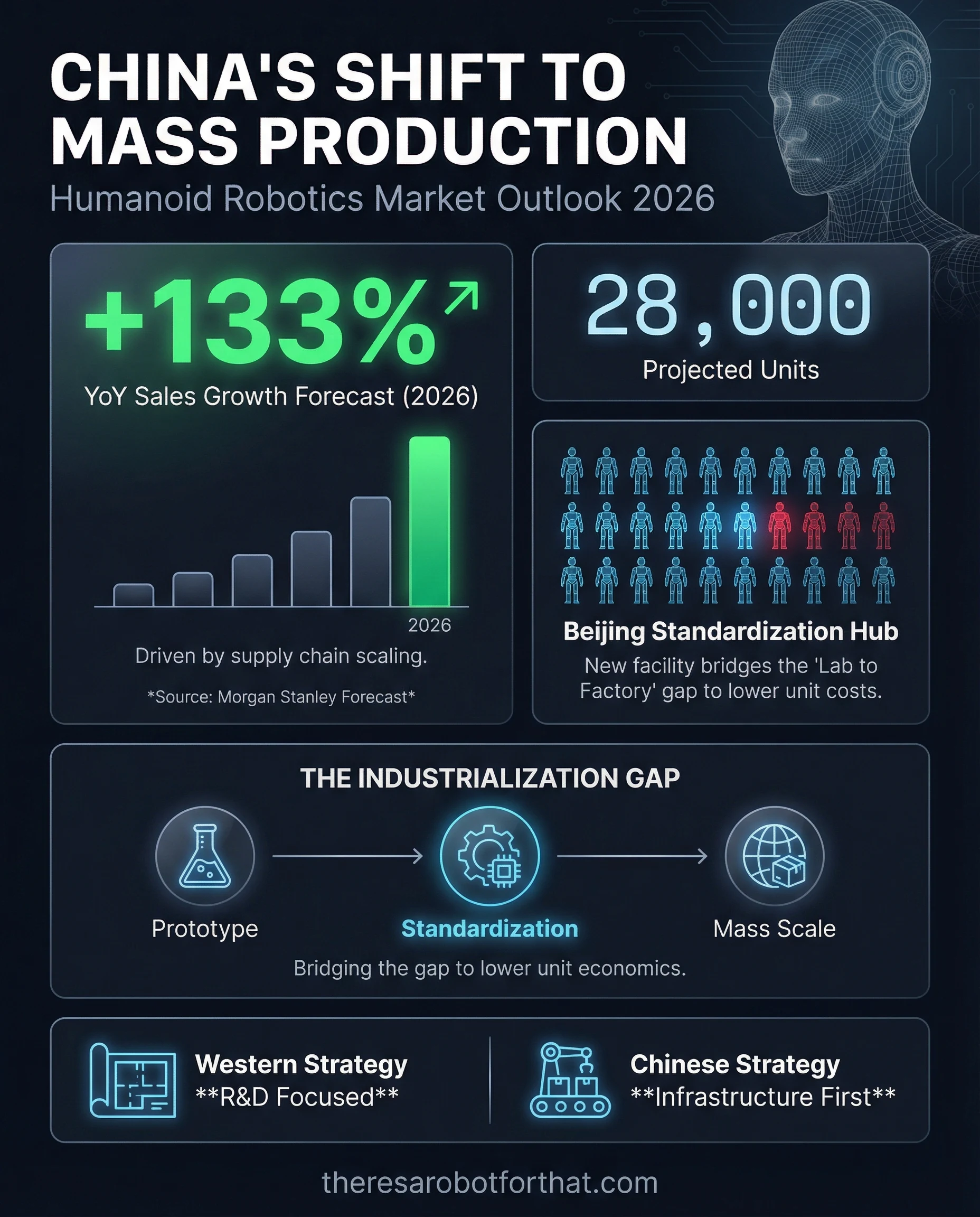
Image Source: There's A Robot For That
Snapshot: China opened its first dedicated facility for standardizing and validating humanoid robot production, a move that signals the industry's shift from prototypes to mass manufacturing as sales are projected to surge 133% in 2026.
Breakdown:
Takeaway: China's focus on industrializing humanoid production infrastructure represents a different strategy than the prototype-heavy approach common in the West. Companies evaluating humanoid investments should track how quickly Chinese manufacturers can translate this production capacity into commercially viable pricing and availability.
Nvidia and Dassault Build 'World Models' for Physical AI
Snapshot: Nvidia and Dassault Systemes announced an expanded partnership to create 'industry world models' - physics-accurate digital environments where robots can train before entering real-world factories and facilities.
Breakdown:
Takeaway: This shifts physical AI development from expensive trial-and-error in real facilities to scalable cloud infrastructure, lowering the barrier for manufacturers who want robot capabilities without building simulation environments from scratch. The infrastructure-as-a-service model signals that training robots in digital twins is moving from experimental to production-ready for mainstream manufacturers.
Other Top Robot Stories
POSCO plans to deploy Persona AI humanoid robots for logistics work in its South Korean steel mills starting in 2026, targeting tasks like fastening crane belts onto 20-40 ton steel coils—a demonstration that heavy industry is moving humanoids beyond pilot programs into hazardous production environments.
Medical deployed advanced robotic systems across seven hospitals in North Texas, with surgeons reporting procedures that previously took 90 minutes now complete in 45 minutes using da Vinci 5 and Mako robots—translating surgical automation into measurable throughput gains that operations leaders can benchmark.
Deloitte reports that 58% of enterprises have already adopted physical AI across monitoring systems, security, and collaborative robotics, with that figure expected to reach 80% within two years—suggesting the window for competitive advantage from early adoption is closing faster than most strategic plans assume.
🤖 Your robotics thought for today:
Clone Robotics spent eight years building Protoclone with 1,000 water-powered muscles and it's still learning to balance while motor-driven humanoids from Figure and Tesla are already running factory pilots—so does biomimicry actually win long-term or are we just romanticizing biology while pragmatic engineering ships products?
Until tomorrow,
Uli


