
Chinese firms ship 10,000 humanoids, US just 150
PLUS: Unitree G1 plays real tennis rallies, CMR Surgical feeds Nvidia's healthcare AI, and Congress probes China's robot threat

Welcome back to your Robot Briefing
Chinese manufacturers shipped over 14,500 humanoid robots in 2025, capturing 90% of the global market while Tesla and other U.S. players delivered roughly 150 units each. It's not just a gap — it's a chasm that exposes hard truths about who owns the supply chains and production scale needed to win this category.
The question for Western companies isn't whether humanoids will hit mass production, but whether they'll be building them or just buying them. If China locks in the same cost and volume advantages it has in EVs and solar, catching up could mean playing a different game entirely.
In today's Robot update:
Chinese Companies Ship 90% of World's Humanoid Robots
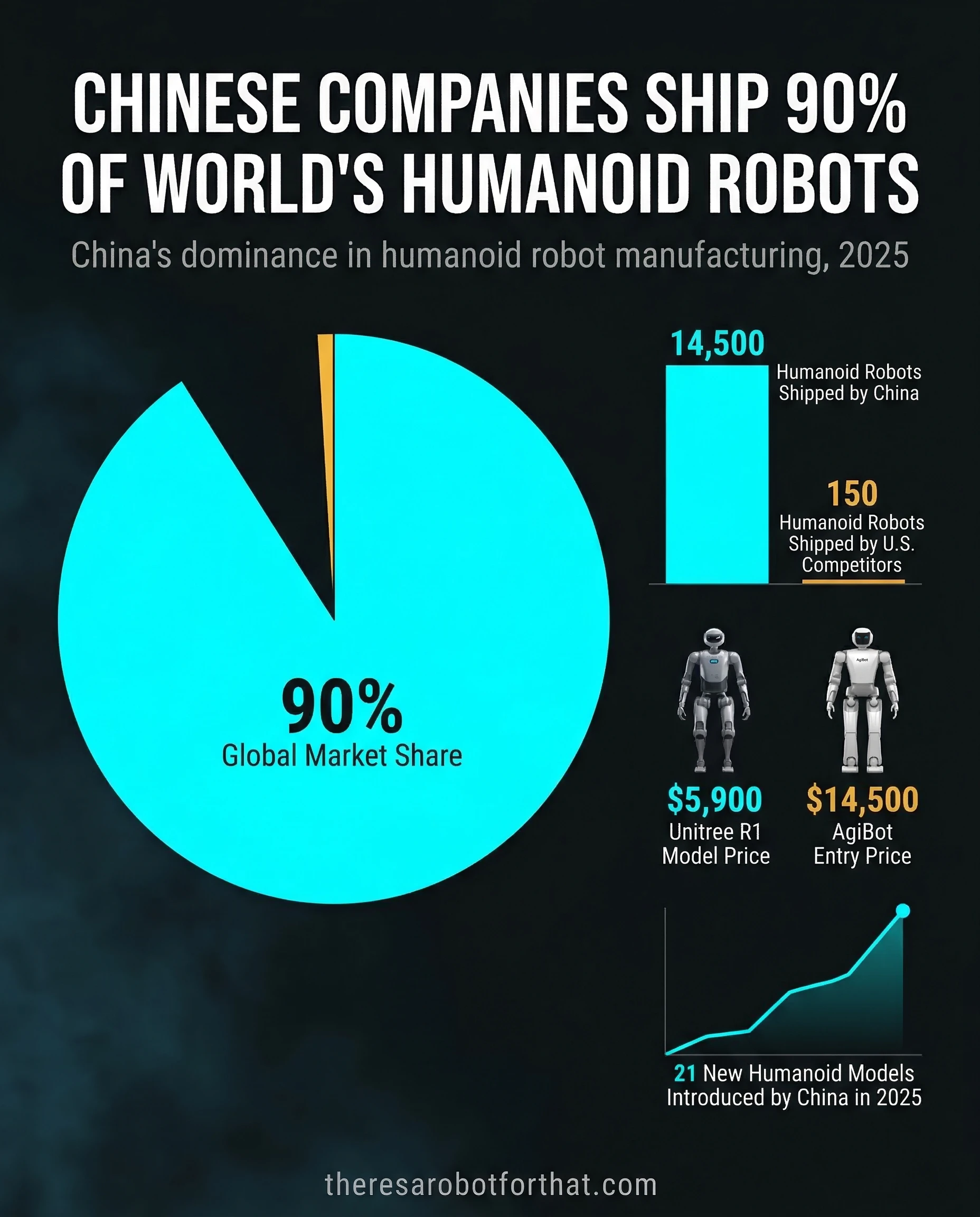
Image Source: There's A Robot For That
Snapshot: Chinese manufacturers shipped over 14,500 humanoid robots in 2025, capturing 90% of global sales while U.S. competitors including Tesla each delivered roughly 150 units. The gap signals China's manufacturing advantage in what could become a mass-market category by 2030.
Breakdown:
Takeaway: The volume gap isn't about prototypes—it's about manufacturing scale and pricing that enables actual deployment economics. Companies evaluating automation roadmaps now face a China-dominated supplier landscape with 10-20x unit availability and significantly lower price points than Western alternatives.
Humanoid Robot Masters Tennis with Millisecond Reactions
Snapshot: Galbot's LATENT system enabled a Unitree G1 humanoid to sustain real-time tennis rallies with human players, demonstrating breakthrough whole-body coordination trained on just five hours of human motion data. This marks the first time a humanoid robot has handled the millisecond-level reactions and full-court movement required for dynamic sports.
Breakdown:
Takeaway: Training highly dynamic physical tasks with minimal human data represents a significant cost and deployment advantage—five hours versus months of data collection means faster adaptation to new tasks. For operations leaders, this suggests physical AI applications requiring complex coordination may arrive sooner than conventional timelines indicated.
Surgical Robotics Giant Fuels Nvidia's Healthcare AI Push
Snapshot: CMR Surgical contributed nearly 500 hours of anonymized surgical data from its Versius robot system to create Open-H, the world's largest open dataset for training intelligent surgical systems. The British company represents the majority of surgical data in Nvidia's Physical AI healthcare initiative announced at NVIDIA GTC.
Breakdown:
Takeaway: When a surgical robotics incumbent contributes hundreds of hours of proprietary clinical data to an open platform, it signals industry belief that AI training advantages outweigh competitive data protection. Healthcare operations leaders should watch whether this data-sharing model accelerates regulatory approval timelines and lowers development costs for AI-assisted surgical capabilities.
US Lawmakers Sound Alarm Over China's Humanoid Robot Dominance
Snapshot: American AI and robotics executives urged Congress to investigate Chinese robot manufacturers including Unitree, citing national security risks as China's rapid advancement in humanoid robotics threatens U.S. competitiveness. The House Homeland Security Cybersecurity Subcommittee heard testimony recommending potential federal procurement bans and expanded export controls.
Breakdown:
Takeaway: Congressional scrutiny typically precedes trade restrictions, procurement limitations, or tariff actions within 12-18 months. Operations leaders planning automation investments should prepare for potential supply chain disruption if Chinese humanoid platforms face regulatory barriers similar to telecommunications equipment or drone restrictions.
Other Top Robot Stories
China unveiled a wheeled humanoid robot designed to assemble infrastructure and transport materials for lunar base construction by 2035, choosing wheels over bipedal walking for mechanical simplicity and energy efficiency in the Moon's harsh environment.
Daifuku plans to begin testing humanoid robots for logistics operations within three years, aiming to extend its roughly 40% global market share in factory automation systems with labor-saving solutions for warehouses and distribution centers.
Foundation deployed two Phantom MK-1 humanoid robots to Ukraine in February for battlefield reconnaissance testing, marking what appears to be the first known instance of a humanoid robot being evaluated on the front lines of an active war zone.
Gecko Robotics secured a $71 million Navy contract to deploy its climbing and swimming robots for ship maintenance assessments, condensing a three-month inspection process to two days and supporting the Navy's goal of 80% fleet readiness by 2027.
🤖 Your robotics thought for today:
Unitree shipped 5,500 humanoid units last year at $5,900 each. Tesla shipped 150. When one country delivers 36x the volume at half the expected price, that's not a temporary lead — that's supply chain dominance hardening into market reality.
The West keeps announcing prototypes while China racks up deployment hours.
Until tomorrow,
Uli


