
China’s X Square raises $140M for robot brains
PLUS: Robots learn to lip-sync, FedEx demands super humanoids, Chery debuts AiMOGA

Welcome back to your Robot Briefing.
Chinese startup X Square just landed $140 million from ByteDance to build foundation models exclusively for embodied AI, bringing their total raised to over $400 million in two years. The company argues that robots need fundamentally different intelligence than chatbots and is already demonstrating autonomous correction capabilities in real-world food delivery.
With Chinese early-stage robotics investment running five to six times higher than Europe, and deployments moving from pilots to production at breakneck speed, Western companies face a compressed competitive timeline. How much runway do businesses have left to finalize their automation strategies before this parallel ecosystem becomes the global standard?
In today's Robot update:
China's X Square secures $140M to build 'Physical AI' brains
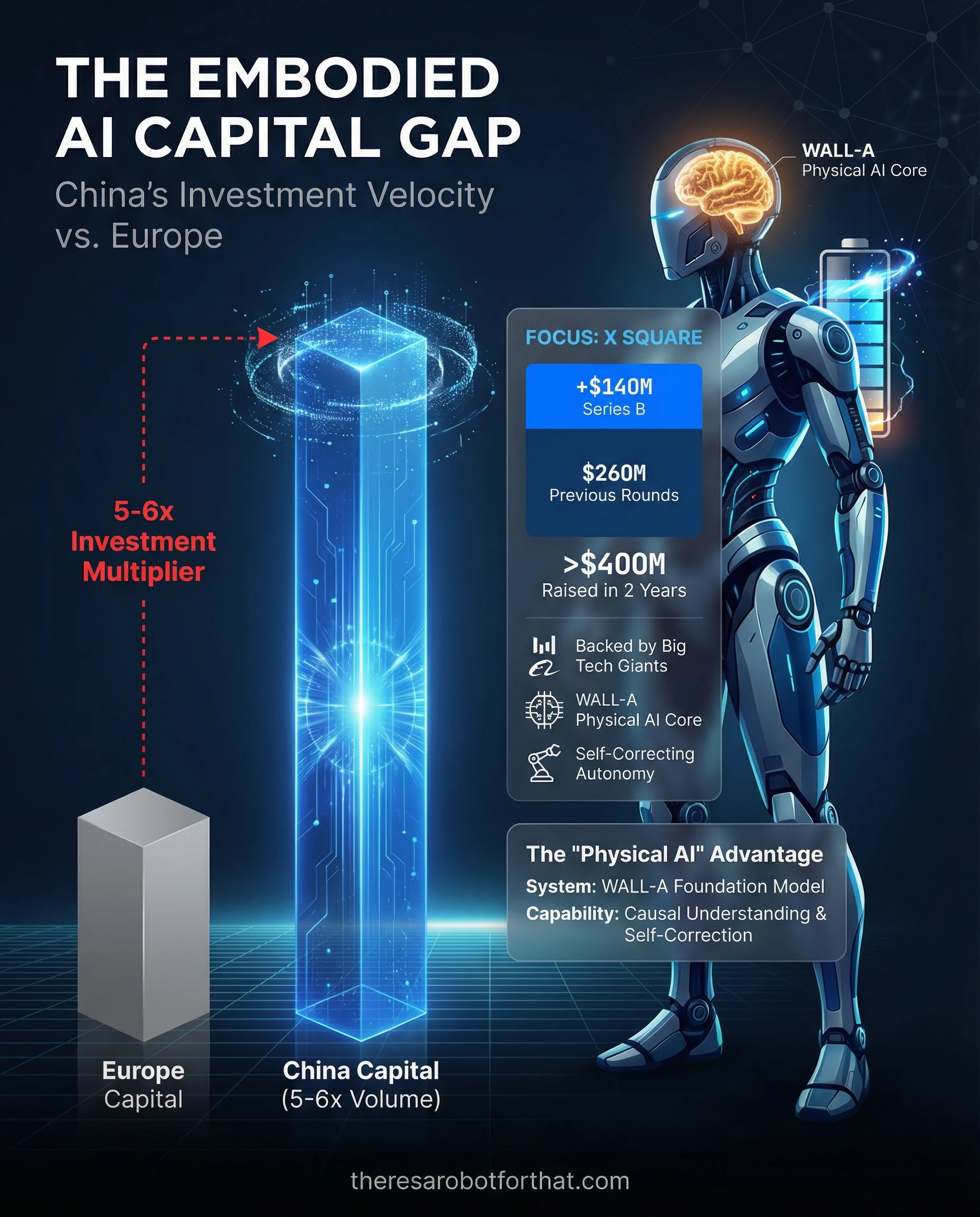
Image Source: Gemini / There's A Robot for That
Snapshot: Chinese robotics startup X Square announced it raised RMB 1 billion ($140M) in a funding round led by ByteDance to develop foundation models specifically for embodied AI, arguing that robots need different intelligence architectures than chatbots.
Breakdown:
Takeaway: China is building a parallel robotics intelligence ecosystem with capital deployment that dwarfs Europe and rivals the U. S., complete with real-world deployments rather than just lab demos. For Western companies watching from the sidelines, the competitive timeline just compressed—this technology is moving from pilots to production faster than most strategic plans anticipated.
Robots finally learn to lip-sync via mirror training
Snapshot: Columbia Engineering researchers have created a robot that learns to realistically lip-sync by observing its own reflection in a mirror and watching human videos, using a new 'vision-to-action' learning model published in Science Robotics.
Breakdown:
Takeaway: This research addresses a critical barrier to humanoid deployment in service roles, but the technology remains early-stage with notable limitations. Companies evaluating humanoid robots for customer interaction should monitor this space but shouldn't expect production-ready solutions for several years.
FedEx CEO: We need 'Super Humanoids' with extra elbows
Snapshot: FedEx's CEO is pushing back on the humanoid robot hype, arguing that copying the human form isn't enough for warehouse automation—the industry needs robots with capabilities beyond human anatomy.
Breakdown:
Takeaway: This is a rare public admission from a Fortune 500 operations leader that humanoid form factor may be the wrong solution for industrial automation. When executives start demanding robots that transcend human anatomy rather than mimic it, it signals the industry is moving past the anthropomorphic assumption toward pure function-driven design.
Chery debuts AiMOGA robot family
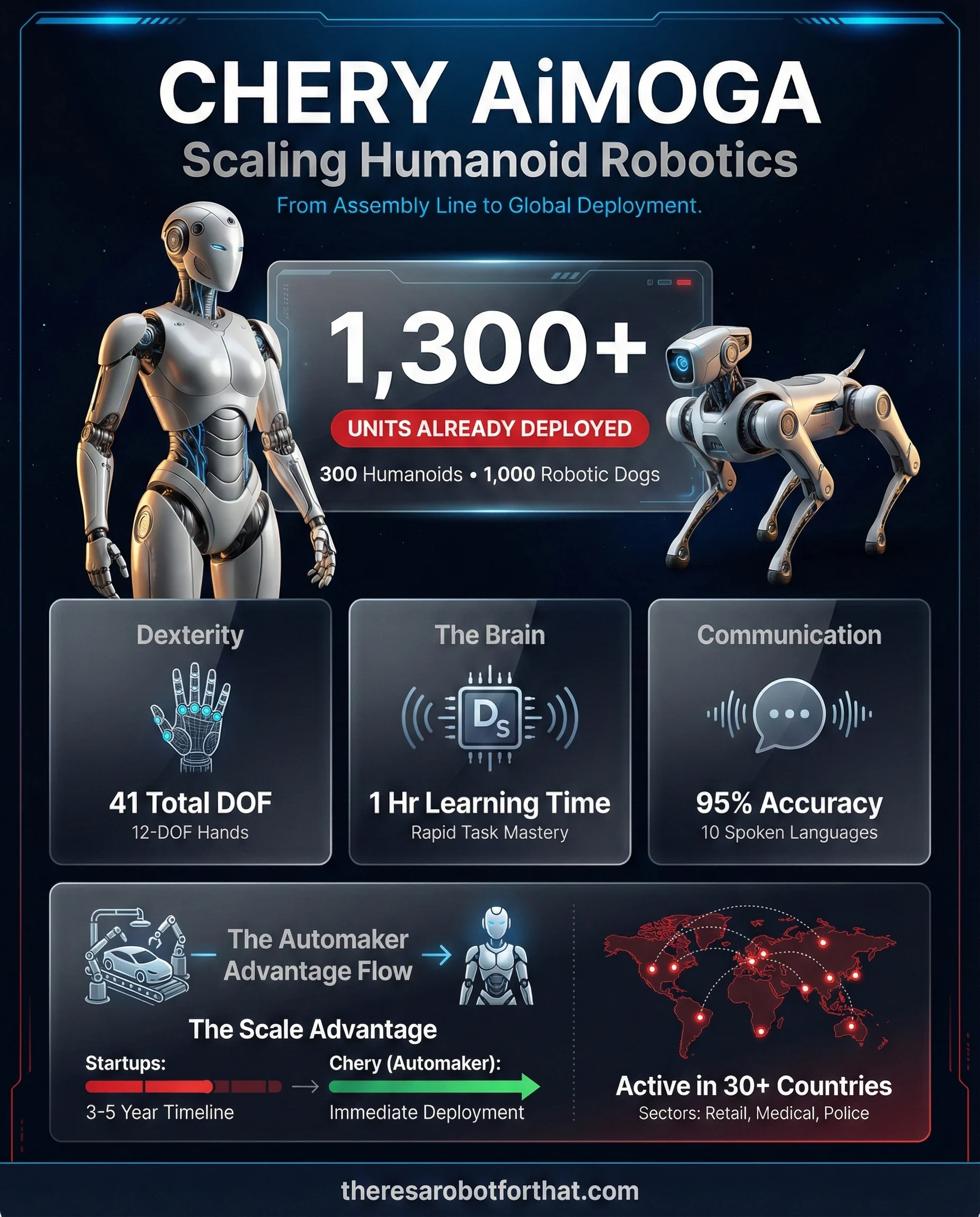
Image Source: Gemini / There's A Robot for That
Snapshot: Chinese automaker Chery Group unveiled its AiMOGA humanoid robot lineup at its 2026 AI Night event, featuring variants for retail, policing, and medical applications—signaling that automotive manufacturers with production scale are now serious competitors in the humanoid space.
Breakdown:
Takeaway: Traditional manufacturers entering humanoids changes the commercialization timeline because they solve the production scaling problem that純 robotics startups struggle with—Chery can leverage existing automotive supply chains and quality systems. This deployment scale from an automaker subsidiary suggests the "humanoids in enterprise" era is arriving faster than the typical 3-5 year projections, especially in markets willing to adopt AI-powered service roles.
Other Top Robot Stories
Chery unveiled its AiMOGA humanoid robot lineup featuring 41 degrees of freedom and multi-language AI decision-making powered by DeepSeek, with 300 robots and 1,000 robotic dogs already deployed across 30+ countries—demonstrating how automotive manufacturers are leveraging existing supply chains to scale humanoid production faster than pure robotics startups.
Humanoid completed a two-week proof-of-concept at a Siemens Electronics Factory where its HMND 01 wheeled robot achieved 90%+ pick-and-place success rates, sustained 8+ hour autonomous operation, and moved 60 totes per hour in live production environments—signaling that industrial humanoid deployments are moving from controlled pilots to real manufacturing floors with measurable performance benchmarks.
🤖 Your robotics thought for today:
X Square raised $400M in two years to build robot-specific AI while Western foundation model companies are still retrofitting chatbot brains for physical tasks—does that mean China's betting specialized beats general-purpose, or are we just watching them skip straight to what actually works?
What's your take?
Until tomorrow,
Uli


