
China’s PNDbotics humanoid learns in hours without setup
PLUS: Schaeffler deploys hundreds of humanoids, X Square raises $140M, and Maize Runner robots
Welcome back to your Robot Briefing
A Chinese startup claims its humanoid can master new tasks in hours, not months. PNDbotics' Adam-U Ultra ships with a pre-trained vision-language-action model and 10,000 real-world scenarios already loaded, eliminating the setup and calibration phases that typically stretch deployment timelines.
If robots can truly go from unboxing to productive work in days instead of quarters, the business case for automation changes overnight. The question is whether these pre-trained models deliver on their promise in messy, real-world conditions, or if we're still years away from plug-and-play humanoids.
In today's Robot update:
China's PNDbotics unveils humanoid that learns in hours
Snapshot: Chinese robotics firm PNDbotics released Adam-U Ultra, a humanoid platform that masters complex manipulation tasks in hours without setup or calibration. The robot comes pre-loaded with a Vision-Language-Action model trained on 10,000+ real-world scenarios, potentially slashing the time and cost of deploying humanoids for practical work.
Breakdown:
Takeaway: If pre-trained models can truly compress deployment timelines from months to weeks, they fundamentally change the ROI equation for companies evaluating humanoids. The shift from "build and train from scratch" to "download and customize" mirrors what happened with large language models, potentially accelerating mainstream adoption by removing a major technical barrier.
Schaeffler to deploy 'hundreds' of humanoids in factories
Snapshot: German industrial giant Schaeffler has signed a strategic partnership with SKL Robotics (Humanoid) to integrate hundreds of humanoid robots into its global production network by 2027.
Breakdown:
Takeaway: This represents a significant shift from pilot projects to production-scale commitments with clear timelines and validation frameworks. The fact that a €16B+ manufacturer is planning hundreds of units within three years suggests the business case for humanoids in manufacturing is becoming concrete enough for major operational bets.
X Square secures $140M for 'Physical Foundation Models'
Snapshot: Chinese robotics startup X Square Robot closed over $140 million in Series A++ funding to develop WALL-A, its vision-language-action model designed to give robots the intelligence to handle real-world tasks without extensive programming.
Breakdown:
Takeaway: This funding round marks another data point showing that embodied AI for robotics is attracting serious capital and moving toward commercial deployment, particularly in Asia. The shift from teleoperation and simulation to autonomous real-world task completion suggests the timeline for general-purpose robots in logistics and service sectors may be compressing faster than many Western companies anticipate.
Autonomous 'Maize Runners' and tractors hit the fields
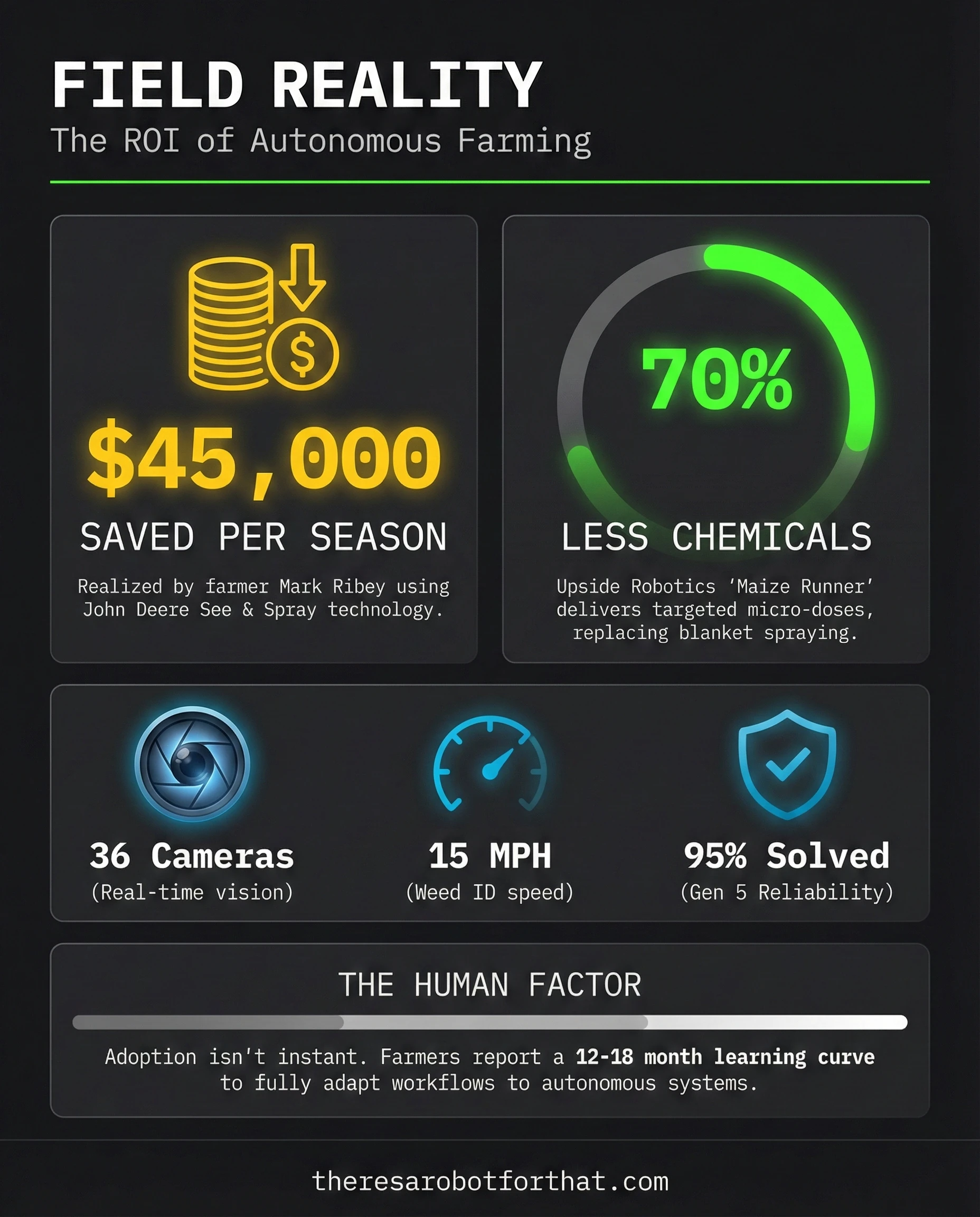
Image Source: Gemini / There's A Robot For That
Snapshot: Farms are deploying 150-pound autonomous robots and self-driving tractors right now to solve labor shortages and cut costs, with one Ontario farmer saving $45,000 while reducing chemical use by 70%. Demonstrations at Grey Bruce Farmers' Week showed these systems working in real field conditions, not just labs.
Breakdown:
Takeaway: The shift from R&D to commercial deployment is happening faster than expected, with measurable ROI already documented on mid-sized farms. Companies evaluating automation should expect 12-18 month learning curves and recognize these systems augment rather than replace human oversight.
Other Top Robot Stories
TESOLLO launched its DG-5F-S humanoid robotic hand at 60% the cost of its predecessor while maintaining 20 degrees of freedom across five fingers, signaling that proprietary actuator development is driving down component costs faster than many expected in the humanoid supply chain.
WIRobotics advanced from technology demonstration to execution phase at CES 2026, establishing concrete plans for technical collaboration with AI companies on its ALLEX humanoid platform and securing distribution partnerships for its WIM wearable robot across Mexico, the Middle East, and Southeast Asia.
GITAI demonstrated autonomous coordination between two Centaur-style rovers in desert testing that drilled, scooped, and sealed lunar soil samples without human intervention, signaling that multi-robot coordination capabilities for extreme environments are moving from concept to field-tested reality.
LimX unveiled COSA (Cognitive OS of Agents), described as the first physical-world-native agentic operating system that enables its Oli humanoid to perform high-level reasoning and whole-body control, representing a shift from command-based operation to contextual autonomous decision-making in real-time.
🤖 Your robotics thought for today:
PNDbotics ships Adam-U Ultra with 10,000 pre-trained scenarios that deploy new skills in hours, not months—so if the setup barrier just collapsed, why are companies still treating humanoid pilots like multi-year R&D projects instead of quarterly capability upgrades?
Until tomorrow,
Uli


