
China's humanoid 'Super Bowl' signals 90% dominance
PLUS: Medtronic’s FDA win, new $62M fund

Welcome back to your Robot Briefing
Four Chinese humanoid startups performed coordinated routines on the country's most-watched television event, the CCTV Spring Festival Gala, as new data shows China now ships 90% of the world's humanoid robots.
With 13,000 units delivered in 2025 versus minimal Western output, and President Xi personally meeting robotics founders, the question for companies planning automation investments is no longer whether Chinese humanoids will dominate supply chains—but whether procurement teams can justify dependency on suppliers with direct government backing.
In today's Robot update:
China's humanoid 'Super Bowl' moment
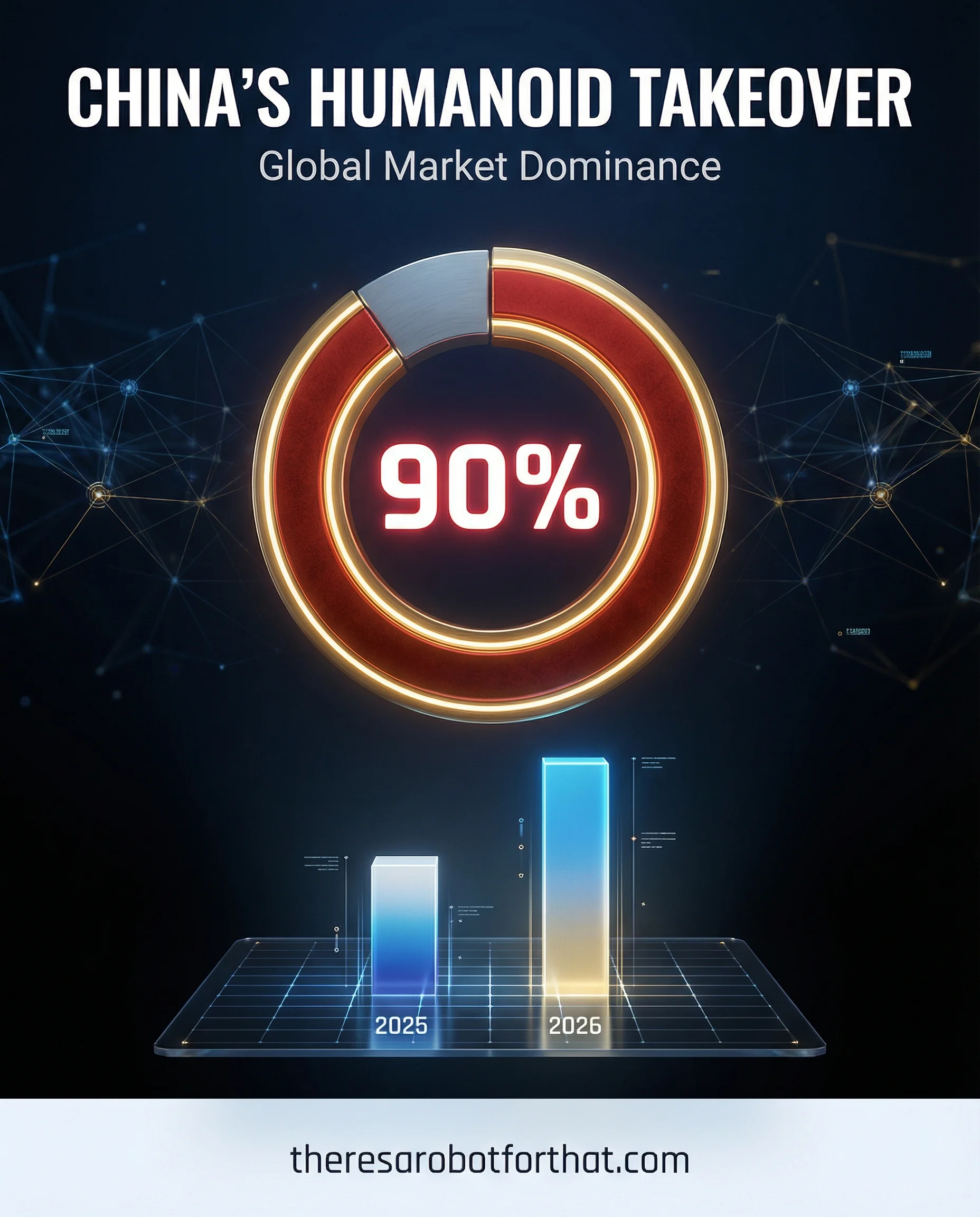
Image Source: There's A Robot For That
Snapshot: China commanded the world's attention by showcasing humanoid robots on its most-watched TV event, the CCTV Spring Festival Gala, as new data reveals the country now controls 90% of global humanoid robot shipments.
Breakdown:
Takeaway: The coordinated display of political backing, manufacturing scale, and prime-time promotion signals China is moving humanoid robots from lab demonstrations to commercial deployment faster than Western competitors expected. Executives evaluating automation roadmaps now face a market where 90% of available humanoid robots come from Chinese suppliers with direct government support.
Tien Kung 3.0: A new open-source humanoid
Snapshot: China's X-Humanoid launched Embodied Tien Kung 3.0, positioning it as the first full-size humanoid with whole-body dynamic motion and tactile control—but the real story is the open architecture designed to lower barriers for integrators and speed commercial deployment.
Breakdown:
Takeaway: This represents China's bet on open ecosystems to dominate humanoid deployment—similar to how Android conquered mobile through accessibility rather than closed innovation. If open platforms gain traction faster than proprietary systems, the competitive landscape could shift quickly toward integrators who can customize rather than manufacturers who control everything.
Japan's DIC launches $62M 'Physical AI' fund
Snapshot: Tokyo-based DIC Corporation, a century-old chemicals and materials giant with €10B+ in annual revenue, has announced a $62 million investment portfolio targeting startups in sensors, wearables, robotics, and automation—signaling that traditional industrial players now view physical AI as core to their future.
Breakdown:
Takeaway: When a $10B+ industrial manufacturer commits this level of capital and infrastructure to robotics startups, it validates that the technology has moved beyond pilot projects into strategic necessity. Companies evaluating automation investments should note this as a timing signal—traditional industry leaders are now competing for the same technologies that will define next-generation operations.
Medtronic wins FDA clearance for spine robot
Snapshot: Medtronic received FDA clearance for its Stealth AXiS robotics platform, marking a significant milestone as surgical robotics moves from specialized tools into mainstream hospital infrastructure through established medical device channels.
Breakdown:
Takeaway: FDA clearance through a major medical device manufacturer like Medtronic signals that surgical robotics has crossed from experimental technology into standard hospital capital equipment. The modular pricing approach and integration into existing surgical workflows suggests adoption timelines for mid-sized healthcare systems are measured in quarters, not years.
Other Top Robot Stories
AGIBOT showcased its X2 humanoid at the 2026 World Artificial Intelligence Cannes Festival, engaging directly with French AI Minister Anne Le Hénanff and Cannes Mayor David Lisnard to demonstrate China's embodied AI capabilities to European policymakers as the company expands beyond Asian markets.
Chinese published research in Science Advances on GrowHR, an inflatable humanoid robot that can shrink to 36% of its height, float on water, and navigate confined spaces—marking a departure from rigid metal designs as researchers explore soft robotics for search-and-rescue operations where adaptability matters more than load-bearing strength.
AGIBOT joined the UAE Lunar New Year Grand Parade in Dubai, deploying humanoid robots for public engagement as the Chinese manufacturer extends its Middle East presence beyond the manufacturing facilities and government contracts that have driven its global shipment leadership.
🤖 Your robotics thought for today:
13,000 humanoids shipped in 2025. Prime-time TV. Five founders in a room with the head of state.
That's what it looks like when an industry stops being a research project and becomes national infrastructure.
The question isn't who's ahead. It's: at what point does "we're still perfecting it" stop being a strategy?
What's your take?
Until tomorrow,
Uli


