
China's 'Apex Predator' drones hunt in wolf packs
PLUS: LG x Tesla battery talks, Chinese humanoids target US, autonomous orchard dog

Welcome back to your Robot Briefing
Military labs in China have trained autonomous drones to hunt like wolf packs and hawks, eliminating targets without human oversight in combat scenarios that wrap up in just over 5 seconds. The real story isn't just military—it's how China's dominance in civilian robotics manufacturing is becoming a direct pipeline for defense applications, leaving U. S.
competitors trailing in both patent filings and deployment speed. What does this mean for commercial robotics firms trying to compete when dual-use technology erases the boundary between civilian and military innovation?
In today's Robot update:
China Labs Develop 'Apex Predator' Drone Swarms
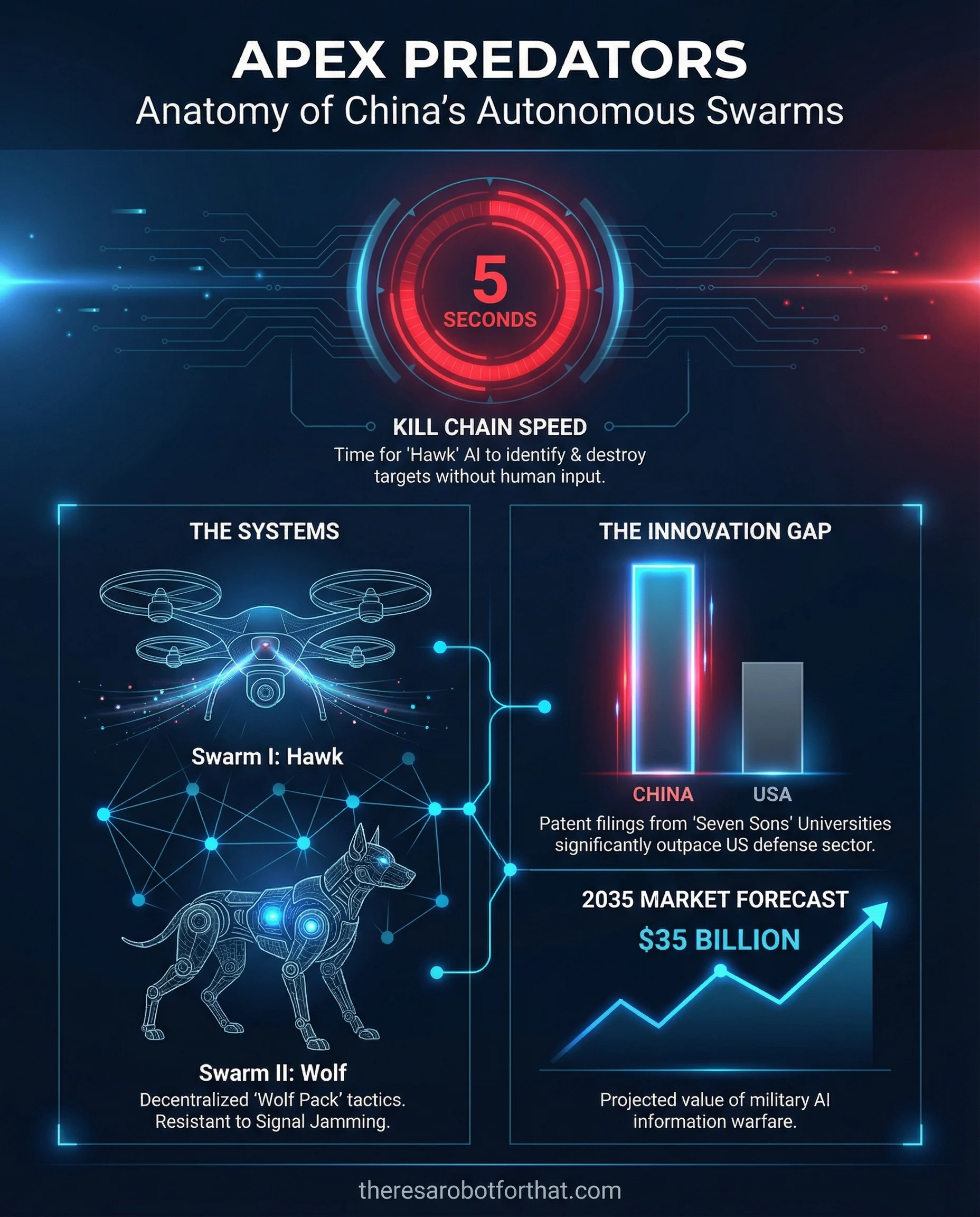
Image Source: There's A Robot For That
Snapshot: Chinese military researchers are engineering autonomous drone swarms that mimic wolf pack and hawk hunting tactics, designed to identify and eliminate targets without human input—a development that showcases how China's civilian robotics manufacturing edge translates directly to military capabilities.
Breakdown:
Takeaway: China's ability to rapidly adapt civilian robotics manufacturing capabilities for military applications signals a competitive pattern that extends beyond defense—companies in commercial robotics sectors should expect increased pressure as dual-use technologies blur the lines between civilian and military innovation. The patent filing gap and speed of deployment suggest China's hardware manufacturing dominance is becoming a strategic advantage in autonomous systems development.
LG Eyes Tesla Deal as Solid-State Batteries Boom
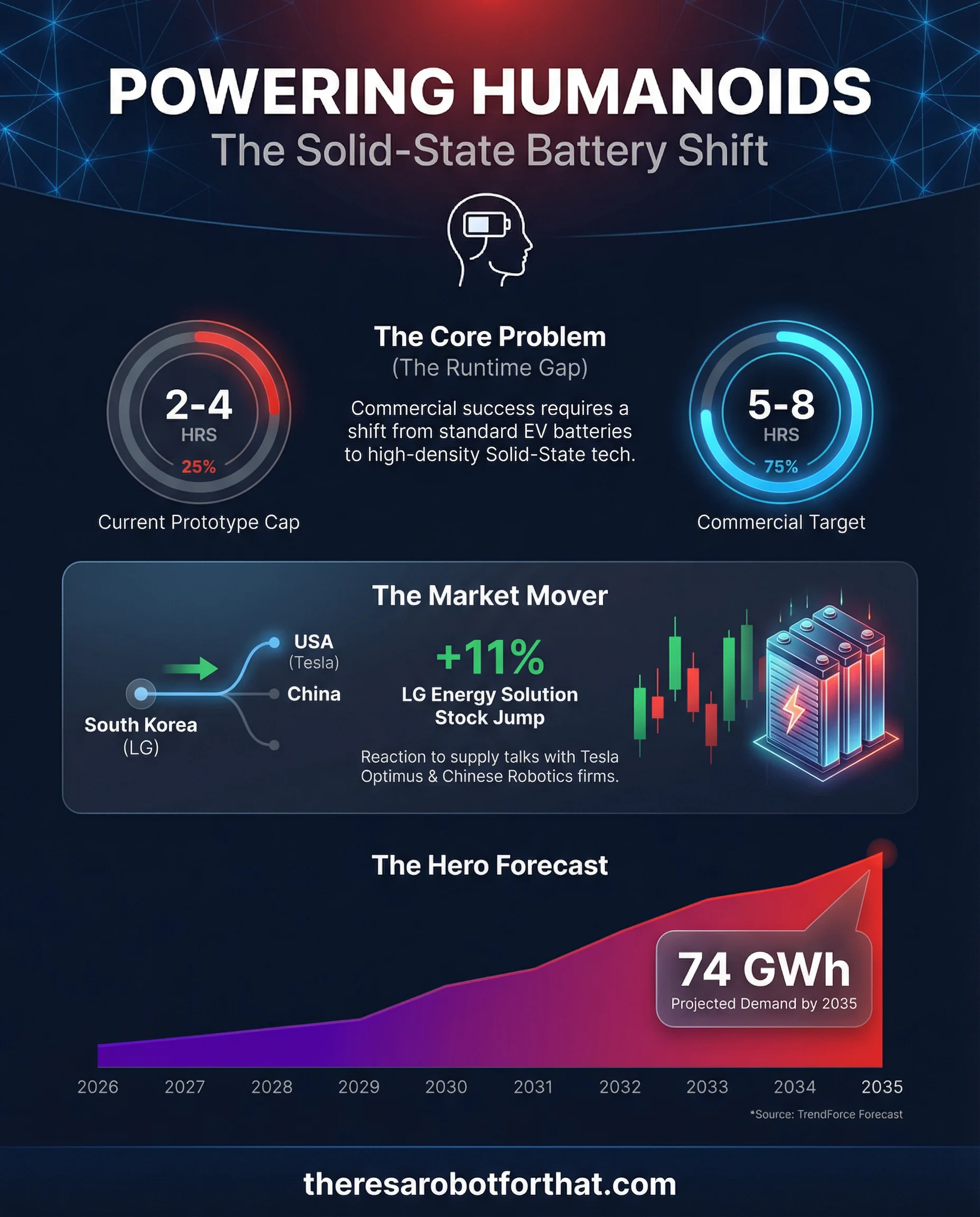
Image Source: There's A Robot For That
Snapshot: LG Energy Solution is reportedly in talks to supply batteries for Tesla's Optimus and multiple Chinese humanoid robots, as new market data projects demand for solid-state batteries in humanoid applications could explode to 74 GWh by 2035.
Breakdown:
Takeaway: This isn't just a battery story—it's a signal that humanoid robots are moving from prototypes to production-ready products with real performance requirements that companies are willing to pay premium prices to solve. The battery specs reveal the hard constraints holding back deployment: current robots can barely operate a full shift, and whoever cracks extended runtime first will have a significant commercial advantage.
Chinese Humanoids Set Sights on U. S. Market
Snapshot: Shenzhen-based LimX Dynamics and other Chinese robotics firms are shipping humanoids now while Tesla's Optimus won't reach consumers until late 2027, with LimX showcasing its humanoid at CES and planning U. S. partnerships following Middle East deployments starting this year.
Breakdown:
Takeaway: The humanoid deployment timeline just compressed significantly—Chinese firms are building international case studies and partnerships today while Western competitors refine their technology. Businesses evaluating humanoid pilots now have accessible pricing benchmarks and multiple vendors competing for early adopter relationships, rather than waiting another 18+ months for Tesla's commercial launch.
Meet the AI 'Robodog' Agronomist
Snapshot: Frutas AI has deployed a quadruped robot that autonomously scouts orchards and collects crop health data, targeting the labor shortage crisis that's making traditional agronomist roles increasingly difficult to fill.
Breakdown:
Takeaway: This isn't a prototype—it's operating in commercial orchards right now with quantified results. Specialty crop growers facing rising labor costs and shrinking agronomist pipelines have a deployable option today, though the infrastructure requirements (clear rows, charging stations) mean it's best suited for established operations with high-value crops.
Other Top Robot Stories
Hyundai's union warns the automaker not to deploy Boston Dynamics Atlas humanoids to its factories without union approval, arguing the robots could enable 24/7 shifts at lower costs than three human workers and create employment shocks as the company plans to manufacture 30,000 robots annually at its new facility by 2028.
UBTECH partners with Airbus to deploy Walker S2 humanoids in aviation manufacturing while Texas Instruments adopts the same robots for semiconductor production lines, marking a strategic expansion beyond the company's traditional electric vehicle manufacturing base as it targets 10,000 annual units by 2027.
Engine launches a partnership with Beijing Interstellar to develop its PM01 humanoid for space missions, while X-Humanoid demonstrates direct satellite connectivity enabling robots to maintain real-time communication in remote locations without cellular or Wi-Fi networks, expanding operational range beyond traditional infrastructure constraints.
🤖 Your robotics thought for today:
China's military researchers built drone swarms that hunt in wolf packs and eliminate targets in 5 seconds while outpacing US patent filings—so if their civilian manufacturing advantage already converted to autonomous weapons dominance, which Western commercial robotics companies are actually ready when Washington asks them to dual-use their tech?
Until tomorrow,
Uli


