
China’s Agibot claims #1 global humanoid shipments
PLUS: Robots fail laundry test, Dreame’s stair-climbing vac, and the robot surgeon debate

Welcome back to your Robot Briefing
Agibot, a Chinese robotics startup, has landed the top spot in global humanoid shipments for 2025 according to Omdia research, backing the ranking with live CES demos and claims of thousands of units already deployed. The company demonstrated three robots on the show floor and announced plans to enter the US market this year.
With Chinese firms now shipping humanoids at commercial scale while Western competitors remain largely in prototype mode, should companies banking on domestic automation suppliers rethink their vendor timelines and geographic assumptions?
In today's Robot update:
China's Agibot claims #1 spot in global humanoid shipments
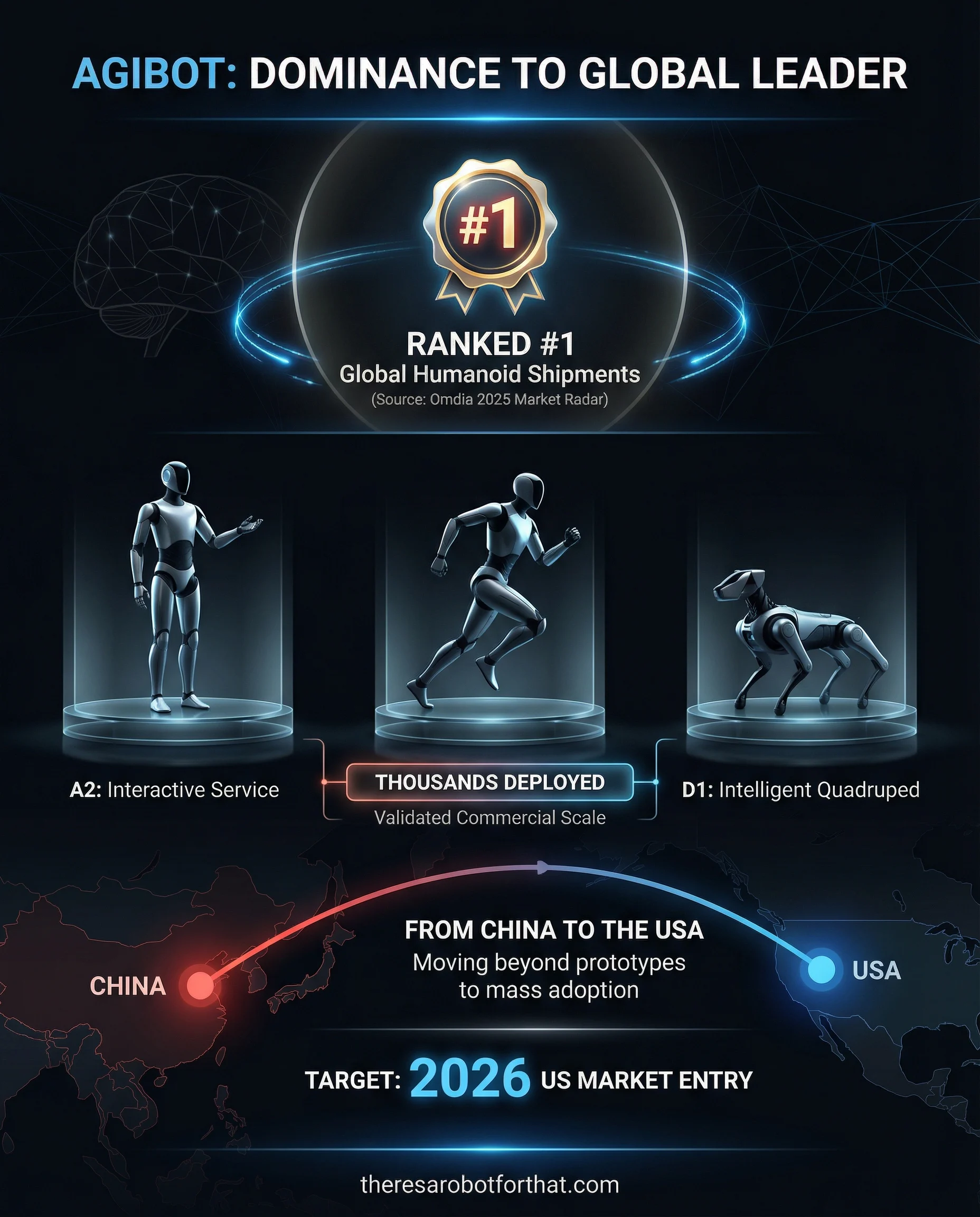
Image Source: Gemini / There's A Robot For That
Snapshot: Chinese robotics company Agibot made waves at CES by citing an Omdia research report that ranks it as the global leader in humanoid robot shipments for 2025, while backing up the claim with impressive live demonstrations.
Breakdown:
Takeaway: This marks a shift from humanoid prototypes to actual commercial deployments at scale, with China moving faster than Western markets. Lukas should note that the gap between ""impressive demos"" and ""thousands shipped"" is closing faster than most expected, particularly in Asia.
The Laundry Test: Robots face their toughest chore yet
Snapshot: LG's CLOiD and SwitchBot's Onero H1 took center stage at CES attempting to solve the laundry problem, though real-world tests suggest we're still in the ""slow and steady"" phase of development.
Breakdown:
Takeaway: Even in controlled CES environments with pre-staged scenarios, these robots struggled to match human speed and versatility at basic household tasks. Companies evaluating automation investments should plan for at least 3-5 years before household robots can reliably handle complex, multi-step chores without human intervention.
Dreame's new vacs sprout arms and legs to conquer corners
Snapshot: Chinese appliance maker Dreame is shipping a robot vacuum with a mechanical arm that can both grab objects and clean hard-to-reach spots, while a separate stair-climbing prototype shows where the category is headed.
Breakdown:
Takeaway: Robot vacuum makers are betting that consumers will pay premium prices for devices that handle multiple cleaning tasks rather than just vacuuming floors. The August ship date for the arm-equipped model signals this technology has moved beyond the demo stage into actual production.
Why Musk Might Be Right About Robot Surgeons
Snapshot: Elon Musk's claim that robots will surpass human surgeons in three years is almost certainly wrong on timing—but a new analysis argues the underlying shift toward automated medical expertise may be the only viable solution to crushing doctor shortages, particularly in countries like South Korea facing deficits of 11,000+ physicians by 2040.
Breakdown:
Takeaway: The business signal isn't whether Musk's three-year timeline is accurate, but that healthcare capacity planning is shifting from a pure labor question to a systems design challenge—relevant for any industry facing skilled labor constraints. Companies combining domain expertise with automation capabilities may find themselves with unexpected competitive advantages as this transition accelerates.
Other Top Robot Stories
1X promoted Mohi Khansari to Head of Robot Learning, appointing a veteran who previously led imitation learning at Everyday Robots (Google X) and served as a key tech lead at Cruise as chief architect behind the company's Redwood AI vision-language model.
MANUS demonstrated high-fidelity data gloves capturing real-time hand tracking with enough precision to record detailed finger movements note by note, addressing the teleoperation bottleneck that's kept dexterous manipulation stuck in research labs rather than production environments.
NVIDIA discounted its Jetson AGX Thor computing platform by 20% for robotics developers, with the chip specifically designed for humanoids and autonomous machines to run multimodal AI on a unified platform as the company signals broader commercial availability.
LimX previewed its newly launched TRON 2 humanoid platform alongside existing TRON 1 and Oli robots at CES, though the company provided limited details on specifications or availability timelines for the next-generation system."
Kawasaki accelerated production plans for its four-legged Corleo robot vehicle from a 2050 concept to commercial availability in just four years, with the hydrogen-powered all-terrain platform now expected to debut by 2029 instead of mid-century.
🤖 Your robotics thought for today:
Agibot shipped thousands of humanoids in China while Western companies are perfecting demos at CES—does that mean we've confused "building the perfect robot" with "building a robot people will actually buy"?
Until tomorrow,
Uli


