
China open sources its full-size Tien Kung humanoid
PLUS: Boosting biped stability 81%, XELA’s digital skin, and precise teleop

Welcome back to your Robot Briefing
China just made its boldest move yet in the humanoid robotics race: X-Humanoid is open-sourcing its entire Tien Kung 3.0 platform — hardware designs, AI models, motion control frameworks, and training datasets included. This isn't just about sharing code; it's a play for global developer mindshare and standard-setting in a market where Western companies still guard IP tightly.
For businesses comparing humanoid suppliers, the calculation just shifted: bet on Chinese platforms with rapidly expanding ecosystems, or stick with Western alternatives that may innovate more slowly but keep tighter control?
In today's Robot update:
X-Humanoid Open Sources 'Tien Kung 3.0'
Snapshot: Beijing's X-Humanoid just released Tien Kung 3.0, a full-size humanoid robot, and is open-sourcing its full platform — including the robot body, motion control framework, AI models, and training datasets — marking China's most aggressive push yet to build a global developer ecosystem around humanoid robotics.
Breakdown:
Takeaway: This open-source release is China's play to set standards and build mindshare in humanoid robotics the way it couldn't in consumer tech. Companies evaluating humanoid suppliers now face a new calculus: Chinese platforms with growing ecosystems versus Western alternatives with tighter IP control but potentially slower innovation cycles.
Georgia Tech Solves Robot Stumbling
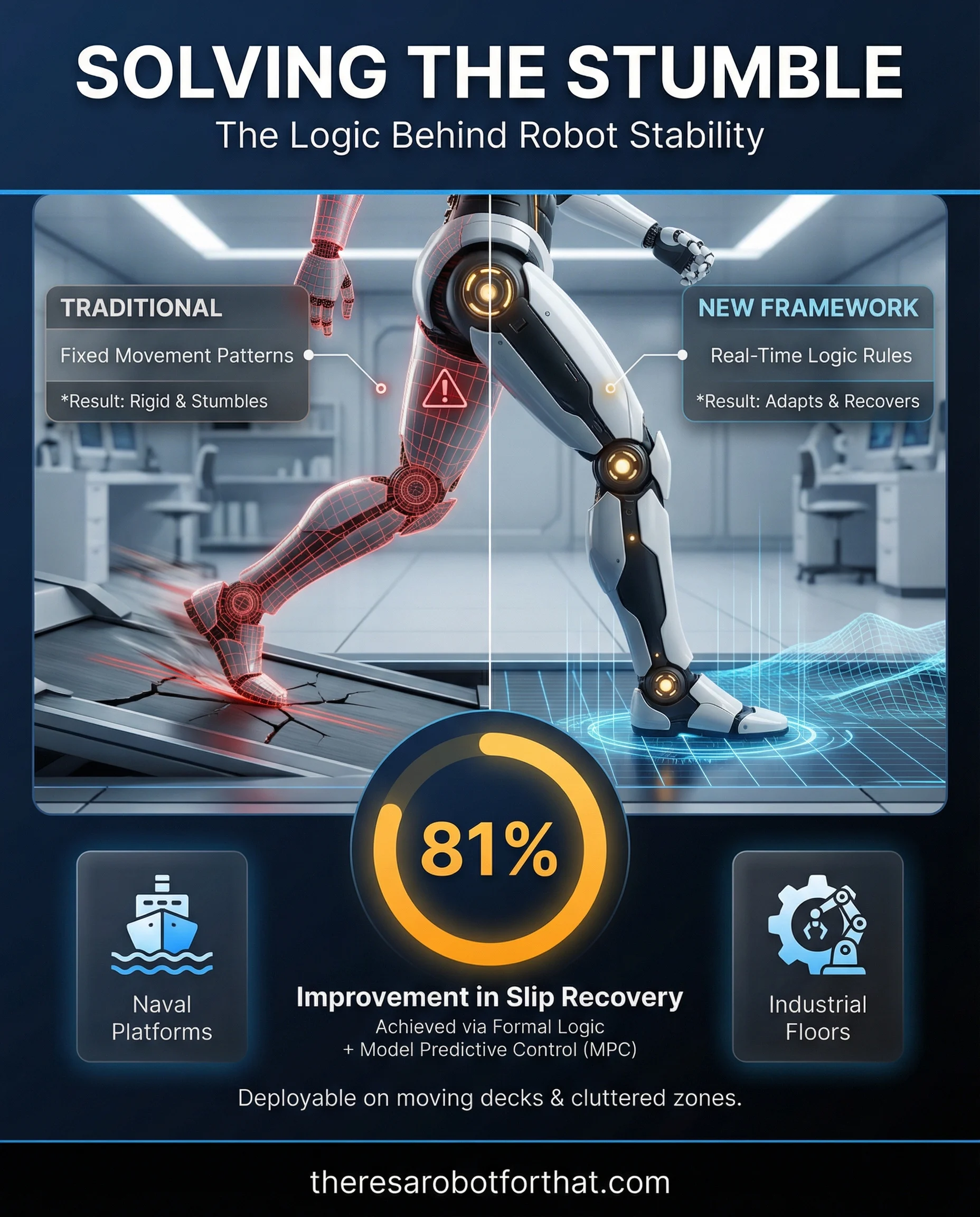
Image Source: There's A Robot For That
Snapshot: Georgia Tech researchers developed a real-time control framework that boosts a bipedal robot's ability to recover from slips and pushes by 81% , bringing humanoid robots closer to reliable factory and logistics deployment.
Breakdown:
Takeaway: The 81% improvement in recovery represents tangible progress toward the stable humanoid platforms that warehouse and manufacturing environments require. Operations leaders should track stability breakthroughs like this as the primary technical barrier between research labs and production floors.
XELA Launches 'Digital Skin' for Robot Hands
Snapshot: XELA Robotics has integrated its uSkin 3D-tactile sensors into Tesollo's anthropomorphic robot hands, enabling robots to handle delicate objects with human-like touch sensitivity—and commercial orders start shipping this quarter.
Breakdown:
Takeaway: This represents one of the first commercially available tactile sensing solutions shipping at scale, moving robotic manipulation from research labs into production environments. Companies automating tasks requiring careful handling—from electronics assembly to food processing—now have an off-the-shelf option rather than waiting for proprietary solutions.
Precise Teleop: Robot Hand Picks Single Card
Snapshot: TetherIA has demonstrated extreme fine motor control by teleoperating a robotic hand using MANUS gloves to precisely pick a single playing card from a deck.
Breakdown:
Takeaway: This shifts the conversation from "when will robots handle delicate tasks autonomously" to "we can deploy human-controlled robots for precision work now." Companies facing labor shortages for intricate assembly or quality control work have a path forward that doesn't require waiting for AI breakthroughs.
Other Top Robot Stories
NVIDIA launched Robotics Office Hours featuring Isaac Lab and Newton, an open-source physics engine built on NVIDIA Warp and OpenUSD, with practical demos of robot locomotion and cloth folding—signaling the infrastructure layer for physical AI development is maturing into production-ready tools that lower barriers for companies building custom automation solutions.
Boston Dynamics deployed Spot robots at ST Engineering MRAS to autonomously collect machine health data and create detailed point cloud scans using integrated Leica BLK ARC sensors, demonstrating how quadrupeds are moving beyond inspection tasks into full digital twin creation for facility management and predictive maintenance programs.
Carbon Robotics discussed the current state of AgTech including industry lawsuits, layoffs, and M&A activity at World Ag Expo 2026, providing operations leaders evaluating agricultural automation with a realistic view of which business models are surviving the sector's consolidation phase and where meaningful innovation is actually happening versus hype.
NVIDIA showcased how AGIBOT, FRANKA ROBOTICS, Caterpillar, and Plus.ai are scaling intelligent machines across industries by combining decades of operational data with AI, simulation, and digital twins—validating that physical AI has moved from research concept to production deployment at companies with established manufacturing and logistics operations.
🤖 Your robotics thought for today:
X-Humanoid open-sourced their full platform—hardware, AI, training data.
Will humanoid robotics be won by whoever builds the best robot, or whoever builds the biggest developer ecosystem first?
Different question. Different winners.
Have a great weekend,
Uli


