
China launches the world’s first humanoid combat league
PLUS: Ouster acquires StereoLabs, Army swarm contract, Gather AI lands $40M

Welcome back to your Robot Briefing
China just opened a combat arena where humanoid robots duke it out for a $1.4 million prize, but the real fight is happening behind the scenes: Beijing has marshaled $26 billion in state funding to back over 140 humanoid robotics companies in a coordinated industrial push. The combat league doubles as a pressure test for components that normally take years to validate in controlled lab settings.
While Western robotics firms hunt for Series B checks, China is deploying coordinated government subsidies, free manufacturing space, and guaranteed public-sector customers to compress development timelines. For companies evaluating humanoid suppliers today, the question isn't whether China will dominate the supply chain—it's how quickly that shift happens and what it means for procurement dependencies in 2029.
In today's Robot update:
First Humanoid Combat League Kicks Off as China Funds $26B Push
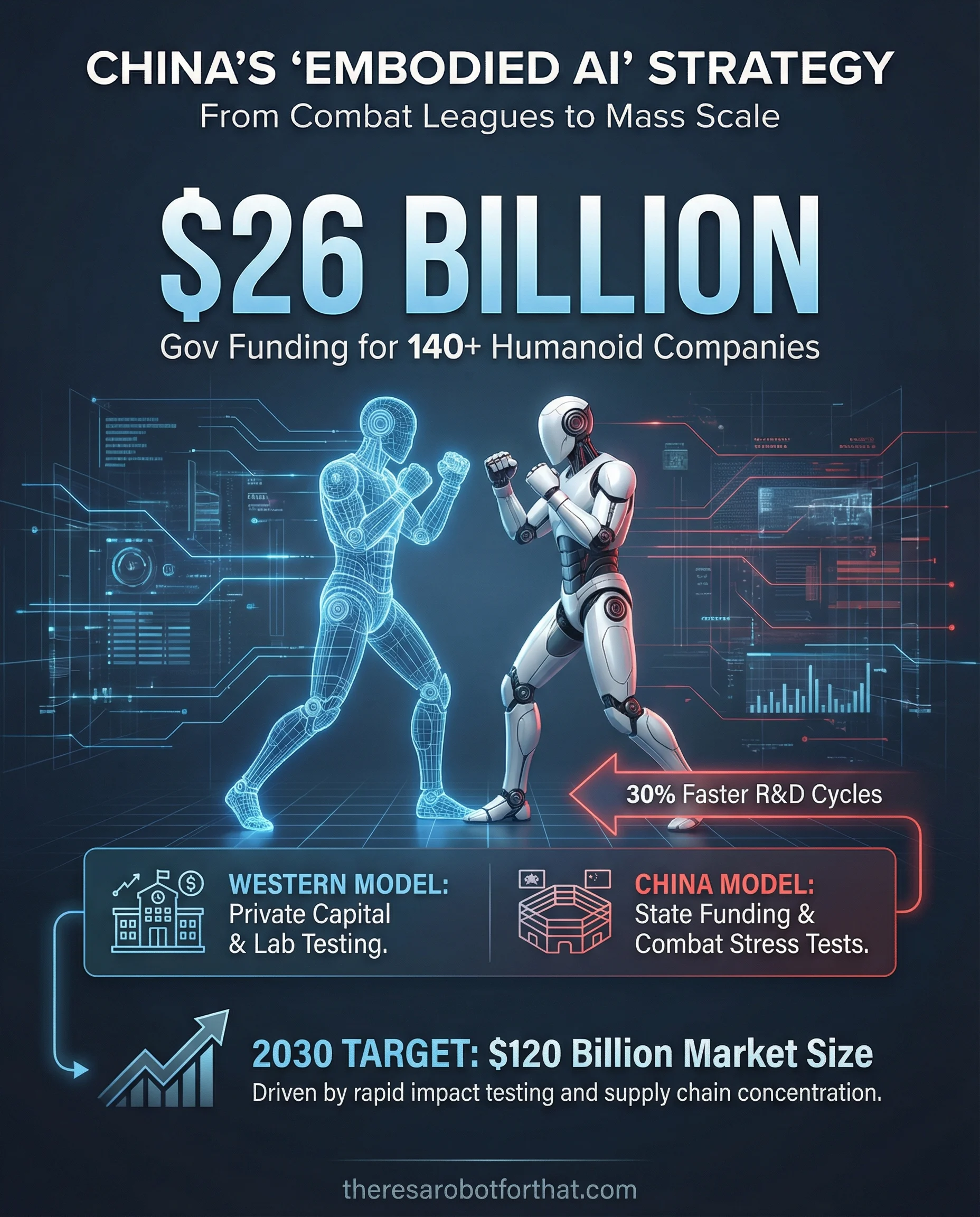
Image Source: There's A Robot For That
Snapshot: Shenzhen launched the world's first humanoid robot fighting league with a $1.4 million prize, but the real story is China's massive industrial bet: over 140 humanoid companies backed by $26 billion in government funding, all racing to dominate what Beijing calls "embodied AI."
Breakdown:
Takeaway: This isn't just about robot boxing—it's China using unconventional R&D methods and state coordination to compress development timelines while Western competitors rely primarily on private capital. For Lukas, the signal is clear: the humanoid robotics supply chain and talent pool is concentrating in China faster than most Western executives realize, which could impact future procurement options and competitive dynamics within 3-5 years.
Ouster Acquires StereoLabs to Fuse Lidar and Vision
Snapshot: Lidar manufacturer Ouster closed its $35M acquisition of StereoLabs, an AI vision company with 10,000+ customers, creating what they're calling the first unified sensing platform that combines lidar, cameras, and perception software in a single package.
Breakdown:
Takeaway: This signals sensor fusion is moving from custom integration projects to off-the-shelf solutions, which compresses deployment timelines and makes robotics adoption more predictable for operations teams evaluating pilots. The EBITDA-positive financials suggest the combined company has a viable path to profitability, reducing the risk that this becomes vaporware in 18 months.
Swarmbotics Wins Army Contract for 'Attritable' Drone Swarms
Snapshot: The US Army selected Swarmbotics AI to develop swarms of small, low-cost ground robots that can navigate challenging terrain autonomously, signaling military validation of economics-driven robotics over traditional expensive platforms.
Breakdown:
Takeaway: Military procurement choosing swarm economics over expensive individual platforms marks a meaningful shift that validates cost-effective robotics for force multiplication. This Army contract provides a concrete signal that autonomous ground systems are moving from research projects to field deployment timelines that mid-sized companies should monitor for adjacent commercial applications.
Gather AI Lands $40M to Scale Warehouse Drones
Snapshot: Logistics startup Gather AI secured $40 million in Series B funding led by Smith Point Capital to expand its fleet of autonomous drones that monitor warehouse inventory using computer vision, achieving accuracy rates that surpass manual counting methods.
Breakdown:
Takeaway: This funding signals that warehouse automation has moved beyond pilot programs into repeatable, fast-payback deployments that mid-sized operations can justify. Companies still relying on manual inventory counts are now competing against facilities with real-time physical intelligence that catches errors before they cascade into costly shipping mistakes.
Other Top Robot Stories
NHS deployed the Hugo surgical robot at Queen Elizabeth The Queen Mother Hospital in Margate for colorectal procedures, marking the first robotic knee surgery capability at the Trust and supporting the National Cancer Plan's goal to expand robotic procedures from 70,000 annually to 500,000 by 2035.
Surgeons reported over 100 malfunctions of Johnson & Johnson's AI-enabled TruDi Navigation System since 2021, including at least 10 patient injuries from the system allegedly misinforming surgeons about instrument locations during sinus surgery—serious enough that two stroke victims have sued, claiming the product was safer before AI integration.
🤖 Your robotics thought for today:
China's backing 140 humanoid companies with $26 billion in state funding and using robot combat leagues to compress R&D cycles by 30% while Western competitors pitch VCs one round at a time—so who actually ships useful robots faster: coordinated industrial policy or Silicon Valley's "let the best startup win" approach?
Until tomorrow,
Uli


