
China deploys UBTech humanoids for border patrol
PLUS: Apptronik raises nearly $1B, Korea’s Physical AI push, and robotic surgery success
Welcome back to your Robot Briefing
China is deploying UBTech's Walker S2 humanoids for border security at the Vietnam crossing, backed by a $37 million contract that represents one of the largest government deployments of humanoid robots in active security operations. The robots can autonomously swap their own batteries in three minutes, enabling continuous 24/7 patrols without human support.
This moves humanoids beyond factory floors and into critical infrastructure roles where reliability and uptime directly impact national operations. For companies evaluating automation in ports, airports, or large facilities requiring round-the-clock monitoring, the question becomes: does autonomous power management finally make humanoids operationally viable at scale?
In today's Robot update:
China deploys humanoids for border patrol
Snapshot: UBTech Robotics has secured a $37 million contract to deploy Walker S2 humanoid robots at the China-Vietnam border crossing in Fangchenggang, marking one of the largest real-world tests of humanoids in government security operations.
Breakdown:
Takeaway: This deployment shifts the timeline for humanoid adoption in critical infrastructure—robots are no longer confined to pilot programs but operating in real security and industrial roles. The autonomous power management capability is what makes continuous operation economically viable, potentially opening similar applications in ports, airports, and large facilities where 24/7 monitoring matters.
Apptronik raises nearly $1B to scale Apollo
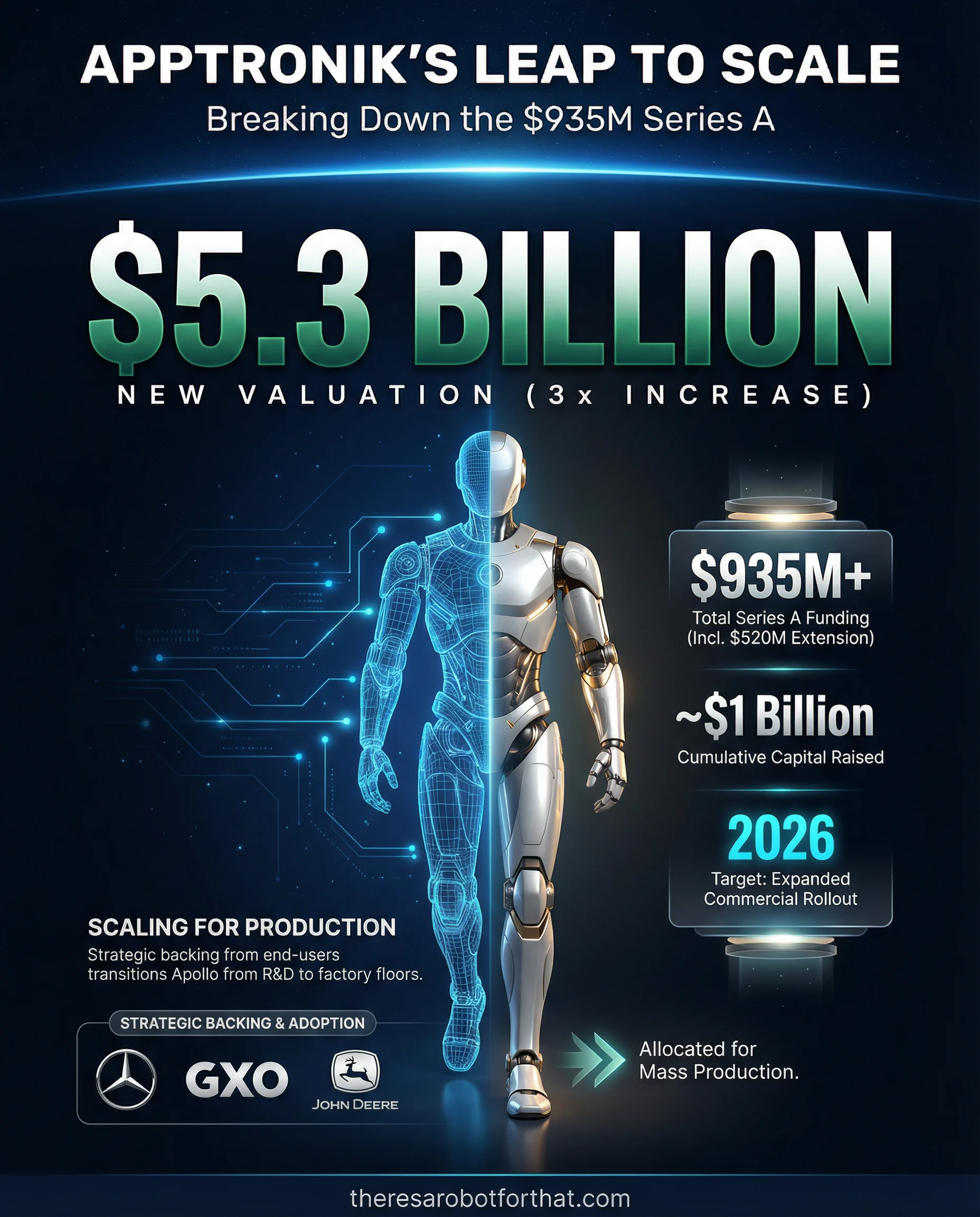
Image Source: There's A Robot For That
Snapshot: Humanoid robotics company Apptronik announced a $520M Series A extension, bringing total Series A funding to over $935M and total capital raised to nearly $1B, with backing from industrial heavyweights like Mercedes-Benz, Google, and John Deere.
Breakdown:
Takeaway: When companies that will actually deploy humanoids—automakers, logistics operators, manufacturers—invest at this scale, it signals the technology is transitioning from research phase to production scaling. The 2026 timeline for expanded deployments and a new Apollo version gives operational leaders a concrete window to evaluate humanoid readiness for their own facilities.
First clinical success for Chinese orthopaedic robot
Snapshot: Yuanhua Tech completed the first clinical procedure using its fully domestically developed orthopaedic surgical robot at West China Hospital, marking China's entry into high-end surgical robotics previously dominated by Western manufacturers.
Breakdown:
Takeaway: This validates that China is rapidly closing the gap in medical robotics where Western companies historically held monopolies, potentially reshaping competitive dynamics in surgical automation. For medical device companies, this signals accelerating pressure in Asian markets and underscores the strategic importance of maintaining technological leads in markets where domestic preference policies favor local manufacturers.
Korea enters Physical AI race with MaumAI
Snapshot: Korean startup MaumAI is commercializing Physical AI with its proprietary WoRV technology, targeting orchard automation and manufacturing while positioning Korea between US software dominance and Chinese hardware leadership.
Breakdown:
Takeaway: This signals that Physical AI competition is evolving beyond the US-China duopoly, with Korea leveraging manufacturing expertise as a third path to market. Companies evaluating robotics partnerships should watch whether Korea's infrastructure-first approach delivers faster ROI than humanoid-focused strategies.
🤖 Your robotics thought for today:
UBTech's border patrol robots aren't smarter than Boston Dynamics' Atlas. They're not more precise than Apptronik's Apollo.
But they swap their own batteries in 3 minutes and work 24/7 without humans—so they're already deployed in government security operations for $37M while Western humanoids perfect their demos.
Turns out the killer app wasn't intelligence. It was autonomous uptime.
What's your take?
Have a great weekend,
Uli


