
Carbon Robotics debuts 150M-image 'Large Plant Model'
PLUS: LimX raises $200M, Unitree G1 braves -47°C, Themis works while walking
Welcome back to your Robot Briefing
Carbon Robotics just eliminated the 24-hour retraining delay that's plagued agricultural AI, unveiling a Large Plant Model trained on 150 million images that lets farmers identify new weeds and adjust robot behavior in minutes through an iPad interface. This shift from brittle vision systems to foundation models means deployment friction is dropping faster than most operations leaders expected.
If specialty crop automation is reaching this maturity level, how much runway do labor-intensive industries really have before similar breakthroughs force their hand on robotics investments?
In today's Robot update:
Agriculture's 'ChatGPT Moment': Carbon Robotics Unveils Large Plant Model
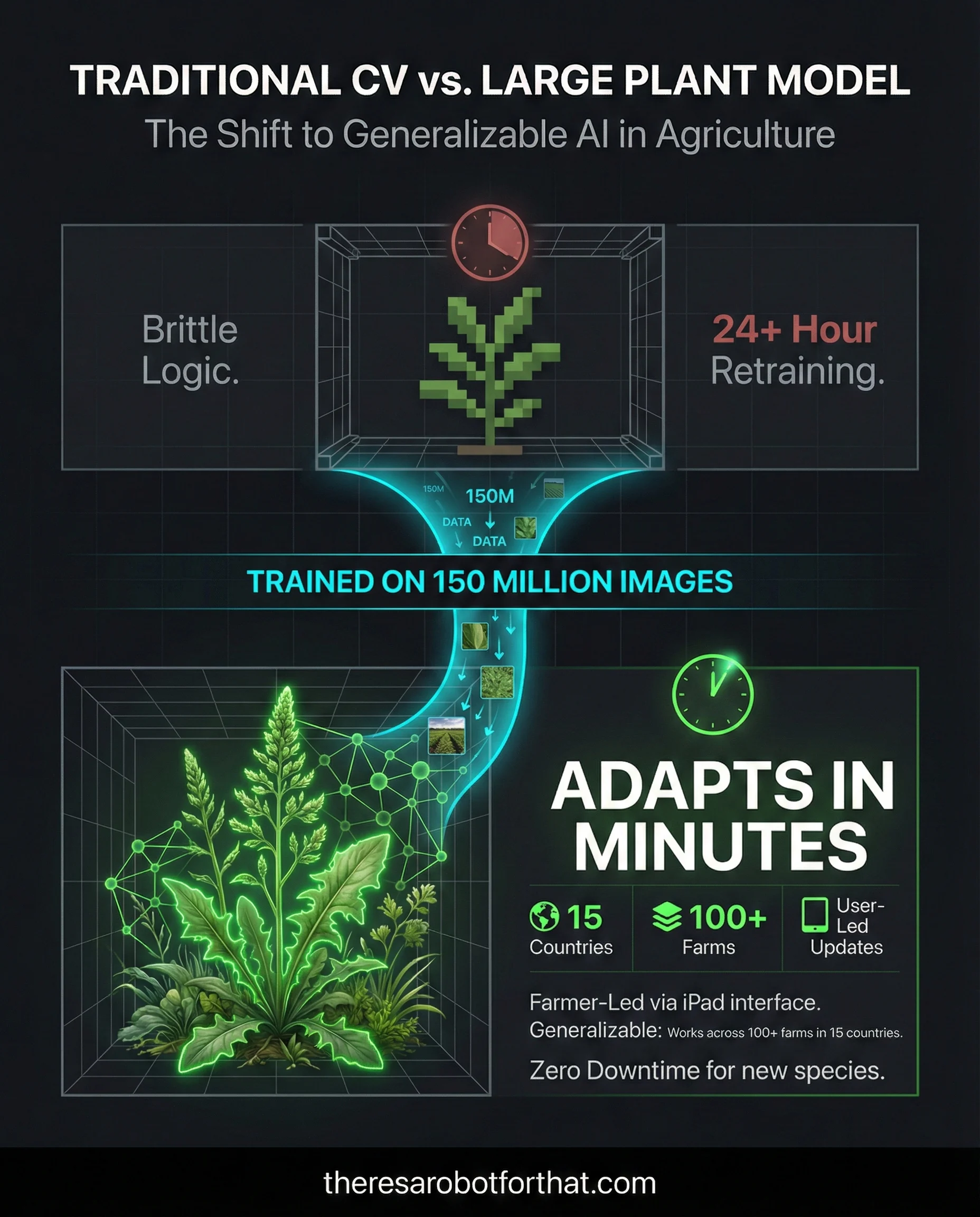
Image Source: There's A Robot For That
Snapshot: Carbon Robotics launched a Large Plant Model that lets its laser-equipped weed-killing robots identify and target new plant species instantly, eliminating the 24-hour retraining cycle that previously delayed operations whenever unfamiliar weeds appeared in fields.
Breakdown:
Takeaway: Agricultural robotics is shifting from brittle computer vision systems that break when conditions change to foundation models that generalize across environments. For operations leaders evaluating automation ROI, this development signals that deployment friction and downtime costs are dropping faster than expected in specialty crop sectors where labor and herbicide costs create immediate pressure to adopt.
LimX Dynamics Raises $200M, Deploys Swarm of 18 Humanoids
Snapshot: Chinese robotics firm LimX Dynamics secured $200 million in Series B funding and demonstrated 18 humanoid robots standing up and moving in coordination without individual human commands—signaling that the industry is shifting from proving robots work to proving they can deploy at scale.
Breakdown:
Takeaway: The combination of substantial institutional backing and demonstrated fleet autonomy suggests humanoid robotics is transitioning from science projects to industrial tools faster than many mid-sized companies realize. Leaders who assume "humanoids are still 5 years away" may want to revisit that timeline—the gap between pilot programs and practical deployment is closing quickly.
Westwood's New Humanoid Can Finally Work While Walking
Snapshot: Westwood Robotics launched Themis Gen 2.5, a humanoid that manipulates objects while walking rather than stopping to work—a capability that directly impacts productivity in logistics and manufacturing environments.
Breakdown:
Takeaway: Continuous manipulation while moving addresses one of the biggest productivity bottlenecks in humanoid robotics—time lost stopping to work. This positions Themis as a contender for environments where mobile picking, sorting, or assembly operations need to maintain flow rather than operate from fixed stations.
Unitree's G1 Robot Conquers -47°C Snowfield in Endurance Test
Snapshot: Unitree's G1 humanoid robot walked over 130,000 steps across a snowfield at -47.4°C in China's Xinjiang region, marking the first autonomous walking demonstration by a humanoid robot in extreme cold conditions.
Breakdown:
Takeaway: Extreme weather reliability has been a critical barrier preventing humanoid deployment in outdoor industrial settings like construction sites, warehouses, and energy facilities. Unitree's test suggests this technical hurdle is being cleared sooner than anticipated, potentially accelerating the timeline for companies evaluating humanoids for year-round outdoor operations.
Other Top Robot Stories
Fraunhofer developed AI-powered autonomous drones and ground robots that detect radioactive, chemical, and biological hazards in environments too dangerous for human access, with field trials showing the systems can pinpoint contamination sources within meters in minutes rather than the days required by traditional handheld detection methods.
China accelerated hybrid crop development by 400% using robotic breeding systems that autonomously pollinate and harvest "robot-friendly" crops, while deploying autonomous robots across farms to handle pest detection, livestock monitoring, and even robotic fish that guide schools to designated feeding and harvesting areas without disturbing aquatic environments.
Tsubame operated its Archax mech for three years with virtually no maintenance while maintaining full functionality across normal operations, transformation sequences, and locomotion—a reliability milestone that demonstrates industrial robots can sustain complex multi-mode performance without constant technical support.
GITAI assembled a 5-meter communication tower using three inchworm robotic arms coordinating with a lunar rover in vacuum chamber testing, demonstrating that multi-robot construction teams can handle complex structural assembly tasks in extreme environments where human labor is impossible or prohibitively expensive.
🤖 Your robotics thought for today:
A farmer updates her weeding robot's vision in 3 minutes on an iPad. No engineer. No vendor call.
Meanwhile, a $500M distribution center is still waiting 6 weeks for the same thing.
The foundation model moment hit agriculture first. Warehouses are next — whether they're ready or not.
Until tomorrow,
Uli


