
Boston Dynamics CEO resigns as Atlas preps for factories
PLUS: Solar swarms cut fertilizer 70%, Krafton’s humanoid pivot, FDA backs stroke robot

Welcome back to your Robot Briefing
Boston Dynamics' three-decade veteran CEO is stepping down just as the company locks in a 2028 deadline to put electric Atlas humanoids on Hyundai factory floors, a transition that shifts the robotics pioneer from research-driven innovation to production-scale manufacturing.
The timing raises questions for any manufacturer mapping out automation roadmaps: does this leadership change signal confidence in commercial readiness, or disagreement about how fast to scale? With a concrete two-year horizon now on the table, companies betting on humanoid labor need to decide whether to wait for proven deployment or lock in partnerships now.
In today's Robot update:
Boston Dynamics CEO Resigns as Atlas Preps for Factory Work
Snapshot: Robert Playter steps down after three decades at Boston Dynamics just as the company confirms plans to deploy its electric Atlas humanoid in Hyundai factories by 2028, marking a pivotal shift from research lab to production floor.
Breakdown:
Takeaway: The 2028 deployment timeline gives manufacturing leaders a concrete planning horizon—humanoid factory workers are roughly two years out, not five or ten. Leadership transitions during commercialization phases often signal either natural succession or strategic disagreements about pace and approach, making Boston Dynamics' execution over the next 18 months a critical indicator for the entire humanoid robotics sector.
Solar-Powered Swarms Cut Fertilizer Use by 70%
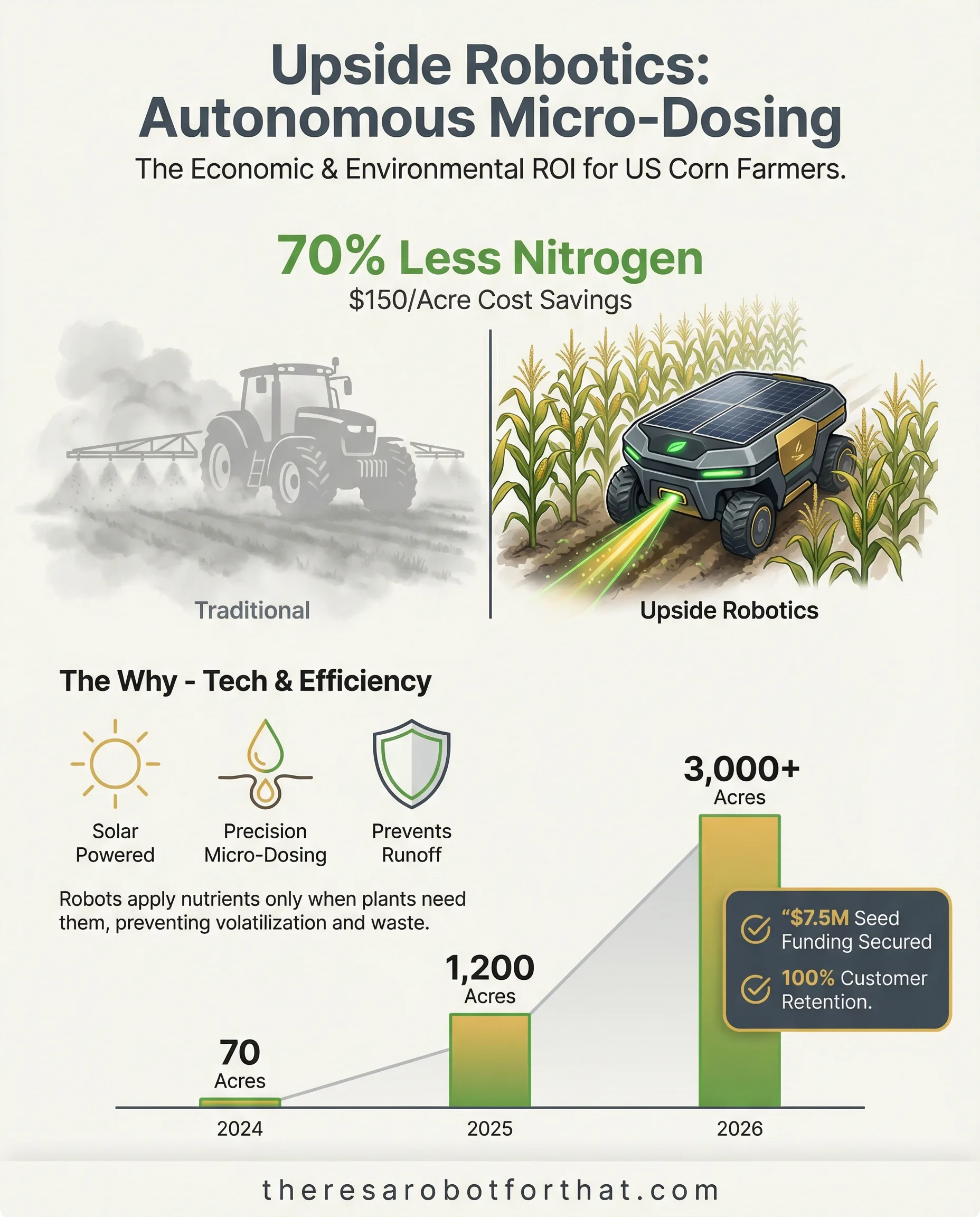
Image Source: There's A Robot For That
Snapshot: Canadian startup Upside Robotics secured $7.5M to deploy autonomous robots that micro-dose nutrients during the growing season, saving corn farmers roughly $150 per acre while slashing fertilizer waste.
Breakdown:
Takeaway: The combination of hard ROI ($150/acre savings), proven retention, and a substantial waitlist signals that precision ag-tech is crossing from pilot projects to operational reality in a sector notorious for slow adoption. Lukas should note this as an early indicator that autonomous field systems with clear payback periods are becoming table stakes for competitive farming operations.
Sentante's Stroke Robot Gains FDA Support
Snapshot: The FDA accepted Lithuania-based Sentante's telerobotic stroke treatment system into its Total Product Life Cycle Advisory Program, signaling regulatory confidence in remote surgery technology that could help close critical gaps in stroke care access.
Breakdown:
Takeaway: TAP acceptance suggests the regulatory pathway for remote surgical robotics is crystallizing faster than many healthcare systems anticipated. Hospital networks evaluating telemedicine infrastructure should track this closely, as the stroke care access gap creates immediate market demand for solutions that work today, not in five years.
PUBG Creator Krafton Pivots Game AI to Humanoids
Snapshot: Gaming giant Krafton announced plans to apply its AI technology and physics simulation data from hit games to train physical humanoid robots, marking a notable shift for the $2.26B company known for PUBG.
Breakdown:
Takeaway: When a major gaming company with proven simulation capabilities commits to humanoid robotics, it signals growing confidence that sim-to-real transfer is becoming practical, not theoretical. This validates the approach smaller robotics startups have been pursuing and suggests the talent and technology barriers to entering physical AI may be lower than traditional manufacturing companies assume.
Other Top Robot Stories
AGIBOT received the Outstanding Innovation Award at the UK's Icebreaker Spring Gala, with the Chinese humanoid robotics company announcing plans to deepen its presence in UK and European markets through partnerships with local robotics ecosystem players like LEC Robotics.
China's government has enabled rapid scaling of robotics and AI infrastructure through non-dilutive grants from local and central authorities, helping explain why Chinese companies can move faster on commercialization while Western competitors rely primarily on venture capital and customer revenue.
Carbon Robotics introduced a $0 down lease program for its LaserWeeder G2 and autonomous tractor kit at World Ag Expo 2026, removing upfront capital requirements that have historically slowed precision agriculture adoption and signaling that robotics-as-a-service models are becoming standard across the sector.
🤖 Your robotics thought for today:
Playter's exit at the exact moment Boston Dynamics shifts from demos to 2028 factory deployment—while calling the sector's manipulation AI "crawling stage"—is either the most fortuitous retirement timing in robotics history, or a signal about commercial readiness that manufacturing leaders betting on humanoid labor should decode carefully.
What's your take?
Until tomorrow,
Uli


