
BMW deploys humanoid robots in German factory
PLUS: Surgical robot hits 45K patients, Airbus tests Chinese humanoids, and brain surgery bot cuts procedure time 29%

Welcome back to your Robot Briefing
BMW just put humanoid robots to work on its Leipzig factory floor, handling materials and assembling batteries in what's being called Germany's first deployment of its kind.
This isn't another controlled demo or research project — it's production-line deployment. The real question: can these machines handle the variability and pace of automotive manufacturing, or will they become expensive bottlenecks that slow down human workflows?
In today's Robot update:
BMW brings humanoid robots to German factory floor
Snapshot: BMW deployed AEON humanoids at its Leipzig plant for material handling and battery assembly, marking the first such implementation in Germany and signaling that physical AI is moving from controlled pilots to production environments.
Breakdown:
Takeaway: The Leipzig deployment signals that humanoid robots are transitioning from proof-of-concept to structured industrial adoption, but success depends as much on data architecture as hardware capability. Operations leaders evaluating automation should focus on whether their IT foundation can support autonomous systems accessing consistent, real-time production data.
Surgical robot company hits 45K patients as US expansion begins
Snapshot: CMR Surgical's Versius Plus robot reached 45,000 patients treated across 30+ countries as the company launches commercial operations in the US following FDA clearance for gallbladder procedures.
Breakdown:
Takeaway: The momentum behind Versius demonstrates that surgical robotics markets are fragmenting as FDA clearances accelerate and hospitals seek alternatives to incumbent platforms. Healthcare operations leaders should track whether multiple approved platforms drive pricing pressure and improve capital equipment negotiations over the next 12-24 months.
Airbus tests Chinese humanoid robots on aircraft assembly lines
Snapshot: Airbus partnered with UBTech Robotics to evaluate Walker S2 humanoid robots at aircraft assembly sites, joining Texas Instruments in adopting the Chinese manufacturer's platforms for high-precision industrial work.
Breakdown:
Takeaway: The partnership between a European aerospace leader and Chinese robotics manufacturer highlights how industrial humanoid adoption is advancing despite geopolitical tensions and acknowledged performance limitations. Operations executives should expect 12-18 months of testing data from these deployments before clear ROI benchmarks emerge for high-precision manufacturing applications.
Brain surgery robot cuts procedure time by 29% in clinical trial
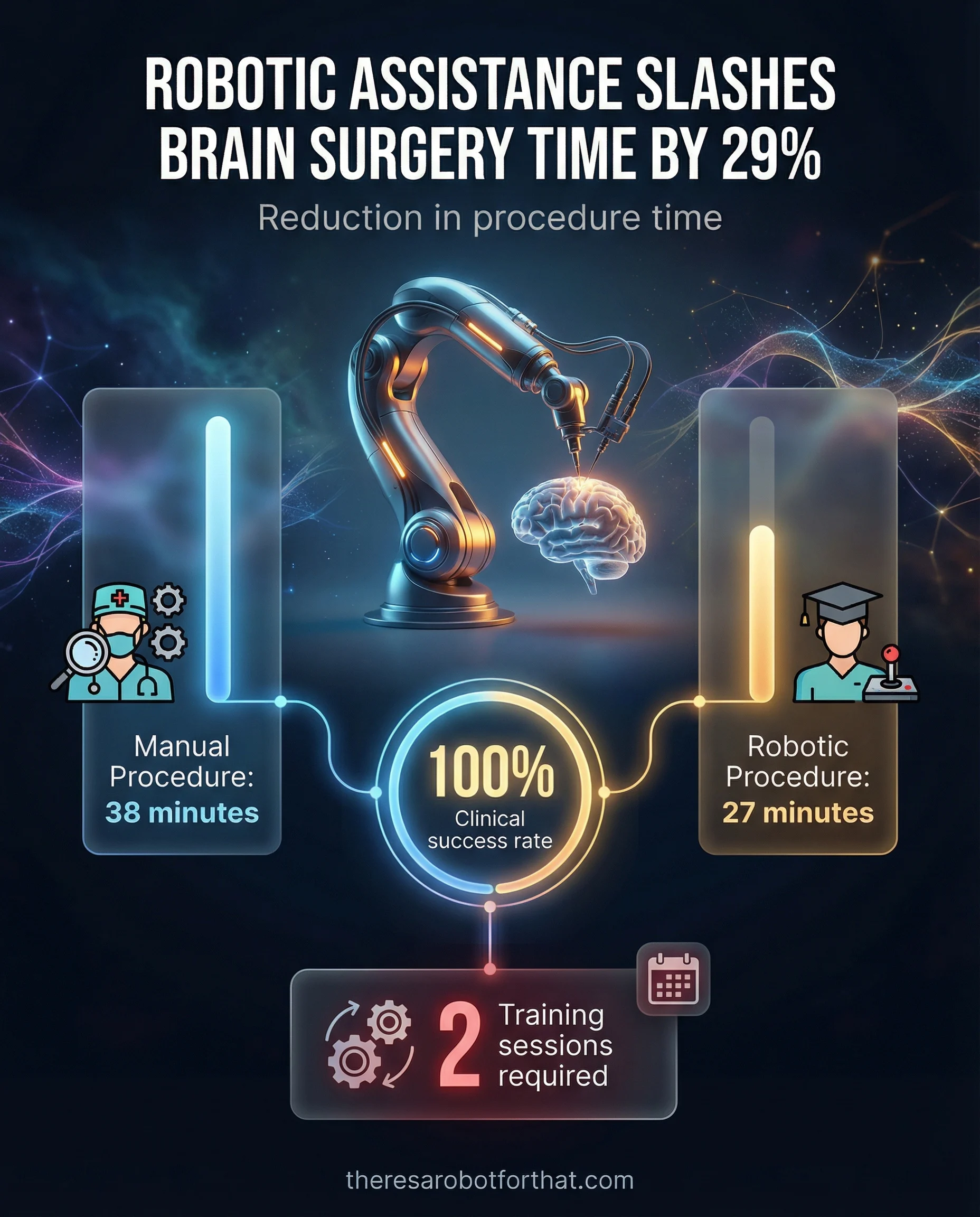
Image Source: There's A Robot For That
Snapshot: Chinese researchers demonstrated a cerebrovascular surgical robot that completed brain imaging procedures 29% faster than manual techniques in a 50-patient study at Peking Union Medical College Hospital, achieving 100% success rates.
Breakdown:
Takeaway: The 29% procedure time reduction with minimal training suggests robotic assistance can compress the experience curve for complex medical procedures, but single-institution results require validation at scale. Healthcare operations leaders should monitor whether multi-center trials confirm these efficiency gains and whether the technology addresses surgeon workforce constraints in specialized procedures.
Other Top Robot Stories
IntBot launched a four-month pilot at San José Mineta International Airport with its humanoid robot "José," tasked with greeting passengers and autonomously navigating Terminal B amid TSA staffing shortages during a government shutdown.
Realbotix featured in Ericsson's live 6G over-the-air trial at its Plano, Texas headquarters, demonstrating how its AI-agnostic humanoid robots can transmit video and operate in real-time over next-generation wireless networks.
Foundation delivered two Phantom MK-1 humanoid robots to Ukraine for reconnaissance missions, with the 180cm, AI-equipped units capable of moving at 6 km/h and carrying 20kg payloads as the company plans production of 50,000 units by 2027.
Columbia published research showing its humanoid robot mastered lip-syncing across multiple languages by analyzing YouTube videos, using 26 facial motors to achieve natural speech simulation that addresses a key gap in human-robot interaction.
🤖 Your robotics thought for today:
BMW's Leipzig deployment isn't just about the robots — it's about the data infrastructure they built first. They spent years standardizing production IT before putting a single humanoid on the floor. Meanwhile, everyone's debating hardware specs and efficiency percentages.
That tells you everything about what actually blocks automation adoption.
Enjoy your weekend,
Uli


