
Tesla kills Model S and X for Optimus
PLUS: Uber's Kalanick unveils industrial robots, Renault deploys 350 humanoids in factories, and Nvidia's new humanoid chip partners
Welcome back to your Robot Briefing
Tesla is killing off the Model S and X — the luxury sedans that built the brand — to turn their Fremont production lines into a humanoid robot factory targeting a million Optimus units a year.
It's a clear signal that Elon Musk sees robotics, not cars, as the company's future. The question for every auto exec and manufacturer watching: is this a visionary pivot or a risky bet on unproven technology while competitors double down on EVs?
In today's Robot update:
Tesla Ends Model S and X Production to Scale Optimus Manufacturing
Snapshot: Tesla is shutting down production of its flagship Model S and X sedans with no successors planned, converting portions of its Fremont factory to build the Optimus Gen 3 humanoid robot with a target of 1 million units annually. The move signals Tesla's shift from automotive-first to robotics as a core business line, repurposing an underutilized luxury car facility for early-stage manufacturing experimentation.
Breakdown:
Takeaway: This is the first major automaker to sacrifice legacy product lines for robotics capacity, making 2027 the critical year to watch for whether Tesla can translate automotive manufacturing scale into viable robot economics. Executives should track whether Tesla's internal deployment reduces Model 3/Y production costs—a clear signal that humanoid ROI is moving from theoretical to measurable.
Uber Founder Travis Kalanick Emerges From Stealth With Industrial Robotics Play
Snapshot: Travis Kalanick is launching Atoms, a robotics venture that has absorbed his CloudKitchens ghost-kitchen business and is building wheeled industrial robots for food service, logistics, and mining—explicitly rejecting humanoid form factors in favor of task-specific wheeled platforms. The company is in talks to acquire autonomous trucking startup Pronto to accelerate its push into mining and industrial transport.
Breakdown:
Takeaway: Kalanick's bet against humanoids directly contradicts the form-factor consensus emerging from Tesla, Renault, and others—making this a useful test case for whether general-purpose bipedal robots or specialized wheeled systems win industrial adoption first. The CloudKitchens integration provides a controlled environment to prove unit economics before scaling to mining and logistics, which is a more pragmatic path than most robotics startups are taking.
Renault to Deploy 350 Humanoid Robots Across Factories in 2027
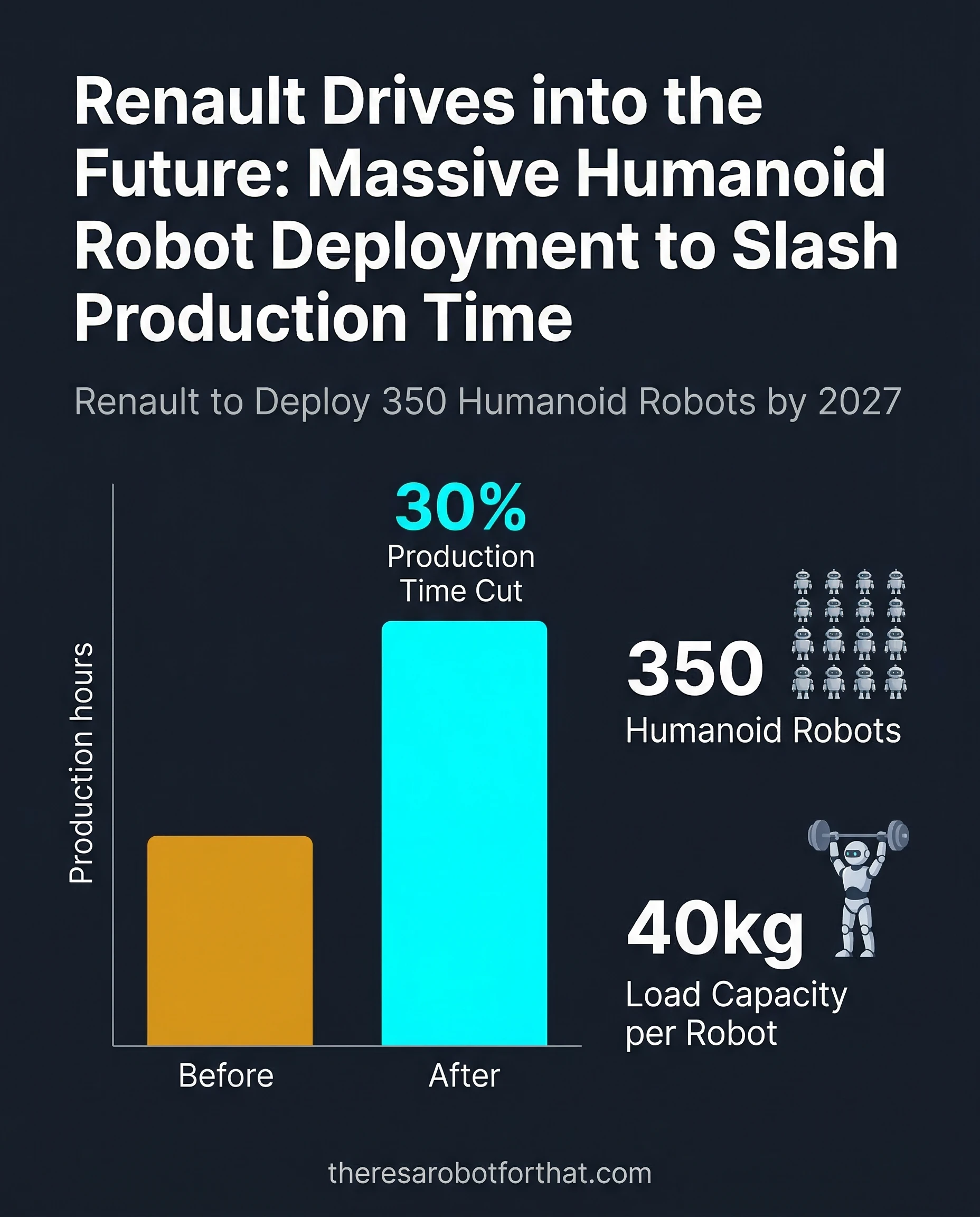
Image Source: There's A Robot For That
Snapshot: Renault Group will deploy 350 Calvin-40 humanoid robots across its factories in 2027 to handle repetitive tasks like tire lifting, targeting a 30 percent reduction in production hours per vehicle and becoming one of the first automakers to bring humanoid technology to production lines at scale. Speed and dexterity limitations currently restrict the robots to back-of-house operations rather than direct assembly work.
Breakdown:
Takeaway: Renault's specific deployment number and productivity target make this the most measurable humanoid robotics pilot in automotive manufacturing—executives should treat 2027-2028 performance data from this rollout as the first real proof point for whether humanoids deliver factory ROI. The explicit limitation to back-of-house tasks signals that even early adopters recognize current robots cannot yet match human assembly line speed and precision.
Nvidia Strikes Humanoid Robot Hardware Partnerships With European Chipmakers
Snapshot: Nvidia coordinated partnership announcements with Infineon, NXP, and STMicroelectronics to supply sensors, motion control, power management, and communications hardware for humanoid robots, positioning its Holoscan Sensor Bridge software as the integration layer between robot bodies and central processing. The partnerships leverage the chipmakers' automotive safety and real-time processing expertise as the humanoid market approaches 50,000 units sold this year.
Breakdown:
Takeaway: The 50,000-unit market size suggests humanoid robotics is transitioning from R&D to early production, making standardized component ecosystems increasingly important as manufacturers optimize bill-of-materials costs. Operations executives should note that Nvidia is positioning itself as the platform layer for humanoid intelligence—similar to its role in autonomous vehicles—which could create vendor lock-in considerations for companies evaluating multi-year robotics strategies.
Other Top Robot Stories
CMR Surgical contributed close to 500 hours of anonymized surgical data from its Versius robotic system to Open-H, the world's largest open dataset for healthcare robotics, as part of Nvidia's Physical AI initiative unveiled at GTC 2026.
ABB integrated Nvidia Omniverse libraries into its RobotStudio platform, enabling manufacturers to deploy physical AI through accurate digital simulation and synthetic data generation that closes the sim-to-real gap for industrial robotics at global scale.
RoboForce raised $52M to accelerate its robot foundation model and scale general-purpose physical AI robots for repetitive industrial work, using Nvidia Jetson Thor processors and Isaac simulation to train systems with both real-world operational data and synthetic datasets.
Niqo Robotics announced its AI-powered RoboWeeder business is on track for profitability in its first full commercial year while expanding beyond lettuce into new crops and US markets, marking what the company claims is a first for agricultural robotics companies.
🤖 Your robotics thought for today:
Tesla is killing cars that made the company famous to build robots at scale. Renault just committed to 350 humanoids with a 30% productivity target. Meanwhile Kalanick is betting the opposite direction — that wheels beat legs for everything that matters. One of these bets is catastrophically wrong, and we'll know by 2028.
I'm watching Renault's numbers more than Tesla's promises.
Until tomorrow,
Uli


