
Are You Ready for Humanoids? 2026 Decision Framework
Humanoid Robots for Manufacturing: 2026 Readiness Assessment & Decision Guide

Key Takeaway
Is your facility ready for humanoid robots in 2026?
- Score 75-100 on the Readiness Scorecard to qualify for pilot programs
- Most US deployments remain pilots (1-10 units), not production-scale
- ANSI/A3 R15.06-2025 compliance is mandatory
Last updated: 01 February 2026
Amazon runs humanoid robots in warehouses. BMW tests them in South Carolina. Mercedes pilots them in Alabama. The headlines suggest humanoid robots are ready for manufacturing. The reality is more nuanced.
Most 2026 deployments are pilot programs, not production-scale operations. Manufacturing executives face a critical decision: invest in humanoid robots now, or stick with traditional automation? The answer depends on four measurable dimensions of facility readiness.
This guide provides a structured framework to evaluate if your facility is ready for humanoid robots in 2026. You'll get a Readiness Scorecard that outputs a clear recommendation: pilot now, plan for 2027-2028, or deploy traditional automation instead. For the complete implementation roadmap after passing this assessment, see our Step-by-Step Humanoid Robot Implementation Guide.
Before evaluating specific platforms or calculating ROI, you need to answer a more fundamental question: Is your facility ready for humanoid robots in 2026?
The Humanoid Decision Matrix – When Do They Make Sense?
According to the International Federation of Robotics 2026 trends report, humanoid robots still need to "prove reliability and efficiency" in manufacturing environments. They suit dynamic, unstructured tasks where traditional automation cannot operate.
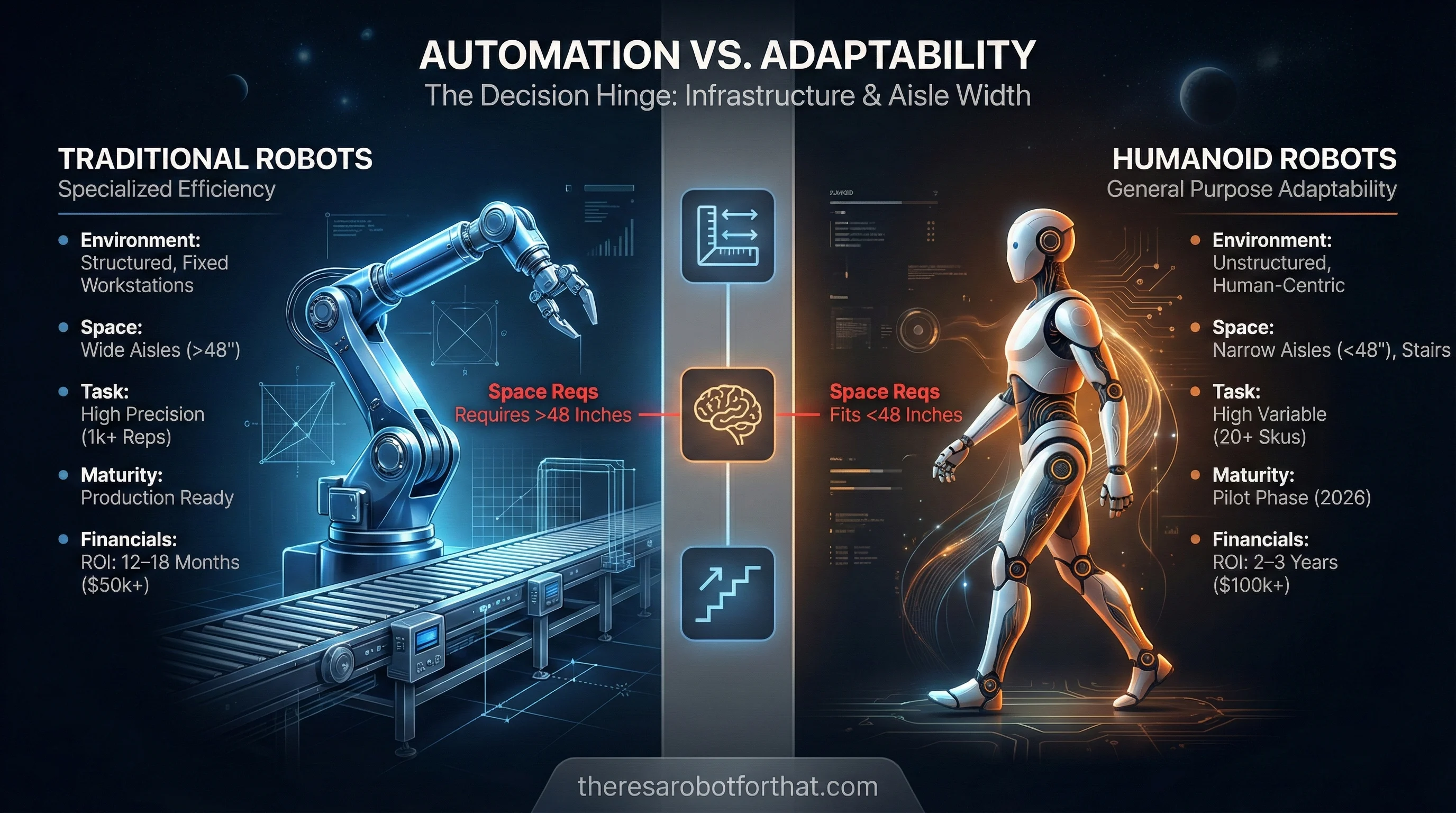
Task variability and environment structure determine automation type. A fixed workstation running the same weld 10,000 times per day? Traditional industrial robots win. A narrow aisle where workers pick variable SKUs from shelves? Humanoids make sense.
The global industrial robot market value reached $16.7 billion according to IFR data. Most of that value comes from traditional automation. Humanoids represent a small but growing segment focused on specific use cases.
Traditional robots excel at repetitive, high-precision tasks. They operate in structured environments with fixed workstations. A robotic arm welding car frames repeats the same motion with micron-level precision. It doesn't need to walk. It doesn't need to adapt to layout changes.
Humanoids excel in human-centric environments. Narrow aisles built for workers, not forklifts. Frequent layout changes as product lines shift. Multi-step processes requiring mobility between zones. A humanoid can walk through a 36-inch aisle, climb stairs, and adapt when a bin moves three inches left.
U.S. Census Bureau data shows manufacturing robot adoption varies widely by state and industry. Automotive leads in traditional automation. Warehousing and logistics drive humanoid pilots.
Here's the decision matrix:
| Task Characteristics | Environment Type | Recommended Solution | 2026 Maturity Level |
|---|---|---|---|
| Repetitive + Structured | Fixed workstations, controlled lighting | Traditional industrial robots | Production-ready |
| Dynamic + Structured | Fixed layout, variable tasks | Collaborative robots (cobots) | Production-ready |
| Repetitive + Unstructured | Human-centric layout, variable lighting | AMRs or humanoids (task-dependent) | Pilot phase |
| Dynamic + Unstructured | Narrow aisles, stairs, layout changes | Humanoid robots | Pilot phase |
The key insight: Don't choose humanoids because they look futuristic. Choose them when your environment structure and task variability make traditional automation impractical.
A 40-year-old factory built for human workers has narrow aisles. Traditional automation wants you to rip out the floor and widen passages. Humanoids walk through the door you already have. That's the value proposition.
But if your facility has wide aisles and fixed workstations, traditional automation delivers better precision, speed, and ROI. Humanoids aren't a replacement for traditional robots. They're a complement for environments where traditional robots can't operate. Not sure which fits your use case? See our technical comparison: Humanoids vs Cobots: Manufacturing Automation Comparison.
The 2026 Readiness Scorecard – 4 Critical Dimensions
A facility's readiness for humanoid robot deployment depends on four measurable dimensions: task audit (0-25 points), facility infrastructure (0-25 points), digital maturity (0-25 points), and workforce adaptability (0-25 points). Scores above 75 indicate viability for 2026 pilot programs.
Each dimension matters. Strong task fit but weak digital infrastructure creates integration failures. Great infrastructure but resistant workforce creates adoption failures. Score all four dimensions honestly.
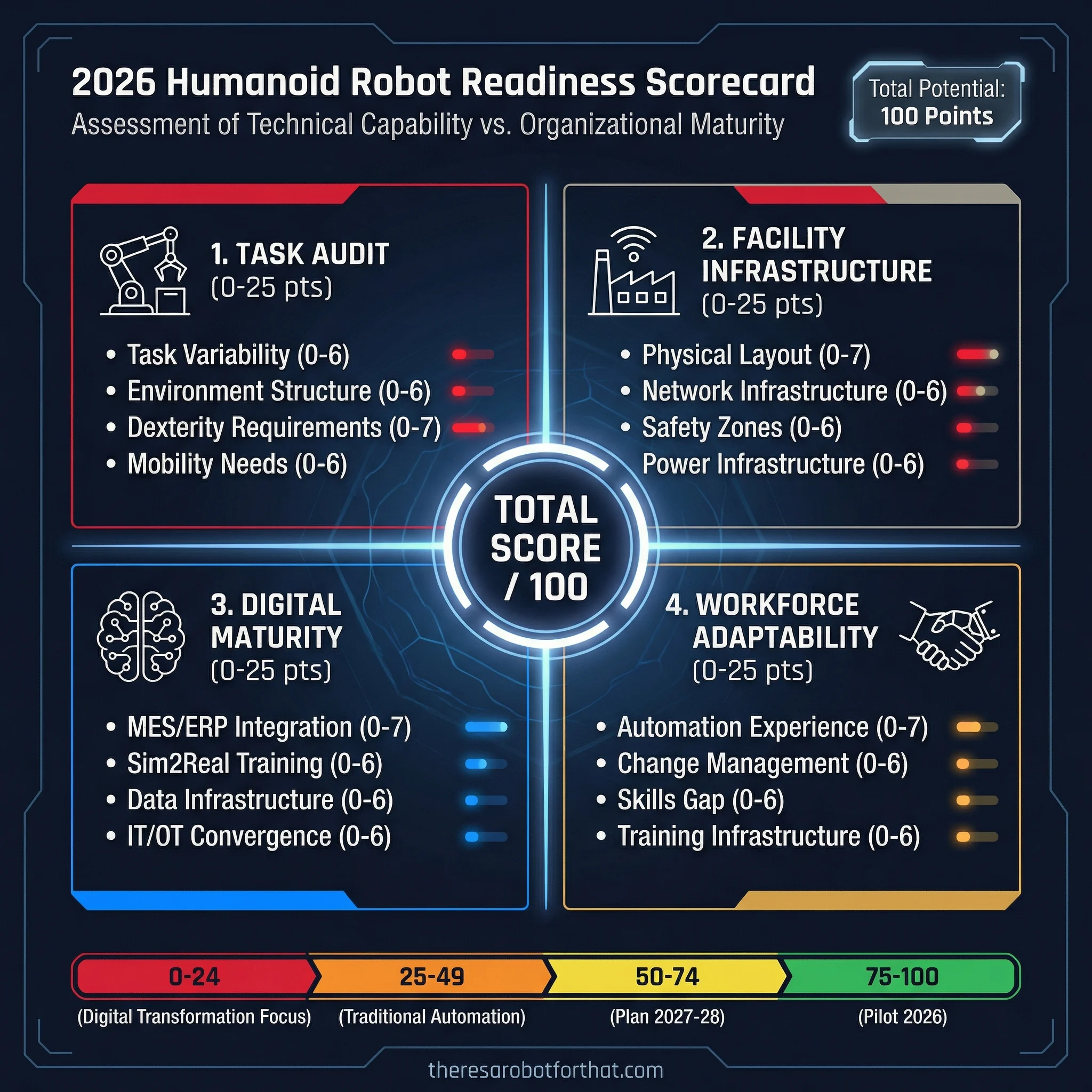
Here's what each score range means:
- 75-100: High readiness—pilot program viable in 2026
- 50-74: Moderate readiness—plan for 2027-2028 deployment
- 25-49: Low readiness—traditional automation recommended
- 0-24: Not ready—focus on foundational digital transformation
A. Task Audit (0-25 points)
Score your facility's tasks across four criteria. Be honest. Inflating scores leads to failed pilots.
Task Variability (0-6 points):
- 0-1 points: Highly repetitive (same motion 1,000+ times/day)
- 2-3 points: Semi-repetitive (5-10 task variations)
- 4-5 points: Variable (20+ task variations)
- 6 points: Highly dynamic (new tasks weekly)
Environment Structure (0-6 points):
- 0-1 points: Fixed workstations, controlled lighting, wide aisles
- 2-3 points: Semi-structured (some layout flexibility)
- 4-5 points: Human-centric layout (narrow aisles, stairs)
- 6 points: Highly unstructured (frequent layout changes)
Dexterity Requirements (0-7 points):
- 0-2 points: Gross motor only (lifting, moving)
- 3-4 points: Moderate dexterity (picking standardized items)
- 5-6 points: Fine manipulation (small parts, variable shapes)
- 7 points: Complex manipulation (assembly, cable routing)
Mobility Needs (0-6 points):
- 0-1 points: Stationary (fixed workstation)
- 2-3 points: Limited mobility (single zone)
- 4-5 points: Multi-zone navigation (cross-facility movement)
- 6 points: Complex navigation (stairs, elevators, outdoor)
A tote transport task from receiving to staging might score: 2 (semi-repetitive) + 4 (narrow aisles) + 2 (gross motor) + 5 (multi-zone) = 13 points. That's moderate task fit.
A variable SKU picking task with small parts might score: 5 (variable) + 5 (human-centric) + 6 (fine manipulation) + 5 (multi-zone) = 21 points. That's strong task fit.
NIST robotic assembly standards provide performance benchmarks for dexterity. Use Assembly Task Boards to test manipulation requirements before committing to humanoids. For detailed task selection criteria during pilot programs, see Phase 3 of our Implementation Guide.
B. Facility Infrastructure (0-25 points)
Physical and digital infrastructure determine deployment feasibility. Humanoids have specific requirements that traditional robots don't.
Physical Layout (0-7 points):
- 0-2 points: Stairs, narrow aisles (<36"), uneven floors (>±5mm)
- 3-4 points: Some constraints (aisles 36-48", minor floor issues)
- 5-6 points: Mostly compatible (aisles >48", flat floors)
- 7 points: Ideal (wide aisles, epoxy floors, no stairs)
Network Infrastructure (0-6 points):
- 0-1 points: No Wi-Fi coverage, legacy systems only
- 2-3 points: Partial Wi-Fi, >100ms latency
- 4-5 points: Wi-Fi 6 coverage, 50-100ms latency
- 6 points: Full Wi-Fi 6, <50ms latency, edge computing
Safety Zones (0-6 points):
- 0-1 points: No fall zone clearances, crowded aisles
- 2-3 points: Partial clearances, some congestion
- 4-5 points: Most areas compliant with ISO 25785-1 fall zone requirements
- 6 points: Full compliance, dedicated robot zones
Power Infrastructure (0-6 points):
- 0-1 points: No charging infrastructure, limited electrical capacity
- 2-3 points: Some charging points, adequate capacity
- 4-5 points: Strategic charging placement, good capacity
- 6 points: Optimized charging network, excess capacity
According to OSHA robotics standards, US manufacturers must comply with ANSI/A3 R15.06-2025 for industrial robots. ISO 25785-1 (currently a Working Draft) addresses unique risks of "walking robots," including fall zone clearances. See our 2026 Humanoid Robot Safety Standards Compliance Guide for detailed fall zone calculations and ANSI/A3 R15.06-2025 requirements.
A bipedal robot that falls creates different hazards than a wheeled robot. Fall zones require clearance around the robot's path. Crowded aisles don't provide that clearance.
Floor surface matters more for humanoids than wheeled robots. Oil residue on concrete creates slip risk. Epoxy coating provides better traction. Expansion joints wider than 10mm can trip bipedal robots. The robot's balance algorithm needs that data. For detailed floor assessment procedures and the complete Site Readiness Checklist, see Phase 1: Digital Nervous System Assessment in our Implementation Guide.
Network infrastructure enables real-time control. A humanoid navigating narrow aisles needs <50ms latency for obstacle avoidance. Wi-Fi 6 provides the bandwidth. Edge computing reduces cloud dependency.
C. Digital Infrastructure Maturity (0-25 points)
Humanoids require digital infrastructure that many facilities lack. This dimension often reveals the biggest gaps.
MES/ERP Integration (0-7 points):
- 0-2 points: No MES, manual tracking only
- 3-4 points: Basic MES, limited API access
- 5-6 points: Modern MES with APIs, real-time data
- 7 points: Full integration, bidirectional data flow
Sim2Real Training Environment (0-6 points):
- 0-1 points: No simulation capability
- 2-3 points: Basic CAD models, no physics simulation
- 4-5 points: Digital twin, basic physics simulation
- 6 points: Full Sim2Real environment, validated physics
Data Infrastructure (0-6 points):
- 0-1 points: No sensor data collection, no cloud/edge storage
- 2-3 points: Limited data collection, local storage only
- 4-5 points: Sensor network, cloud storage, basic analytics
- 6 points: Comprehensive data pipeline, AI training ready
IT/OT Convergence (0-6 points):
- 0-1 points: IT and OT completely separate, no collaboration
- 2-3 points: Some coordination, security concerns
- 4-5 points: Coordinated strategy, security protocols in place
- 6 points: Full convergence, unified architecture
The IFR 2026 trends report highlights IT/OT convergence as a critical enabler for advanced robotics. Humanoids need both operational technology (sensors, actuators) and information technology (cloud, AI) working together.
Sim2Real training is essential. You scan your facility with LIDAR to create a digital twin. The robot trains in simulation, learning to navigate your specific layout. Only validated policies transfer to physical hardware. For step-by-step Sim2Real environment setup, including LIDAR scanning and digital twin validation, see Phase 2: Simulation-First Training.
MES integration enables task assignment. The robot receives pick orders from your MES. It reports completion status back. Without APIs, you're stuck with manual task assignment. That defeats the automation purpose.
D. Workforce Adaptability (0-25 points)
Worker acceptance determines pilot success. Technical readiness means nothing if your workforce resists deployment.
Current Automation Experience (0-7 points):
- 0-2 points: No automation, manual processes only
- 3-4 points: Basic automation (conveyors, simple robots)
- 5-6 points: Advanced automation (cobots, AMRs)
- 7 points: Robotics expertise, dedicated team
Change Management Readiness (0-6 points):
- 0-1 points: Strong resistance to change, no innovation culture
- 2-3 points: Some resistance, limited change programs
- 4-5 points: Generally accepting, established change processes
- 6 points: Innovation culture, workers drive improvements
Skills Gap for Robot Supervision (0-6 points):
- 0-1 points: No technical staff, no robotics knowledge
- 2-3 points: Some technical staff, limited robotics experience
- 4-5 points: Experienced technical team, some robotics knowledge
- 6 points: Dedicated robotics team, supervision expertise
Training Infrastructure (0-6 points):
- 0-1 points: No formal training programs
- 2-3 points: Basic training, limited resources
- 4-5 points: Established training programs, good resources
- 6 points: Advanced upskilling programs, VR/AR training
Floor workers react with curiosity and anxiety when a 1.7-meter robot starts working beside them. The humanoid form triggers responses wheeled robots don't. Workers attribute intent to bipedal machines.
A wheeled robot that stops is a glitch. A humanoid that stops while facing you triggers threat assessment. That's human psychology, not a technical problem.
Successful deployments communicate early. Let workers control the robot via teleoperation. Show them the robot handles dull, dirty, dangerous tasks. Their jobs evolve, not disappear. For detailed workforce communication strategies and training timelines, see our guide on Managing Workforce Expectations.
Facilities with no automation experience face steeper adoption curves. Start with collaborative robots or AMRs first. Build automation literacy. Then introduce humanoids.
Leading Humanoid Platforms for Manufacturing (2026 Status)
As of early 2026, platforms like Agility Robotics' Digit and Apptronik's Apollo are in commercial pilot programs with US manufacturers. Boston Dynamics' Atlas and Tesla's Optimus remain in R&D or internal deployment phases.
"Commercially available" doesn't mean "proven at scale." Most platforms are in pilot programs with 1-10 units per facility. Production-scale deployments with 50+ units remain rare in 2026.
Here's the current landscape:
| Platform | Manufacturer | 2026 Status | Primary Use Case | Deployment Model | Estimated Cost |
|---|---|---|---|---|---|
| Digit | Agility Robotics | Commercial | Tote transport, material handling | RaaS | ~$10-12/hour (~$2,000-3,000/month) |
| Apollo | Apptronik | Pilot | Automotive assembly, logistics | RaaS (planned) | $30,000-$50,000 (est.) |
| Atlas | Boston Dynamics | R&D | Material handling, research | Not available | Not disclosed |
| Figure 01 | Figure AI | Pilot | Automotive assembly | Purchase/RaaS | $50,000-$100,000 (est.) |
| Neo | 1X Technologies | Pilot | Safety-focused tasks | RaaS (planned) | $40,000-$80,000 (est.) |
| Optimus | Tesla | Internal only | Factory automation | Not available | Not disclosed |
For detailed 2026 pricing, RaaS vs. purchase analysis, and 5-year TCO calculations, see our Complete Humanoid Robot Cost & ROI Breakdown.
Agility Robotics' Digit leads in commercial availability. Amazon deployed Digit units in warehouses for tote transport. The RaaS model reduces upfront capital requirements. You pay monthly fees instead of $150,000 purchase price.
Apptronik's Apollo partners with Mercedes at the Alabama facility. The pilot focuses on automotive assembly tasks. Commercial availability expected in late 2026 or early 2027.
Boston Dynamics' Atlas remains in R&D phase. The company demonstrates impressive capabilities in videos. But commercial deployment timelines remain unclear. Atlas focuses on material handling and research applications.
Figure AI's Figure 01 pilots at BMW's South Carolina plant. The focus is automotive assembly. The platform emphasizes AI-driven learning and adaptation.
1X Technologies' Neo takes a safety-first approach. The platform prioritizes human-robot interaction safety. Pilot programs focus on tasks where safety concerns are paramount.
Tesla's Optimus remains internal deployment only. The company uses Optimus at the Fremont factory. External availability hasn't been announced. Cost estimates are speculative.
The cost ranges reflect 2026 estimates based on industry reports and manufacturer statements. Actual pricing varies by deployment model, customization, and support requirements.
RaaS models are emerging to reduce CapEx barriers. Instead of $100,000 upfront, you pay $2,000-$5,000 monthly. That includes hardware, software updates, and support. The model shifts risk from buyer to manufacturer.
Battery life remains a constraint across platforms. Most humanoids operate 2-5 hours per charge depending on task intensity—with heavy manipulation draining batteries faster than simple transport. That requires strategic charging station placement and shift planning.
Dexterity varies significantly. Digit excels at tote transport but struggles with fine manipulation. Apollo targets assembly tasks requiring greater dexterity. Match platform capabilities to your task requirements.
US Regulatory & Market Context for 2026
According to OSHA's robotics standards guidance, US manufacturers must comply with ANSI/A3 R15.06-2025 (the US adoption of ISO 10218) for industrial robots. ISO 25785-1 (currently a Working Draft, expected publication 2026-2027) will address unique risks of dynamically stable "walking robots" including fall zone requirements.
ANSI/A3 R15.06-2025 is the primary US safety standard for industrial robots. It adopts ISO 10218:2025 international requirements with US-specific modifications.
Safety Standards & Compliance
ANSI/A3 R15.06-2025 covers robot design, safeguarding, and operation. Key requirements include:
- Risk assessment before deployment
- Safeguarding measures (physical barriers or collaborative operation protocols)
- Emergency stop systems
- Operator training and certification
ISO 25785-1 addresses walking robots specifically. Traditional robot standards assume wheeled or fixed-base robots. Bipedal robots introduce fall risks that wheeled robots don't have.
Fall zone clearances require space around the robot's path. If a humanoid falls, it creates a hazard zone. ISO 25785-1 will specify minimum clearances based on robot height and weight.
OSHA's General Duty Clause applies even without specific humanoid regulations. Employers must provide workplaces "free from recognized hazards." A humanoid robot operating in crowded aisles without fall zone clearances violates this clause.
CDC/NIOSH data documents 41 robot-related fatalities in the US from 1992-2017. Most involved traditional industrial robots. As humanoid deployments increase, new hazard patterns may emerge.
The same CDC/NIOSH research shows 10% growth in industrial robots in US factories in 2022. That growth continues in 2026, driven by labor shortages and automation economics.
Compliance isn't optional. OSHA inspections following incidents can result in citations and fines. Worse, worker injuries create legal liability and reputational damage.
See the detailed ANSI/A3 R15.06-2025 compliance guide for implementation checklists and risk assessment templates.
2026 Market Maturity Reality Check
Most US humanoid deployments in 2026 are pilots, not production-scale operations. Amazon, BMW, and Mercedes run pilot programs with 1-10 units. Production-scale deployments with 50+ units remain rare.
The IFR 2026 trends report emphasizes that humanoids still need to "prove reliability and efficiency." That's diplomatic language for "not production-ready yet."
Current limitations include:
- Battery life: 2-5 hours per charge limits shift coverage
- Dexterity: Fine manipulation tasks remain challenging
- Integration complexity: MES integration requires custom development
- Cost: $30,000-$150,000 purchase prices or $2,000-$5,000 monthly RaaS fees
Production-scale deployment timeline: 2027-2028. That's when platforms will have proven reliability in pilot programs. Battery life will improve. Integration tools will mature. Costs will decrease.
UC Berkeley robotics research highlights Moravec's paradox: tasks easy for humans are hard for robots. A child can pick up a novel object. Robots struggle without extensive training data.
The 100,000-year data gap matters. Humans evolved fine motor skills over millennia. Robots have a few years of training data. That gap narrows with AI advances, but it hasn't closed in 2026.
Strategic competition research notes generative AI's impact on robot development. Vision-language models enable robots to understand novel objects and tasks. That's a genuine breakthrough. But breakthrough doesn't mean production-ready.
If your facility scores 75+ on the Readiness Scorecard, a 2026 pilot makes sense. You'll gain experience and data. You'll identify integration challenges. You'll build workforce acceptance.
If your facility scores 25-49, traditional automation delivers better ROI in 2026. Deploy cobots for immediate productivity gains. Build digital infrastructure. Revisit humanoids in 2027-2028 when they're more mature.
Honest assessment matters. Humanoids aren't magic. They're tools suited for specific tasks in specific environments. Choose them when the use case fits, not because they're trendy.
Next Steps Based on Your Readiness Score
Facilities scoring 75-100 on the Readiness Scorecard should initiate pilot programs with 1-2 units in controlled environments. Those scoring 25-49 should prioritize traditional automation solutions like collaborative robots or AMRs for immediate ROI.
Your score determines your path. Don't force a humanoid deployment if your facility isn't ready. Failed pilots waste money and damage workforce trust.
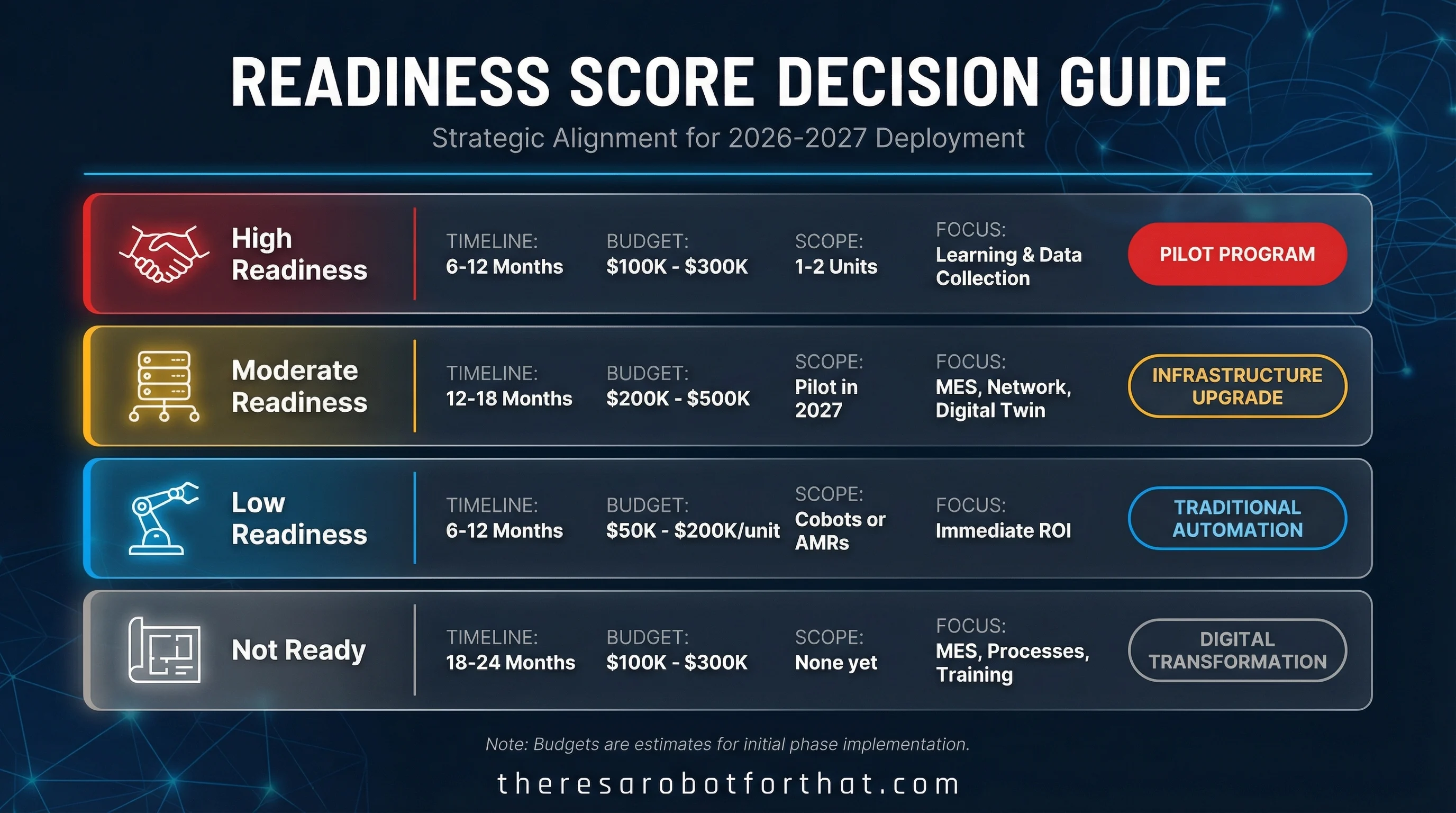
High Readiness (75-100): Pilot Program Roadmap
Start with 1-2 units in a controlled environment. Choose a task that's "dull, dirty, dangerous, or dear." Tote transport from receiving to staging is a common starting point.
Follow the detailed pilot program roadmap for phase-by-phase implementation:
- Site assessment and task selection (4-6 weeks)
- Sim2Real environment setup (6-8 weeks)
- Robot training in simulation (4-6 weeks)
- Controlled deployment with safety protocols (8-12 weeks)
- Performance evaluation and scale decision (12+ weeks)
Timeline: 6-12 months for pilot, 12-18 months for scale decision. Don't rush. Gather data. Measure performance against traditional automation alternatives.
Budget: $100,000-$300,000 for pilot. That includes:
- RaaS fees ($2,000-$5,000/month × 12 months)
- Integration costs (MES connection, network upgrades)
- Training costs (worker training, technical team upskilling)
- Safety infrastructure (fall zone clearances, emergency stop systems)
Focus on learning, not immediate ROI. Pilots generate data for scale decisions. They reveal integration challenges. They build workforce acceptance.
Success metrics:
- Task completion rate (target: 95%+ after 3 months)
- Incident rate (target: zero safety incidents)
- Worker acceptance (target: 70%+ positive feedback)
- Integration complexity (actual vs. estimated effort)
Moderate Readiness (50-74): Infrastructure Upgrade Plan
Prioritize digital backbone before deploying humanoids. MES integration, network infrastructure, and Sim2Real capability are prerequisites.
Timeline: 12-18 months for infrastructure upgrades, pilot in 2027.
Budget: $200,000-$500,000 for infrastructure:
- MES/ERP integration and API development
- Network infrastructure (Wi-Fi 6, edge computing)
- Digital twin and Sim2Real environment
- Safety infrastructure upgrades
Work with IT early. Cloud access, network latency, and cybersecurity concerns require IT/OT collaboration. Engage them in Phase 1, not after you've ordered robots.
Use this time to deploy traditional automation for immediate ROI. Collaborative robots handle tasks where humanoids aren't necessary. AMRs transport materials in wide aisles. Build automation literacy while upgrading infrastructure.
During infrastructure upgrades, review our Pilot Challenges Guide to prepare for common integration issues like network latency and MES connectivity.
See the Sim2Real training environment setup guide for digital twin implementation details.
Low Readiness (25-49): Traditional Automation Path
Deploy collaborative robots (cobots) for immediate ROI. Cobots handle human-adjacent tasks without full facility restructuring. They're production-ready in 2026. See our Humanoids vs Cobots Comparison for detailed cobot specifications and ROI analysis.
AMRs transport materials in facilities with wide aisles. They don't need bipedal locomotion. They're cheaper and more reliable than humanoids.
Timeline: 6-12 months for traditional automation deployment.
Budget: $50,000-$200,000 per cobot or AMR unit. That's lower than humanoid costs. ROI timelines are faster because the technology is mature.
Build digital infrastructure foundation while deploying traditional automation:
- Implement or upgrade MES
- Deploy sensor networks for data collection
- Establish cloud/edge storage
- Train workforce on automation basics
Revisit humanoids in 2027-2028. By then, platforms will be more mature. Your facility will have stronger digital infrastructure. Your workforce will have automation experience.
Not Ready (0-24): Foundational Work
Focus on foundational digital transformation before any advanced automation.
Timeline: 18-24 months before automation readiness.
Budget: $100,000-$300,000 for foundational work:
- MES/ERP implementation
- Process standardization and documentation
- Workforce training on basic automation concepts
- Data infrastructure (sensors, storage, analytics)
Many facilities jump to robots before they're ready. They lack MES integration. They have no data infrastructure. They haven't standardized processes. The robot can't fix those problems.
Fix the foundation first. Implement MES. Standardize processes. Train workers. Build data infrastructure. Then evaluate automation options in 2027-2028.
The Human Factor
Worker acceptance determines pilot success. Floor workers react with curiosity and anxiety when a 1.7-meter robot starts working beside them.
The humanoid form triggers responses wheeled robots don't. Workers attribute intent to bipedal machines. A wheeled robot that stops is a glitch. A humanoid that stops while facing you triggers threat assessment.
Successful deployments communicate early. Announce the pilot 2-3 months before deployment. Explain the task selection: dull, dirty, dangerous work. Show workers their jobs evolve, not disappear.
Let workers control the robot via teleoperation during training. They see the robot responds to human commands. It doesn't have independent agency. That reduces anxiety.
Address job security concerns directly. Most humanoid pilots in 2026 handle tasks workers don't want. Tote transport in hot warehouses. Repetitive material handling. Overnight shifts with poor lighting.
Workers who operate humanoids need new skills. Robot supervision, troubleshooting, and task programming create new roles. Facilities that invest in worker training see higher acceptance rates.
Facilities with strong change management programs see smoother humanoid adoption. Innovation culture matters. Workers who drive continuous improvement embrace new tools. Workers in rigid hierarchies resist change.
Common Pitfalls
Choosing tasks too complex for day one. Start with tote transport. Multi-step assembly fails in early pilots.
Underestimating floor requirements. Uneven joints and debris trip bipedal robots. Measure friction, don't guess.
IT blocking cloud access late. Robots need cloud for updates. Engage IT in Phase 1.
Skipping Sim2Real training. Deploying without simulation training causes navigation failures. Scan your facility first.
Ignoring fall zone clearances. ISO 25785-1 requires space around robot paths. Crowded aisles violate standards.
Expecting immediate ROI. 2026 pilots generate data, not immediate payback. Production-scale ROI comes in 2027-2028.
For a deeper analysis of deployment failures and how to avoid them, see 7 Humanoid Deployment Mistakes Manufacturing Leaders Make.
Limitations & Alternatives
This framework does NOT cover specific ROI calculations. ROI varies by facility, labor costs, task complexity, and integration requirements. Use this scorecard to determine readiness, then calculate ROI for your specific situation.
The framework doesn't provide vendor selection criteria. Platform capabilities, support quality, and integration complexity vary. Evaluate platforms based on your specific task requirements after confirming readiness.
Detailed technical specifications aren't included. Floor load capacity, power requirements, and network architecture need facility-specific engineering. Engage technical consultants for detailed specifications.
Alternative approaches often deliver better results:
- Traditional industrial robots for high-precision, repetitive tasks in structured environments
- Collaborative robots (cobots) for human-adjacent work with variable tasks
- Autonomous Mobile Robots (AMRs) for material transport in facilities with wide aisles
- Automated Guided Vehicles (AGVs) for fixed-path material transport
Professional consultation makes sense for:
- Facilities with unique layouts (multi-story, outdoor areas, extreme temperatures)
- Highly regulated industries (pharmaceutical, aerospace, food processing)
- Complex integration requirements (legacy systems, custom MES)
- Facilities scoring 50-74 (moderate readiness) needing infrastructure upgrade guidance
Don't choose humanoids because they're futuristic. Choose them when your environment structure and task variability make traditional automation impractical. For many facilities in 2026, traditional automation remains the right choice.
Conclusion
The 4-dimension Readiness Scorecard provides a structured approach to evaluating humanoid robot deployment viability. Task audit, facility infrastructure, digital maturity, and workforce adaptability determine if your facility is ready.
Most US manufacturers in 2026 are in pilot phase. Amazon, BMW, and Mercedes test humanoids in controlled environments. Production-scale deployment requires scores of 75+ and realistic 2027-2028 timelines.
Humanoid robots for manufacturing are a strategic decision, not a technology gamble, when evaluated through this readiness framework. They suit specific tasks in specific environments. Traditional automation remains the right choice for many facilities in 2026.
Score your facility honestly. If you score 75-100, initiate a pilot. If you score 25-49, deploy traditional automation. If you score 0-24, focus on foundational digital transformation.
Subscribe to There's A Robot For That for ongoing coverage of 2026 pilot program results, ROI data, and deployment case studies as the market matures.
FAQ
What are the leading humanoid robots for manufacturing?
Agility Digit, Apptronik Apollo, Figure 01, and Boston Dynamics Atlas lead the 2026 market. Digit is commercially available via RaaS for tote transport. Apollo pilots with Mercedes for automotive assembly. Boston Dynamics' Atlas remains in R&D. Tesla's Optimus is internal deployment only. Most platforms are in pilot programs, not production-scale deployment in 2026.
How to decide if humanoid robots are right for manufacturing?
Score your facility across four dimensions: task audit, facility infrastructure, digital maturity, and workforce adaptability. Scores of 75-100 indicate readiness for 2026 pilots. Scores below 50 suggest traditional automation is more appropriate. The scorecard provides a structured framework for deployment decisions.
What is the ROI of humanoid robots in manufacturing?
22-28% labor cost reduction within the first year is typical for well-matched deployments. ROI timelines dropped from 5.3 years (2019) to 2.8 years (2023) as technology matured. However, most 2026 deployments are pilots, not production-scale, making ROI projections preliminary. Traditional automation often delivers faster ROI for repetitive tasks in structured environments.
What are the safety standards for humanoid robots?
US manufacturers must comply with ANSI/A3 R15.06-2025, the US adoption of ISO 10218. According to OSHA, this is the primary industrial robot standard. ISO 25785-1 (Working Draft, expected 2026-2027) will address unique risks of "walking robots," including fall zone clearances. OSHA's General Duty Clause also applies, requiring workplaces free from recognized hazards.
What are common problems with humanoid robot pilots?
Battery limits (2-5 hours), gripper failures on novel objects, MES integration complexity, and workforce resistance cause most pilot failures. Most humanoids operate 2-5 hours per charge depending on task intensity, requiring strategic charging placement. Fine manipulation tasks remain difficult. Legacy MES integration requires custom development. Workers may resist change without proper communication. Successful pilots address these through phased deployment, Sim2Real training, and robust change management.
References
-
International Federation of Robotics (IFR) - 2026 Trends - Humanoids need to prove reliability, $16.7B market value, IT/OT convergence trend - https://ifr.org/ifr-press-releases/news/top-5-global-robotics-trends-2026
-
OSHA Robotics Standards - ANSI/A3 R15.06-2025 compliance, primary US safety standard - http://www.osha.gov/robotics/standards
-
ISO 10218:2025 Official Standard - International safety requirements for industrial robots - https://www.iso.org/standard/73933.html
-
CDC/NIOSH Robot Safety Data - 41 robot fatalities 1992-2017, 10% growth in industrial robots 2022 - https://www.cdc.gov/niosh/robotics/about/index.html
-
U.S. Census Bureau - 2022 Economic Census - National/state robot adoption data, capital expenditures - https://www.census.gov/library/publications/2025/econ/2022-ec-robotic-equipment.html
-
UC Berkeley Robotics Research - Moravec's paradox, 100,000-year data gap, dexterity challenges - https://vcresearch.berkeley.edu/news/are-we-truly-verge-humanoid-robot-revolution
-
U.S.-China Economic and Security Review Commission - Generative AI impact on robot development, strategic competition - https://www.uscc.gov/research/humanoid-robots
-
NIST Robotic Assembly Standards - Performance metrics, Assembly Task Boards, dexterity benchmarks - https://www.nist.gov/el/intelligent-systems-division-73500/robotic-grasping-and-manipulation-assembly/assembly
-
Humanoid Robot Safety Standards 2026 (Internal) - ISO 25785-1 fall zones, ANSI/A3 R15.06-2025 details - https://www.theresarobotforthat.com/blog/humanoid-robot-safety-standards-2026/
-
Humanoid Robot Factory Implementation Guide (Internal) - Pilot program roadmap, Sim2Real training, 5-phase deployment - https://www.theresarobotforthat.com/blog/humanoid-robot-factory-implementation-guide/


