
7 Humanoid Deployment Mistakes Manufacturing Leaders Make
7 Humanoid Robot Deployment Mistakes Costing Manufacturers Time and Budget
Key Takeaway
Failed humanoid pilots burn $500K-$1M+ in early deployments.
- Physical AI needs 500-1,000 hours Sim2Real training
- Floor and battery issues cause most failures
- Fewer than 20 companies will scale by 2028
Last updated: 29 January 2026
Gartner predicts fewer than 20 companies will scale humanoid robots to production by 2028. Most pilots fail before month six.
Humanoid robots cost $30,000-$250,000 per unit. Battery life averages 90-120 minutes versus 8-20 hour factory shifts. Production deployments achieve 40-60% task success in first six months. Vendor demos show 95%+ success.
The International Federation of Robotics reports global industrial robot market value hit $16.7 billion in 2026. Yet humanoids struggle to prove ROI. Manufacturing leaders face pressure to automate due to labor shortages.
These seven mistakes cost early adopters millions. The reality gap between vendor promises and production performance reveals why:
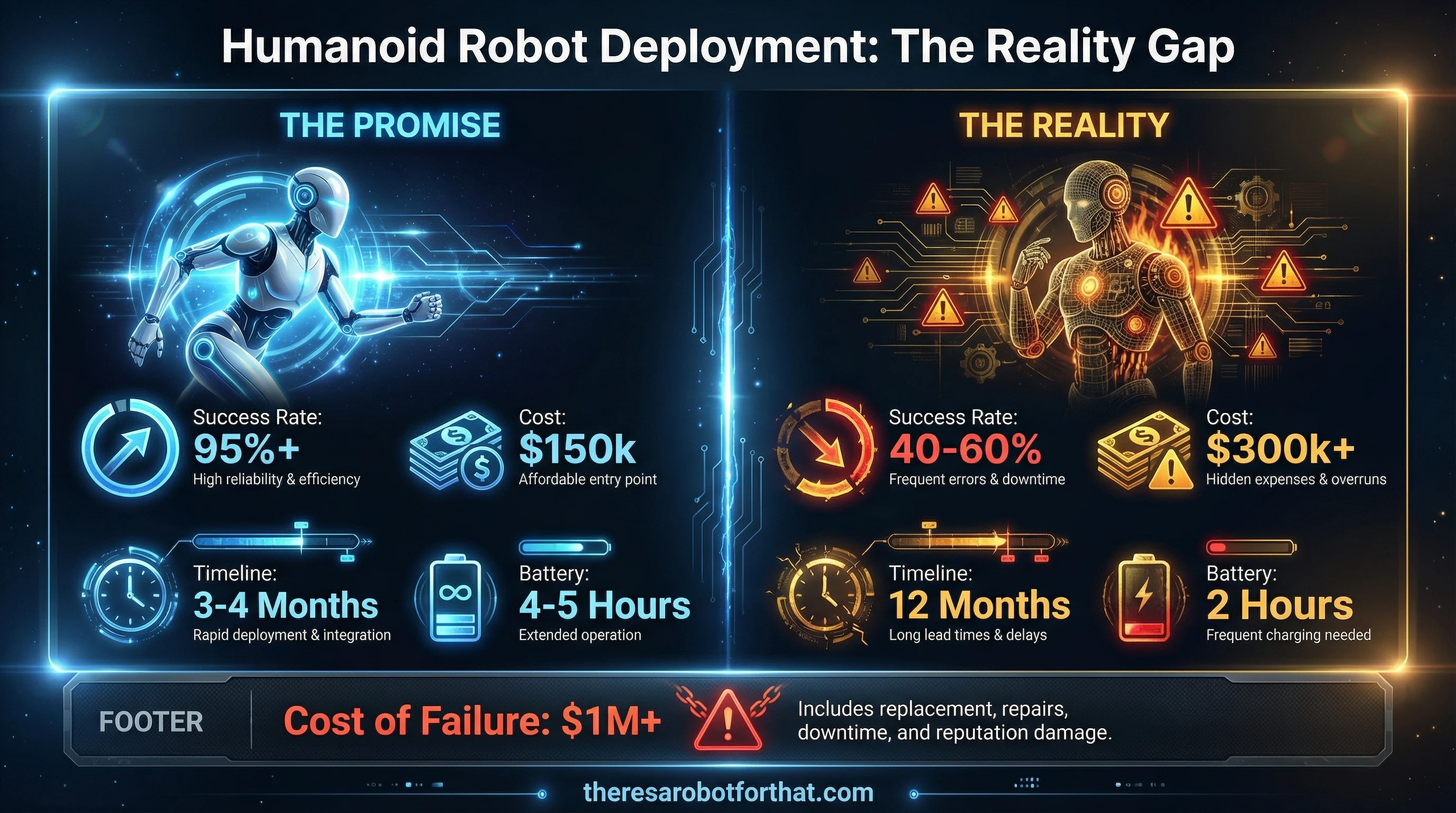
Learn what goes wrong and how to avoid expensive failures. For the complete implementation roadmap, see our Humanoid Robot Factory Implementation Guide.
Mistake #1 – Underestimating 'Physical AI' Training Data Needs
UC Berkeley roboticist Ken Goldberg calls it the "100,000-year data gap." LLMs train on trillions of text tokens. Robots have thousands of hours of physical interaction data. You need 500-1,000 hours of Sim2Real training per task type before production.
Physical AI differs fundamentally from software AI. You can't train a robot to pick up a wrench by showing it Wikipedia articles. The robot needs to feel weight, adjust grip pressure, compensate for center of gravity shifts.
This is Moravec's paradox in action. A five-year-old walks across uneven ground while carrying a glass of water. A $150,000 humanoid robot struggles with both tasks separately.
The 100,000-Year Data Gap
- LLMs: 100,000+ years equivalent training data
- Robots: Months of physical experience
- Gap explains why ChatGPT launched in weeks while humanoid pilots take years
Iowa State University research shows Sim2Real training reduces physical training time 80%. But you still need 500-1,000 hours per task type. A robot learning tote handling needs separate training for bins, pallets, and irregular packages.
Manufacturing leaders assume robots work like software. Deploy code, run program, get results. Physical AI doesn't work that way. Insufficient training causes 60% failure rates in first six months. Proper Sim2Real prep reduces failure to 20%.
Cost impact: Pilots with inadequate training burn $200K-$300K in wasted robot time, facility disruption, and abandoned integration. Budget 3-6 months for Sim2Real before physical deployment.
Red flags:
- Vendor promises "ready to deploy out of the box"
- No mention of simulation or digital twin requirements
- Training timeline shorter than 12 weeks
Mistake #2 – Choosing Generalist Robots for Specialist Tasks
Gartner's 2026 analysis reveals humanoid robots marketed as "general purpose" are half as efficient as humans in most factory tasks. Specialized robotic arms or AGVs deliver 3-5x better performance per dollar invested.
"General purpose" is marketing language. Humanoids excel at specific use cases, not all tasks. A humanoid navigates tight aisles between legacy equipment. It handles irregular objects that confuse traditional grippers. It works in human-designed environments without facility modifications.
But robotic arms dominate repetitive assembly. An arm completes 200 cycles per hour. A humanoid completes 80 cycles. The arm costs $50,000. The humanoid costs $150,000.
The IFR's $16.7B market data proves specialized automation works. Humanoids fill gaps arms can't reach. They're not replacing robotic arms.
When to deploy humanoids:
- Task requires both manipulation AND navigation
- Warehouse with narrow aisles and mixed SKUs
- Factory floor with human workers and legacy equipment
- Quality inspection requiring movement between stations
When NOT to deploy humanoids:
- Repetitive assembly line work (use robotic arms)
- Pure transport tasks (use wheeled AGVs)
- High-speed pick-and-place under 5-second cycles
Cost impact: Wrong robot type wastes $200K+ in capital expenditure plus 6-12 months lost productivity during pivot.
Mistake #3 – Ignoring Floor Surface Compatibility
Bipedal humanoids need flatter surfaces than wheeled AGVs. NIST Assembly Task Board standards recommend flatness tolerances many legacy US factories fail to meet. Result: "drunken robot syndrome."
Industry reports show floor issues cause 30-40% of early deployment downtime.
A wheeled AGV rolls over a 1-inch floor joint without issue. A bipedal robot's balance algorithm detects the irregularity, stutters, recalculates, sometimes falls.
Common floor problems:
- Oil residue on concrete
- Epoxy coating with different friction coefficients
- Expansion joints every 20 feet
- Uneven floor drains and transitions
ISO 10218 safety requirements and NIST standards specify maximum irregularity tolerances. Most legacy US factories built 30-50 years ago don't meet these standards.
Floor assessment is mandatory:
- Measure flatness with 10-foot straightedge
- Document surface transitions
- Map oil stains and chemical residue
- Identify expansion joints and floor drains
Cost impact: Remediation costs $5-$15 per square foot. A 5,000 square foot deployment zone costs $25K-$75K. Without assessment, robots spend 40% of shift time recalculating balance instead of working.
Some humanoid models handle rougher surfaces better. Robots with wider foot bases and lower centers of gravity tolerate more irregularity. But even robust models need floor assessment data. Don't deploy blind.
Mistake #4 – Failing to Define 'Success' Metrics Before Deployment
Industry analysis from LinkedIn robotics professionals: most failed humanoid pilots share one trait. Vague goals like "improve efficiency" or "test automation" provide no measurable criteria. Leaders can't justify continued investment within the critical 6-12 month evaluation window.
Vague goals equal impossible ROI justification. That equals pilot cancellation.
Not a metric:
- "Improve efficiency"
- "Test automation"
- "Increase productivity"
Actual metrics:
- "Reduce manual material handling time 25% within 6 months"
- "Achieve 90% uptime by month 12"
- "Complete 50 pick-and-place cycles per hour with <2% error rate by month 9"
Financial metrics for executives:
- Payback period
- Total Cost of Ownership over 3-5 years
- Labor cost savings (use conservative numbers)
Operational metrics for plant managers:
- Uptime targets
- Task success rate thresholds
- Cycle time requirements
- Error rate tolerances
The 6-12 month window is critical. Executives evaluate pilots quarterly. If you can't show measurable progress toward defined goals, funding disappears.
Red flags:
- No written success criteria before robot arrives
- Metrics defined after deployment begins
- Goals that can't be measured objectively
For detailed ROI analysis frameworks, see Phase 5: Scaling & ROI Analysis in the implementation guide.
Mistake #5 – Believing 'Demo Hype' Over Production Reality
The 2025 World Humanoid Robot Games in Beijing exposed the demo-reality gap. Multiple humanoid robots fell, collided with officials, and exhibited chaotic behavior during live competitions.
According to CNN's coverage, scientists acknowledged the challenges: "At Beijing's World Humanoid Robot Games, one robot crashed into a human operator, while another made an unexpected 90-degree turn to collide with the referee seats. Boxing robots frequently missed their punches, and the humanoids kept staff busy by frequently falling over on the soccer pitch."
This contrasted sharply with polished vendor videos showing 95%+ task success in controlled environments. Production deployments average 40-60% success in first six months per Gartner analysis.
Why demos mislead:
- Perfect lighting
- Flat, pristine surfaces
- Known object positions
- No unexpected obstacles
- No human workers moving unpredictably
- Rehearsed routines trained for weeks
Production reality:
- Lighting changes throughout the day
- Shadows from overhead cranes
- Reflections from metal surfaces
- Surface irregularities from wear
- Unexpected obstacles from workers and forklifts
- Objects in slightly different positions every cycle
The AIdol robot incident in Moscow showed similar issues. Russia's first AI humanoid robot fell face-first during its November 2025 debut at a technology conference. According to Newsweek's coverage, "As the robot was being led on stage by two staff members to the soundtrack from the film Rocky, it lost balance and fell, leaving several pieces behind on the stage."
Vendor blamed "lighting and calibration issues." The robot had demonstrated flawless performance in controlled testing. Real-world conditions introduced variables it couldn't handle.
Verification strategy:
Demand 30-day pilot in YOUR facility with YOUR workflows. Not vendor facility. Not demo environment.
Measure these metrics:
- Actual task success rate (count successful vs failed cycles)
- Actual cycle time in your environment
- Actual error rate per 100 cycles
• Demo only happens in vendor facility
• Robot performs single task repeatedly
• Pristine environment with perfect lighting
• No task success rate data from production deployments
• Sales emphasizes "potential" over documented performance
Mistake #6 – Underestimating Integration Complexity
Advanced Manufacturing industry reports: integration challenges are the primary barrier to humanoid deployment. Software integration with Manufacturing Execution Systems, Warehouse Management Systems, safety systems, and human workflow coordination requires 3-6 months. This adds $50K-$100K beyond robot purchase price.
Humanoid robots are NOT plug-and-play. They need deep integration with existing factory systems.
What robots need:
- Receive task assignments from MES
- Report completion status
- Coordinate with human workers
- Comply with safety protocols
- Scan barcodes/RFID tags
- Report inventory data to WMS
Integration timeline: 3-6 months
This is purely software work:
- API development
- Data mapping between systems
- Testing and validation
- Safety system integration
Manufacturing leaders budget 2-4 weeks. Reality is 3-6 months.
Hidden costs:
- Integration labor: $50K-$100K
- Software licensing: $10K-$20K
- System upgrades: $10K-$30K
ANSI/A3 R15.06-2025 compliance mandates safety system integration and risk assessment. Not optional for US manufacturers. For complete safety requirements, see our 2026 Humanoid Robot Safety Standards Guide.
Solution: Hire robotics integrator with humanoid experience. Don't attempt DIY integration unless you have dedicated robotics engineers on staff. Specialists complete in 3 months what takes internal teams 9 months.
For detailed integration requirements, see Phase 1: The "Digital Nervous System" Assessment in the implementation guide.
Mistake #7 – Miscalculating Battery Life and Uptime Requirements
Battery life is the single most critical bottleneck preventing widespread deployment. Most models run 90-120 minutes per charge. Factory shifts run 8-20 hours.
Battery reality:
- 90-120 minutes per charge for most models
- Real-world performance 30-40% less than specs under load
- Lithium-ion batteries lose 20-30% capacity over 1,000 cycles
Factory reality:
- 8-hour shifts minimum
- Often 12-16 hours (two shifts)
- Some facilities run 20-24 hours (three shifts)
The math doesn't work: Robot with 90-minute battery operates 90 minutes out of 480 minutes in 8-hour shift. That's 18.75% uptime. Add 90 minutes charging: robot works 90 minutes, charges 90 minutes. Maximum 50% uptime.
50% uptime destroys ROI. You paid $150K for a robot that works half the time. You need two robots to cover one shift. Now capital cost is $300K.
Solutions:
1. Battery swap stations
- Robot returns to swap station at 20% battery
- Automated system swaps depleted for charged battery
- Swap time: 2-5 minutes
- Requires 3-4 battery packs per robot
- Cost: $20K-$40K per robot
2. Robot-as-a-Service models
- Pay $2K-$5K monthly
- Vendor manages charging, swaps, maintenance
- Vendor ensures uptime targets
- Avoids capital expenditure
3. Hybrid deployment
- Use humanoids for specific 2-hour tasks
- Charge during low-traffic periods
- Match robot capabilities to actual requirements
Cost impact: Failing to plan for battery limitations causes 50%+ downtime and ROI failure.
Red flags:
- Vendor quotes battery life without load specifications
- No discussion of charging infrastructure
- Timeline doesn't include battery swap station installation
The Human Factor
Worker acceptance determines pilot success. Floor workers react with curiosity and anxiety when 1.7-meter robots start working beside them. The humanoid form triggers responses wheeled robots don't.
NIOSH research documents 41 robot-related fatalities in US between 1992-2017. Most involved workers entering robot work zones during operation. Humanoids introduce new risks because they move through shared spaces.
Successful deployments communicate early:
- Let workers control robot via teleoperation
- Show robot handles dull, dirty, dangerous tasks
- Frame as job evolution, not replacement
- Provide training on safe interaction protocols
Plant managers who skip workforce communication face resistance. Workers slow-walk integration. They report problems that don't exist. This kills pilots faster than technical failures.
Common Pitfalls
Choosing tasks too complex for day one. Start with tote transport. Multi-step assembly fails in early pilots.
IT blocking cloud access late. Robots need cloud for updates. Engage IT in Phase 1.
Believing vendor timelines. Vendors quote best-case scenarios. Add 50% to all timeline estimates.
Skipping Sim2Real training. Physical-only training costs 10x more and takes 10x longer.
Conclusion
These seven humanoid deployment mistakes cost early adopters $500K-$1M+ in failed pilots. All are preventable with proper planning.
The most underestimated challenges:
- Physical AI training needs (500-1,000 hours Sim2Real)
- Floor surface compatibility requirements
- Battery life limitations (90-120 minutes)
Critical requirements:
- Define SMART metrics before deployment
- Verify production performance, not demo hype
- Budget 3-6 months for integration
- Plan for battery infrastructure or RaaS models
- Comply with ANSI/A3 R15.06-2025 safety standards
Total deployment costs: Factor $200K-$300K beyond robot purchase price for integration, floor remediation, battery infrastructure, and Sim2Real training.
Gartner predicts fewer than 20 companies will scale humanoid robots to production by 2028. Learning from these seven mistakes separates successful deployments from expensive failures.
Ready to deploy humanoid robots correctly? See our complete Humanoid Robot Factory Implementation Guide for the five-phase roadmap: Digital Nervous System assessment, Sim2Real training, pilot program structure, ANSI compliance, and scaling with ROI analysis.
Stay ahead of the robotics revolution. Subscribe to There's A Robot For That for daily updates on humanoid robot deployments, safety standards, and implementation strategies that work in US manufacturing.
FAQ
What are common challenges in humanoid robot development?
Common challenges include bipedal locomotion, dexterity, and battery efficiency. According to UC Berkeley research, robots face a "100,000-year data gap" in training data compared to large language models. Physical task learning is significantly slower than software AI development. These technical hurdles explain why Gartner predicts fewer than 20 companies will scale humanoid robots to production by 2028.
What is the most significant human judgment error when working around robots?
Overconfidence in robot predictability causes most incidents. According to NIOSH research, 41 robot-related fatalities occurred in the US between 1992-2017. Workers assume robots behave consistently. Sensor failures, software glitches, or environmental changes cause sudden, unpredictable movements. ANSI/A3 R15.06-2025 standards now require comprehensive risk assessments and safety protocols.
Why do humanoid robot pilots fail?
Seven preventable mistakes cause most failures: underestimating Physical AI training needs (500-1,000 hours required), choosing generalist robots for specialist tasks, ignoring floor surface compatibility, failing to define success metrics, believing demo hype over production reality, underestimating integration complexity (3-6 months), and miscalculating battery life requirements. Each mistake costs $50K-$200K+ in rework and delays.
How much does a humanoid robot cost for manufacturing?
Purchase price ranges $30,000-$250,000 per unit depending on capabilities. Total deployment costs reach $200K-$300K+ when including integration ($50K-$100K), floor remediation ($5-$15 per square foot), battery infrastructure ($10K-$20K), and Sim2Real training. Robot-as-a-Service models offer alternative pricing at $2K-$5K monthly with maintenance included.
What safety standards apply to humanoid robots in US factories?
US factories must comply with ANSI/A3 R15.06-2025, the US adoption of ISO 10218:2025. The developing ISO 25785-1 standard specifically addresses "dynamically stable walking robots," covering unique risks like fall zones and bipedal locomotion hazards. NIOSH recommends comprehensive risk assessments before deployment. For complete safety requirements, see our 2026 Humanoid Robot Safety Standards Guide.
References
- UC Berkeley VC Research - "Are we truly on the verge of a humanoid robot revolution?" - https://vcresearch.berkeley.edu/news/are-we-truly-verge-humanoid-robot-revolution
- International Federation of Robotics - "Top 5 Global Robotics Trends 2026" - https://ifr.org/ifr-press-releases/news/top-5-global-robotics-trends-2026
- Gartner - "Fewer Than 20 Companies Will Scale Humanoid Robots for Manufacturing and Supply Chain to Production Stage by 2028" - https://www.gartner.com/en/newsroom/press-releases/2026-01-21-gartner-predicts-fewer-than-20-companies-will-scale-humanoid-robots-for-manufacturing-and-supply-chain-to-production-stage-by-2028
- NIST - "Assembly Task Boards for Robotic Grasping and Manipulation" - https://www.nist.gov/el/intelligent-systems-division-73500/robotic-grasping-and-manipulation-assembly/assembly
- NIOSH / CDC - "Robotics Safety" - https://www.cdc.gov/niosh/robotics/about/index.html
- ISO - "ISO 10218:2025 Robots and robotic devices" - https://www.iso.org/standard/73933.html
- Association for Advancing Automation - "ANSI/A3 R15.06-2025 American National Standard for Industrial Robot Safety Now Available for Purchase" - https://www.automate.org/robotics/news/new-ansi-a3-r15-06-2025-american-national-standard-for-industrial-robot-safety-now-available-for-purchase
- Iowa State University - "The value of physical intelligence" - https://www.news.iastate.edu/news/value-physical-intelligence-how-researchers-are-working-safely-advance-capabilities-humanoid
- CNN - "China's robot sports craze could eventually put humanoids in homes" - https://www.cnn.com/2026/01/02/china/china-humanoid-robot-sports-intl-hnk-dst
- Newsweek - "Russia 'human' robot falls on stage during debut" - https://www.newsweek.com/russia-human-robot-falls-stage-during-debut-11031104


