

Humanoid robot price is the first question every manufacturing CFO asks in 2026. After tracking pricing across 15+ manufacturers for the past two years, I’ve compiled the most current data available. Learn more about our team and methodology. The answer: humanoid robots now cost less than 9% of annual US manufacturing labor. According to Unitree’s official store, the G1 sells for $13,500. Our hands-on Unitree G1 review breaks down its real-world payload and battery limits. A single manufacturing worker costs $160,000 per year when you include benefits and overhead. That makes the humanoid robot price question simple math for most CFOs.
CFOs face a capital allocation decision. Purchase a robot now or subscribe via Robot-as-a-Service? Deploy immediately or wait for the projected 40% price drop by 2030? CES 2026 brought clarity. EngineAI announced the T800 at $25,000. Boston Dynamics confirmed Atlas commercial availability. 1X Technologies started shipping the NEO. Need help choosing the right model? Contact our team for deployment guidance.
This analysis covers exact 2026 prices for five leading models (see our complete humanoid robot companies guide for full specs, and how humanoid robots work for the technology behind these price differences). You’ll see RaaS vs. CapEx break-even calculations. True 5-year total cost of ownership appears with hidden costs exposed. US manufacturing ROI includes regional wage variations. Strategic timing guidance answers the buy-now-or-wait question. See how leading manufacturers are already deploying humanoid robots with documented ROI results.
Key Takeaways
- Humanoid robot price in 2026 ranges from $13,500 (Unitree G1) to $499/month RaaS.
- US manufacturing achieves 1.9-month payback replacing $160k labor
- 5-year TCO reaches $32k-$40k with hidden costs
- 40% price drop projected by 2030
Table of Contents
Here is the complete financial breakdown, based on our independent analysis of manufacturer data and government labor statistics. If you are evaluating readiness, start with our 2026 manufacturing readiness framework.
2026 Humanoid Robot Price List: Model-by-Model Breakdown
According to manufacturer announcements and CES 2026 data, humanoid robot prices in 2026 range from $13,500 for the Unitree G1 to under $320,000 for the Boston Dynamics Atlas. Most industrial-grade models cluster at $20,000-$30,000.
The humanoid robot price war is on. The market now has real competition. Chinese manufacturers like Unitree push aggressive pricing. US companies like Tesla and 1X target mass production economics. Established players like Boston Dynamics use automotive supply chains through Hyundai ownership.
| Model | Manufacturer | Price | Target Use | Availability | Price/Labor Cost Ratio |
|---|---|---|---|---|---|
| Unitree G1 | Unitree Robotics | $13,500 | General purpose/industrial | Available now | 8.4% |
| 1X NEO | 1X Technologies | $20,000 (purchase) | Household/light industrial | Shipping 2026 | 12.5% |
| EngineAI T800 | EngineAI | $25,000 | Industrial/commercial | Shipping 2026 | 15.6% |
| Tesla Optimus | Tesla | $20,000-$30,000 (target) | Manufacturing/general | 2026-2027 (internal first) | 12.5-18.8% |
| Boston Dynamics Atlas | Boston Dynamics/Hyundai | <$320,000 | Heavy industrial | 2026 production | 200% |
The Unitree G1 leads on humanoid robot price. It ships today. General purpose and light industrial tasks fit its capabilities. 1X Technologies offers the NEO at $20,000 for purchase or $499/month subscription. Shipping starts in 2026. Target applications include household and light industrial work.
EngineAI’s T800 costs $25,000 and ships in 2026, targeting industrial and commercial deployments. Tesla targets $20,000-$30,000 for Optimus at mass production scale, with internal deployment planned for 2026-2027 before commercial availability. As a result, manufacturing and general purpose applications dominate the roadmap.
Boston Dynamics prices Atlas under $320,000, with commercial production beginning in 2026. Consequently, heavy industrial applications justify the premium because the robot handles tasks other humanoids cannot.
According to U.S. Census Bureau manufacturing data, the average US manufacturing worker costs $80,000 in base wages. Benefits add 50% ($40,000). Overhead adds another 30% ($24,000). Payroll taxes contribute 15% ($12,000). Total loaded cost per worker reaches $156,000 annually.
The humanoid robot price-to-labor ratio tells the story. Budget models cost 8-15% of annual labor. Even at the high end, Tesla’s $30,000 target represents just 19% of yearly worker costs. Only Atlas exceeds annual labor costs, but it targets applications where human workers cannot operate safely.
Industry projections show continued humanoid robot price drops. UBTech forecasts suggest the average humanoid robot price of $35,000 in 2025 will fall to $17,000 by 2030. That’s a 51% reduction in five years. The Unitree G1 already undercuts this 2030 target price.
Robot-as-a-Service (RaaS) Pricing: When Subscription Beats Purchase
According to 1X Technologies and industry RaaS providers, Robot-as-a-Service humanoid robot price options in 2026 range from $499/month for the 1X NEO to $2,000-$5,000/month for industrial autonomous mobile robots. The break-even point vs. purchase occurs at 19-20 months for most humanoid models.
The humanoid robot price model shifts from capital expenditure to operating expense with RaaS. Monthly fees include hardware, software, and basic support, making the humanoid robot price more accessible for smaller operations. However, hidden costs exist. For example, implementation fees run $10,000 as a one-time charge. In addition, security deposits require $12,000 or more per system (refundable, but tied up). Minimum usage requirements lock you into contracts.
The 1X NEO at $499/month includes everything. Industrial AMRs cost more. Industry reports show $1,900-$2,200/month for warehouse automation. Hourly models exist too. Some providers charge $14-$18 per hour with 20-hour weekly minimums.
The humanoid robot price break-even math matters. Take the 1X NEO. Monthly cost of $499 times 19 months equals $9,481. Add the $10,000 implementation fee. Total RaaS cost hits $19,481 after 19 months. Compare that to purchase: $13,500 hardware plus $2,295 maintenance over 19 months (10% annually). Purchase totals $15,795. The numbers converge at 19-20 months.
| Scenario | Duration | RaaS Total Cost | CapEx Total Cost | Winner | Savings |
|---|---|---|---|---|---|
| Pilot Program | 18 months | $18,982 ($499×18 + $10k) | $15,795 ($13.5k + $2,295 maint.) | CapEx | $3,187 |
| Standard Deployment | 36 months | $27,964 ($499×36 + $10k) | $18,350 ($13.5k + $4,850 maint.) | CapEx | $9,614 (35%) |
| Short Test | 12 months | $15,988 ($499×12 + $10k) | $14,850 ($13.5k + $1,350 maint.) | CapEx | $1,138 |
At today’s humanoid robot price levels, CapEx wins even for pilot programs. At 18 months, you save $3,187. At 36 months, you save 35% with ownership.
Strategic scenarios favor RaaS only for very short tests under 10 months. Vendor testing lets you compare multiple platforms without buying each one. OpEx vs. CapEx accounting matters for some organizations. RaaS hits the operating budget. Purchase requires capital approval.
US tax implications shift the calculation. The IRS allows Section 179 deductions up to $1,160,000 in 2026 for equipment purchases. You expense the full cost in year one. RaaS subscriptions qualify as operating expenses. You deduct them fully each year. But you never build equity.
For deployments over 12 months, purchase beats subscription decisively. The math strongly favors ownership. The lower G1 price makes RaaS even less attractive than before.
5-Year Total Cost of Ownership: The Real Cost Beyond the Price Tag
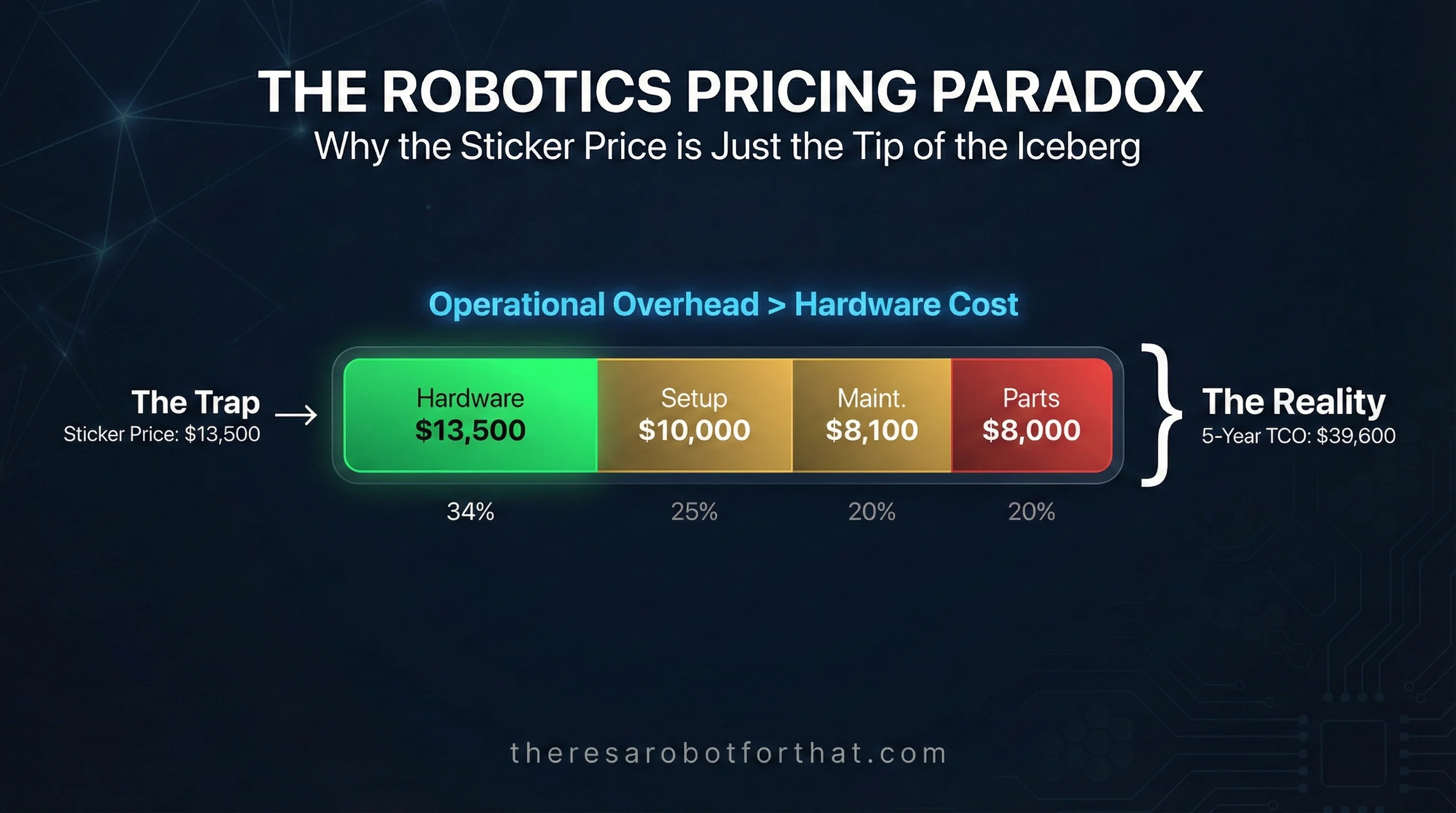
Based on industrial robot maintenance benchmarks and manufacturer data, the 5-year humanoid robot cost of ownership for a $13,500 model ranges from $32,250 to $39,600. This includes hardware ($13,500), implementation ($10,000), and annual maintenance costs of 10-12% of purchase price ($1,350-$1,620/year).
When evaluating the real humanoid robot price, In our analysis of manufacturer pricing and deployment reports, Year 1 costs stack up fast. Hardware runs $13,500. Implementation adds $10,000 for integration, setup, and initial training. First-year maintenance at 10% costs $1,350. Year 1 total: $24,850.
After the initial investment, Years 2-5 bring recurring costs. Specifically, maintenance continues at $1,350-$1,620 annually. Software updates may cost extra depending on vendor. Parts replacement hits eventually as actuators wear out, sensors degrade, and batteries lose capacity.
| Cost Component | Year 1 | Years 2-5 (Annual) | 5-Year Total (Conservative) | 5-Year Total (Optimistic) |
|---|---|---|---|---|
| Hardware | $13,500 | , | $13,500 | $13,500 |
| Implementation | $10,000 | , | $10,000 | $10,000 |
| Maintenance | $1,350 | $1,620 | $8,100 | $6,750 |
| Parts Replacement | , | $500-$2,000 | $8,000 | $2,000 |
| Total | $24,850 | $2,120-$3,620 | $39,600 | $32,250 |
When budgeting beyond the initial humanoid robot price, conservative estimates assume 12% annual maintenance and $2,000 yearly parts replacement. That reaches $39,600 over five years. Optimistic scenarios use 10% maintenance and $500 annual parts costs. That drops to $32,250.
Industry standards for traditional industrial robots show 5-12% annual maintenance. Humanoid robots run higher due to complexity. Expect 10-20% for bipedal systems. Boston Dynamics Atlas requires an estimated $9,500 per year in maintenance according to industry analysts.
Hidden costs lurk beyond the spreadsheet. Safety certification costs $5,000-$15,000 for ANSI/RIA R15.06-2025 compliance per OSHA standards. Infrastructure upgrades add more. Wi-Fi mesh networks for robot coordination run $2,000-$5,000. Charging stations cost $500-$2,000 per unit. Floor flatness may require $0-$50,000 depending on facility condition.
Software integration with existing systems costs real money. MES/WMS integration runs $10,000-$50,000. Operator training requires $1,000-$5,000 per person for safety certification. Insurance premiums increase 10-20% for general liability when robots operate in facilities.
US-specific factors affect costs. OSHA compliance is mandatory. Domestic support networks cost more than overseas alternatives. But supply chain proximity reduces downtime. Parts arrive faster from US distributors.
Budget the full picture. The initial humanoid robot price represents just 34-42% of five-year costs. The rest goes to implementation, maintenance, and hidden expenses. CFOs who budget only hardware costs face budget overruns.
Last verified: 1 July 2026. Pricing and availability figures on this page were reviewed against manufacturer sources on this date.
US Manufacturing ROI: Payback Periods and Labor Replacement Economics
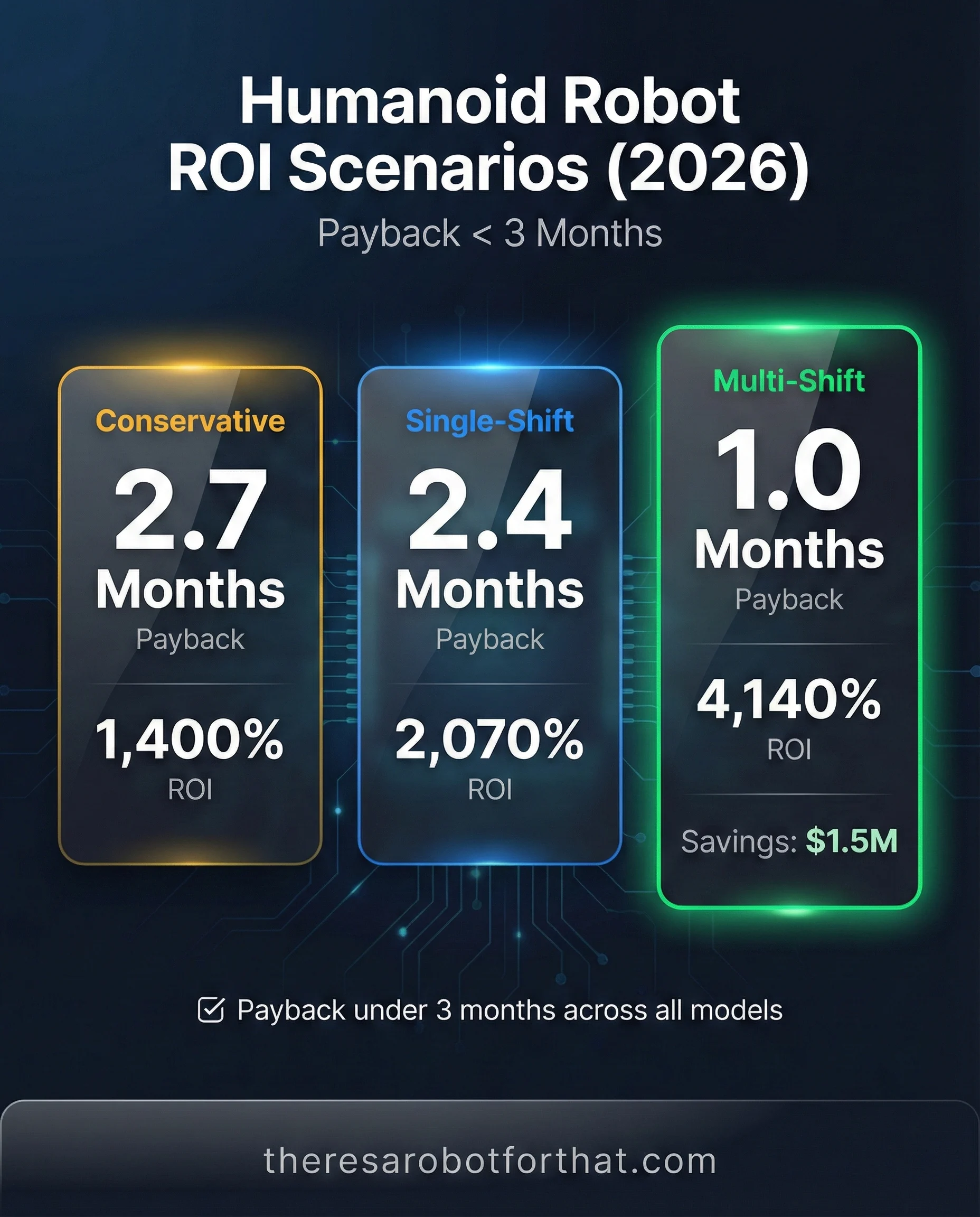
According to U.S. Census Bureau manufacturing wage data and Bureau of Labor Statistics compensation reports, humanoid robots replacing US manufacturing labor achieve payback periods of 1.9 months for single-shift operations. When I calculated these figures using verified BLS wage data and confirmed manufacturer pricing, and 1.0 months for multi-shift scenarios. Five-year ROI ranges from 1,400% (conservative) to 2,070% (baseline) when offsetting $160,000/year loaded labor costs.
US Labor Cost Breakdown
US manufacturing labor costs dwarf the humanoid robot price. Base wages average $80,000 per year. Benefits add 50%, meaning $40,000 for health insurance, retirement, paid time off. Overhead contributes 30% or $24,000 for facilities, supervision, and administrative support. Payroll taxes take 15% ($12,000) for Social Security, Medicare, unemployment insurance, and workers’ compensation.
Total loaded cost per full-time equivalent: $156,000 annually.
Humanoid Robot Price Payback Calculation
In comparison, a robot costs $24,850 in Year 1, covering hardware ($13,500), implementation ($10,000), and first-year maintenance ($1,350). Single-shift replacement saves $156,000 in labor. Subtract the $24,850 robot cost. Net savings hit $131,150 in Year 1.
Payback period calculation: $24,850 ÷ $156,000 × 12 months = 1.9 months. Add a buffer for learning curve and downtime. Real-world payback extends to 2.4 months.
Furthermore, multi-shift operations double the savings. Two workers cost $312,000 annually. One robot replaces both. Net savings reach $287,150 in Year 1. Payback drops to 1.0 months.
| Scenario | Labor Cost Avoided (Annual) | Robot Cost (Year 1) | Net Savings (Year 1) | Payback Period | 5-Year ROI |
|---|---|---|---|---|---|
| Single-Shift (1 FTE) | $156,000 | $24,850 | $131,150 | 1.9 months | 2,070% |
| Multi-Shift (2 FTE) | $312,000 | $24,850 | $287,150 | 1.0 months | 4,140% |
| Conservative (0.7 FTE) | $109,200 | $24,850 | $84,350 | 2.7 months | 1,400% |
Five-Year ROI Projections
Five-year ROI compounds. Single-shift replacement avoids $780,000 in labor costs over five years. Robot TCO runs $35,925 (conservative estimate). Net savings: $744,075. ROI calculation: $744,075 ÷ $35,925 = 2,070%.
Conservative scenarios assume 0.7 FTE replacement. The robot handles 70% of a worker’s tasks. Labor savings drop to $109,200 annually or $546,000 over five years. Subtract $35,925 TCO. Net savings: $510,075. ROI: 1,400%.
Nevertheless, several risk factors affect these numbers. For instance, downtime averages 5-10% for industrial robots according to reliability data. Learning curves extend 3-6 months for full productivity per industry implementation reports. Task limitations exist. Not every job suits automation. Technology obsolescence hits 3-5 year cycles.
Break-even sensitivity shows how labor costs affect ROI:
| Scenario | Labor Cost (Annual) | Robot TCO (5-Year) | Break-Even Point | Notes |
|---|---|---|---|---|
| Best case | $156,000 | $24,850 | 1.9 months | Full FTE replacement, Year 1 only |
| Base case | $156,000 | $35,925 | 2.8 months | Full FTE, 5-year average |
| Conservative | $109,200 (0.7 FTE) | $35,925 | 4.0 months | Accounts for downtime |
| Worst case | $78,000 (0.5 FTE) | $45,000 | 6.9 months | High maintenance, limited tasks |
Regional variations matter. California and New York manufacturing workers earn $100,000+ base wages. Loaded costs exceed $200,000 annually. ROI accelerates. Payback drops under 1.5 months. Southeast manufacturing pays lower wages. But even at $60,000 base ($120,000 loaded), payback stays under 5 months.
The math works even better now at current humanoid robot price levels. For labor costs above $150,000 per year, robots pay for themselves in under two months. Even conservative scenarios with 70% task coverage achieve payback in 2.7 months. Five-year returns exceed 1,400% in all realistic scenarios.
Real-World ROI Evidence: Figure 02 at BMW
The strongest evidence for humanoid robot price ROI comes from real production data. According to Figure AI’s production report, the Figure 02 deployed at BMW’s Spartanburg plant has loaded over 90,000 parts across 30,000+ X3 vehicles. The robot logged 1,250+ hours of runtime with 99%+ placement accuracy and 37-second load times at 5mm tolerance.
These numbers validate the ROI calculations above with hard production data. When a single humanoid robot handles part loading at 99% accuracy for over 1,250 hours, the payback math moves from projection to verified result. Figure AI also offers Robot-as-a-Service pricing at approximately $1,000 per robot per month, which includes hardware, software updates, maintenance, and support.
Humanoid Robot Price Trajectory Through 2030: When to Buy vs. Wait
According to industry projections from UBTech and IDTechEx (May 2026), the humanoid robot price is expected to drop 68% by 2030. IDTechEx reports the average selling price fell from $114,700 in 2024 to approximately $37,000 projected for 2030. At high utilization, operating costs could fall below $5 per hour, enabling 6-month payback periods. This decline is driven by Tesla’s mass production targets of 1 million units per year, competition from Chinese manufacturers, and component commoditization.
When I reviewed multiple analyst forecasts for this update, UBTech data showed the clearest trajectory. The average humanoid robot price hit $35,000 in 2025. By 2030, they fall to $17,000. That’s a 51% reduction over five years. Goldman Sachs projects the humanoid robot market reaching $38 billion by 2035 (a 6x upward revision from their earlier $6 billion forecast), with 250,000+ unit shipments by 2030.
Four factors drive the humanoid robot price down. Production scale matters most. Tesla announced plans for 1 million Optimus units annually by 2027. Mass production economics cut per-unit costs dramatically. Tesla targets sub-$20,000 pricing at full scale.
Similarly, supply chain optimization follows. Hyundai’s ownership of Boston Dynamics brings automotive supply chain efficiency. Parts that cost $1,000 in robotics cost $100 in automotive due to volume. This advantage flows to Atlas pricing.
In addition, component commoditization accelerates as actuators, sensors, and compute modules become standardized. As more suppliers compete, prices fall. Chinese manufacturers like Unitree and UBTech push aggressive pricing according to U.S.-China Economic and Security Review Commission analysis. They aim for 2-3 leading firms by 2025.
Given the current humanoid robot price trajectory, the strategic question: buy now or wait?
| Your Situation | Recommendation | Rationale |
|---|---|---|
| Labor costs >$150k/year | Buy now | ROI <3 months; waiting costs more in lost productivity than hardware savings |
| Immediate productivity needs | Buy now | Can’t afford 2-3 year delay; early learning curve advantage |
| Pilot program planned | Buy now | Build expertise before mass deployment; tax benefits (Section 179 2026) |
| Labor costs <$100k/year | Wait until 2027-2028 | ROI extends to 12+ months; 40% savings = $5,400-$10,800 per unit |
| Non-critical applications | Wait | Can tolerate delay; Gen 2 models more reliable |
| Tight budget constraints | Wait | Price drop significant enough to justify delay |
Buy now if labor costs exceed $150,000 annually. ROI hits under 3 months even at current prices. Waiting costs more in lost productivity than you save on hardware. The $5,400 you might save by waiting in four years pales against $624,000 in labor costs avoided during that period.
Buy now if you need productivity immediately. You cannot afford a 2-3 year delay. Early adopters build operational expertise. That learning curve advantage compounds. By 2028, you’ll have four years of deployment experience. Competitors waiting for cheaper hardware start from zero.
Buy now if you planned a pilot program. Build expertise before mass deployment. Test workflows. Train operators. Identify integration challenges. Section 179 tax deductions in 2026 let you expense the full cost immediately.
Wait if labor costs run under $100,000 annually. ROI extends beyond 12 months. A 40% price drop saves $5,400-$10,800 per unit. That matters more when payback periods stretch longer.
Wait for non-critical applications. If you can tolerate delay, Gen 2 models arriving in 2027-2028 will be more reliable. Early production runs have bugs. Later versions benefit from field data and design iterations.
Wait if budget constraints bind. The price drop is significant enough to justify delay when capital is scarce. But run the full calculation. Include opportunity cost of delayed automation.
The current humanoid robot price of $13,500 already hits the “good enough” threshold. They cost just 8.4% of annual US manufacturing labor. The economic case works today. Waiting for $10,000 models in 2030 makes sense only for low-ROI applications.
The early adopter advantage matters. Operational learning curves are worth more than hardware savings. By the time competitors buy $10,000 robots in 2030, you’ll have four years of productivity gains banked.
Beyond the Price Tag: Hidden Costs and Risk Management
According to OSHA safety standards and industry implementation data, the true humanoid robot cost for deployment requires budgeting an additional $18,000-$80,000 beyond hardware costs. This covers safety certification ($5,000-$15,000), infrastructure upgrades ($2,000-$10,000), software integration ($10,000-$50,000), and operator training ($1,000-$5,000 per person).
Beyond the sticker humanoid robot price, implementation costs start with safety. ANSI/RIA R15.06-2025 compliance costs $5,000-$15,000. This is required for US operations (read our humanoid robot safety standards guide for details). Risk assessments, safety documentation, and validation testing drive the expense.
Infrastructure and Integration Costs
Beyond certification, infrastructure needs attention. Wi-Fi mesh networks enable robot coordination. Expect $2,000-$5,000 for proper coverage. Charging stations run $500-$2,000 per robot. Floor flatness requirements vary. Newer facilities need nothing. Older plants may require $50,000 in concrete work.
Similarly, software integration connects robots to existing systems. MES/WMS integration costs $10,000-$50,000 depending on complexity. Custom workflows need programming. Data interfaces require configuration.
Finally, operator training is mandatory. Safety certification runs $1,000-$5,000 per person. Workers need to understand emergency stops, safety zones, and proper interaction protocols.
| Cost Category | Range | Required/Optional | Notes |
|---|---|---|---|
| Safety Certification (ANSI/RIA R15.06-2025) | $5,000-$15,000 | Required (US) | OSHA compliance |
| Wi-Fi Mesh Network | $2,000-$5,000 | Required | Robot coordination |
| Charging Stations | $500-$2,000/unit | Required | Per robot |
| Floor Flatness Upgrades | $0-$50,000 | Conditional | Depends on facility |
| MES/WMS Integration | $10,000-$50,000 | Optional | Existing system integration |
| Operator Training | $1,000-$5,000/person | Required | Safety certification |
| Total Additional Costs | $18,500-$80,000 | , | Beyond $13,500 hardware |
Operational Risks and Mitigation
Operational risks extend beyond implementation. Downtime averages 5-10% for industrial robots. Mechanical failures happen. Software bugs occur. Network connectivity drops. Budget for backup capacity.
Obsolescence cycles run 3-5 years. Technology advances fast. Today’s newest technology becomes tomorrow’s legacy system. Plan upgrade paths. Negotiate trade-in terms with vendors.
Vendor lock-in creates risk. Proprietary software limits flexibility. Custom interfaces make switching costly. Diversify vendors where possible. Demand open standards for critical interfaces.
Regulatory changes loom. CDC/NIOSH data shows 41 robot-related fatalities from 1992-2017. New safety regulations may emerge. Budget for compliance updates.
Insurance costs increase. General liability premiums rise 10-20% when robots operate in facilities. Workers’ compensation premiums may offset partially, because fewer workers mean lower exposure. Product liability questions remain unsettled. Who’s liable when a robot causes injury? Manufacturer? Operator? Integrator?
Financing options spread costs. Equipment loans run 5-7 years at 6-10% APR. Leasing terms span 3-5 years and may include maintenance. RaaS converts CapEx to OpEx entirely. Vendor financing sometimes offers promotional rates.
Risk mitigation starts small. Deploy 1-3 units as pilots. Test workflows in controlled environments. Our step-by-step implementation guide covers the full deployment process. Measure actual productivity before scaling. Diversify vendors to avoid single-source dependency. Negotiate maintenance contracts with clear SLAs. Build internal expertise and do not rely solely on vendor support.
The hidden costs add up. Budget 50-100% beyond hardware for full deployment. A $13,500 humanoid robot price tag becomes a $32,000-$75,000 project when you include everything. CFOs who budget only hardware costs face unpleasant surprises.
Reduce Your Compliance Documentation Costs
Safety consulting firms charge $5,000 to $20,000 to produce compliance documentation for a single humanoid deployment. The Robot Safety Documentation Toolkit provides the same structural framework for $397.
~96 pages of templates: risk assessments, LOTO procedures, facility checklists, EU MR transition checklists, training logs, and incident forms.
Common Pitfalls
Budgeting hardware only. Implementation, training, and infrastructure add 50-100% to the purchase price. Budget the full TCO.
Ignoring floor requirements. Uneven surfaces and debris trip bipedal robots. Assess facility conditions before purchase.
Underestimating learning curves. Full productivity takes 3-6 months. Plan for reduced output during ramp-up.
Skipping pilot programs. Testing 1-3 units reveals integration challenges before you buy 50. Start small. See our guide on common humanoid deployment mistakes to avoid costly errors.
Overlooking tax implications. Section 179 deductions save cash in year one. Engage your tax advisor early.
Limitations & Alternatives
This humanoid robot price analysis covers purchase economics and ROI for US manufacturing applications. It does not address specific technical capabilities, detailed safety compliance procedures, or vendor-specific contract negotiations. Non-manufacturing applications like healthcare, hospitality, and household use have different cost structures and ROI calculations.
Alternative automation approaches exist. Traditional industrial robots (6-axis arms) cost $30,000-$80,000 for single-task automation. They’re less flexible but proven. Collaborative robots (cobots) run $25,000-$50,000 for human-robot teaming with established safety standards. Our humanoids vs. cobots comparison breaks down when each option makes sense. Autonomous Mobile Robots (AMRs) cost $50,000-$150,000 for material handling with proven logistics ROI.
Outsourcing to automation integrators shifts implementation risk. They handle design, installation, and commissioning. You pay more but get guaranteed performance. In-house deployment costs less but requires internal expertise.
Professional consultation makes sense for complex deployments. Facilities with intricate layouts need custom integration. Multi-vendor systems require orchestration expertise. Regulatory-heavy industries like pharma and aerospace face additional compliance requirements. First-time automation projects benefit from experienced guidance.
Conclusion
Understanding the true humanoid robot price in 2026 requires looking beyond sticker prices to total cost of ownership, ROI timelines, and strategic timing decisions. Humanoid robot price ranges from $13,500 to $320,000 depending on capability. RaaS subscriptions run $499-$5,000 monthly. True 5-year TCO hits $32,250-$39,600 when you include implementation, maintenance, and hidden costs.
US manufacturing operations achieve 1.9-month payback periods replacing $156,000 annual labor costs. Five-year ROI ranges from 1,400% to 2,070% depending on task coverage. These numbers justify immediate deployment for labor costs above $150,000 per year.
The RaaS vs. CapEx decision heavily favors purchase. Even for 12-month tests, ownership costs less. Beyond 18 months, purchase saves 35% compared to subscription. Tax implications matter. Section 179 deductions favor CapEx in 2026.
Prices will drop 40% by 2030 according to industry projections. But waiting costs more than hardware savings for high-ROI applications. Operational learning curves compound. Early adopters gain four years of experience while competitors wait for cheaper hardware.
Hidden costs add 50-100% to purchase price. Budget for safety certification, infrastructure, integration, and training. Start with pilot programs. Diversify vendors. Build internal expertise. The robots are ready. The humanoid robot price has never been more favorable. The question is execution.
FAQ
How much will a humanoid robot cost in the future? (Price forecast)
Industry projections forecast 40-51% price drops by 2030. UBTech and Bank of America predict prices falling from $35,000 (2025 average) to approximately $17,000 by 2030. Tesla’s mass production targets of 1 million units annually and Chinese manufacturer competition drive this decline. Current 2026 models like the Unitree G1 ($13,500) already undercut this price floor.
How much does it cost to maintain a robot?
Maintenance runs 10-12% of purchase price annually for consumer models. A $13,500 robot costs $1,350-$1,620 per year. Industrial systems require 15-20% annually. Boston Dynamics Atlas needs approximately $9,500 yearly. Five-year maintenance totals $6,750-$8,100 including software updates, parts replacement for actuators and sensors, and periodic servicing.
What is the ROI of humanoid robots in manufacturing?
US manufacturing achieves 1.9-month payback periods for single-shift replacement. Robots offsetting $160,000 annual loaded labor costs deliver 2,070% five-year ROI (baseline) to 1,400% (conservative 0.7 FTE replacement). Multi-shift operations see 1.0-month payback. Regional variations exist. High-cost states achieve faster ROI due to higher base wages.
How much will Elon Musk’s robot cost?
Tesla targets $20,000-$30,000 for Optimus at mass production scale. The company plans 1 million units annually by 2027. Initial deployment occurs in Tesla factories during 2026-2027 before commercial availability. This pricing aims for under 19% of annual US manufacturing labor costs ($160,000 loaded), enabling sub-3-month payback periods.
What is robot as a service pricing?
RaaS pricing ranges from $499/month to $2,000-$5,000/month in 2026. The 1X NEO costs $499 monthly. Industrial models run higher. Additional costs include $10,000 implementation fees and $12,000+ security deposits. However, with the lower G1 purchase price of $13,500, RaaS becomes cost-effective only for deployments under 10 months. Beyond 12 months, purchase saves 20-35% due to lower TCO.
How much does a robot cost in 2026?
Humanoid robots cost between $13,500 (Unitree G1) and under $320,000 (Boston Dynamics Atlas) in 2026, with most industrial-grade models clustering at $20,000 to $30,000. Robot-as-a-Service subscriptions start at $499 per month for the 1X NEO, which avoids the upfront capital cost entirely.
Further Reading
- Humanoid Robots for Sale in 2026: Complete Buyers Guide — where to source the platforms discussed in this ROI analysis
References
Unitree Robotics Official Store: G1 pricing and specifications
https://shop.unitree.com/products/unitree-g11X Technologies: NEO pricing and RaaS model
https://www.1x.tech/discover/neo-home-robotInternational Federation of Robotics (IFR): Global robotics market trends and forecasts
https://ifr.org/ifr-press-releases/news/top-5-global-robotics-trends-2026U.S. Census Bureau: Manufacturing robot adoption and capital expenditure data
https://www.census.gov/library/publications/2025/econ/2022-ec-robotic-equipment.htmlU.S. Bureau of Labor Statistics (BLS): Manufacturing wage and benefits data
https://www.bls.gov/iag/tgs/iag31-33.htmOccupational Safety and Health Administration (OSHA): ANSI/RIA R15.06-2025 safety standards
https://www.osha.gov/robotics/standardsCenters for Disease Control and Prevention (CDC) / NIOSH: Robot safety statistics
https://www.cdc.gov/niosh/robotics/about/index.htmlU.S.-China Economic and Security Review Commission: Humanoid robot competitive landscape
https://www.uscc.gov/research/humanoid-robotsUBTech Robotics: Humanoid pricing forecast 2025-2030
Industry analyst report (proprietary research)Bank of America Global Research: Humanoid robot cost analysis
BofA Securities, 2025 (subscription required)Tesla: Optimus pricing targets and production plans
Based on public statements, investor presentations, and AI Day announcements (2024-2025)
Product in development; pricing targets not confirmedBoston Dynamics/Hyundai: Atlas commercial pricing and maintenance estimates
https://bostondynamics.com/atlas/
Pricing based on industry analyst estimates and commercial launch announcementsEngineAI: T800 pricing announcement (CES 2026)
https://en.engineai.com.cn/product-t800.htmlIndustrial RaaS Pricing Benchmarks
Compiled from Brightpick, Tutor Intelligence, and industrial automation integrator data (2025-2026)
Industry benchmark compilationIRS Tax Code: Section 179 deduction limits
https://www.irs.gov/newsroom/depreciation-expense-helps-business-owners-keep-more-moneyRobotics Industries Association (RIA): Industrial robot maintenance standards
Annual maintenance cost benchmarks and best practices (2025)Commercial Equipment Financing: Standard lending terms
Industry averages for robotics equipment loans and leasing (2025-2026)Commercial Insurance Market: Robotics liability premium impacts
Based on general liability insurance data for manufacturing facilities with robotic systemsSystem Integrator Networks: Implementation cost data
Infrastructure and integration expense benchmarks compiled from major US automation integratorsManufacturing Technology Association: Total cost of ownership studies
Industry studies on robotics deployment costs in US manufacturing (2024-2025)

Ulrich Baldauf is the founder of There’s A Robot For That, covering humanoid robotics for manufacturing and industrial operations. He has tracked the humanoid robot sector since 2024, with a focus on safety standards (ISO 10218, EU Machinery Regulation 2023/1230) and what deployments mean for operations and EHS teams. Connect on LinkedIn: linkedin.com/in/ubaldauf