
Bessemer maps 50 startups building Physical AI economy
PLUS: Autonomous tomato robot works 22 hours daily, Serve deploys 2,000 delivery bots, and STMicro joins NVIDIA's robotics platform
Welcome back to your Robot Briefing
Bessemer Venture Partners just mapped out 50 startups turning AI and robotics into real-world businesses — spanning defense contractors, hospital operators, farms, and factory floors. They're calling it one of the most significant technological shifts of this generation, with over 2.5 billion robots projected worldwide by 2035.
The question isn't whether physical AI is coming — it's already here. What's unclear is which sectors will see the biggest disruption first, and whether these 50 companies represent the winners or just the early movers in a market that's still defining itself.
In today's Robot update:
VCs Map the 50 Companies Building the Physical AI Economy
Snapshot: Bessemer Venture Partners published a market map highlighting 50 startups deploying AI-powered robotics across defense, manufacturing, healthcare, and agriculture — calling the convergence of AI, robotics, and hardware one of the most significant technological shifts of this generation. The research projects over 2.5 billion robots worldwide by 2035, with the true opportunity extending beyond simple automation to entirely new markets.
Breakdown:
Takeaway: When a major VC firm maps an emerging category and draws comparisons to generational technology shifts, it signals capital deployment and M&A activity will accelerate. The full-stack integration requirement means businesses evaluating robotics partners should look beyond point solutions — vendors that control the entire stack from sensors to software will likely deliver more reliable performance and faster iteration.
German Startup Exits Stealth With €8M for Autonomous Greenhouse Harvesting
Snapshot: Cologne-based Eternal.ag launched commercially with €8 million in funding for autonomous tomato-harvesting robots that operate up to 22 hours daily, addressing Europe's 30% decline in greenhouse labor since 2010. The startup's first product, Harvester, is designed as a modular platform that will expand to additional greenhouse functions over time.
Breakdown:
Takeaway: The simulation-to-deployment approach signals robotics companies are solving the iteration problem that made earlier generations too slow and expensive to scale. Agriculture represents a proving ground for autonomous systems — controlled environments, repetitive tasks, and clear labor economics — making it a reliable indicator for when similar systems will reach factories and warehouses.
Delivery Robot Maker Serve Eyes $450B Opportunity With 2,000 Robots Deployed
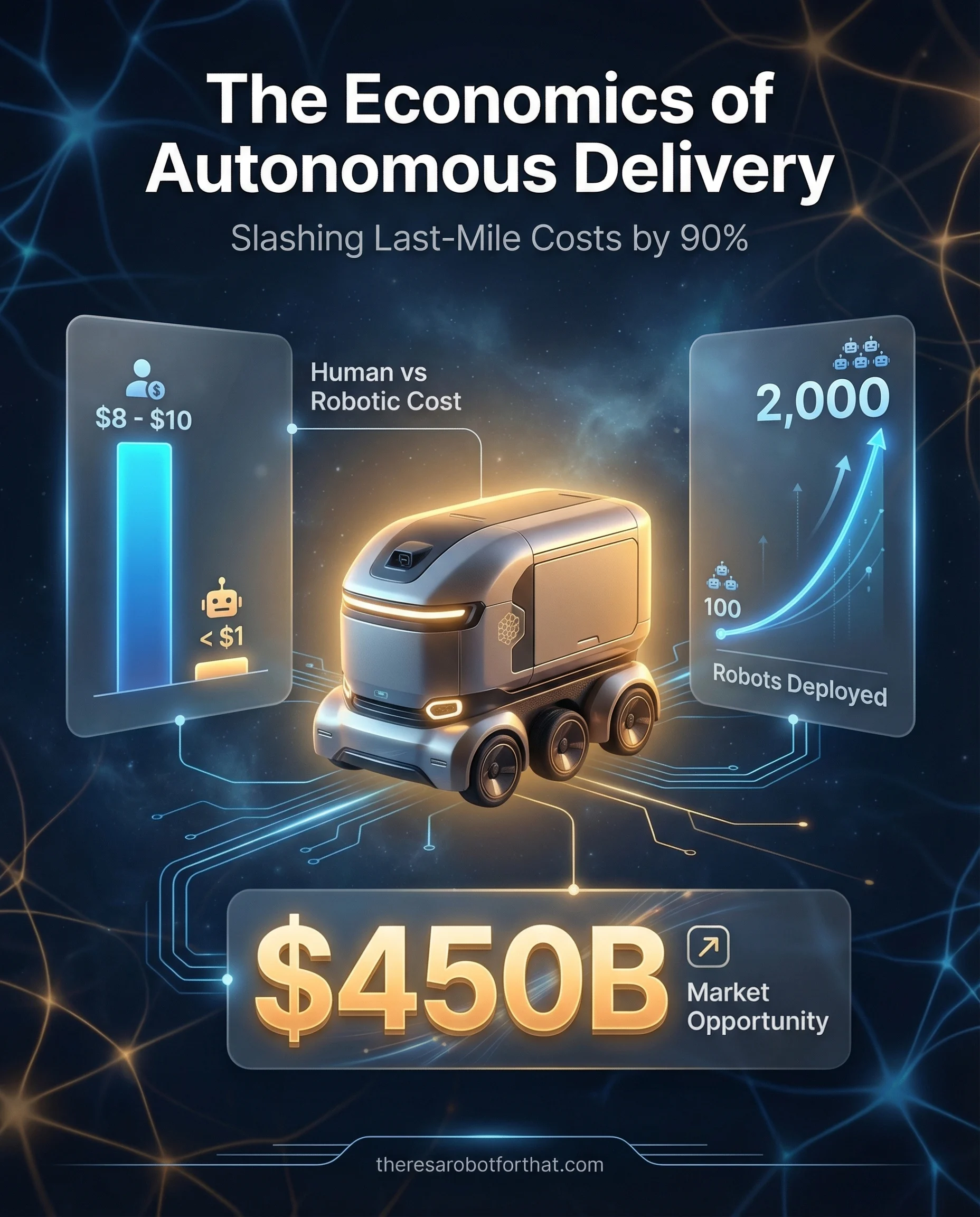
Image Source: There's A Robot For That
Snapshot: Serve Robotics scaled from 100 to 2,000 autonomous delivery robots in 12 months, targeting delivery costs under $1 compared to $8-$10 for human-driven deliveries as it expands through Uber Eats and DoorDash networks. The company plans international launches in Japan, Spain, Taiwan, and the UK in 2027.
Breakdown:
Takeaway: A 20x fleet expansion in one year through established distribution partners like Uber and DoorDash demonstrates the commercial infrastructure for sidewalk robots already exists. The unit economics — roughly 90% cost reduction versus human delivery — create compelling ROI that will push rapid adoption once regulatory frameworks stabilize across major metros.
STMicroelectronics Integrates Sensor Portfolio Into NVIDIA Robotics Platform
Snapshot: STMicroelectronics announced integration of its sensors and actuators into NVIDIA's Holoscan Sensor Bridge and Isaac Sim ecosystem, streamlining hardware connections for humanoid and industrial robots. The collaboration aims to accelerate development by simplifying data acquisition from multiple sensors and reducing the gap between virtual simulation and real-world deployment.
Breakdown:
Takeaway: Major chip suppliers integrating directly with NVIDIA's robotics platform reduces a critical bottleneck — the complexity of connecting sensors to compute platforms. This infrastructure play makes robot development more accessible to companies without deep hardware expertise, potentially accelerating the timeline for commercially viable humanoids from research projects to production deployments.
Other Top Robot Stories
Krafton signed a deal with a Korean aerospace firm involving up to $1 billion in investment to expand the "physical AI ecosystem," marking the PUBG developer's pivot into defense technologies and military applications.
SuperSeed launched its £50 million Fund III with British Business Bank backing to invest in seed-stage B2B physical AI startups focused on manufacturing, energy, construction, and autonomous systems, building on a portfolio of 38 companies across its previous two funds.
Synopsys launched its Electronics Digital Twin Platform enabling automotive OEMs to achieve up to 90% of software validation before hardware availability, with Volvo Cars pioneering the virtualized ECU approach to reduce development costs and accelerate time-to-market.
Overland secured placement in the U.S. Army's G-TEAD Marketplace as a pre-vetted vendor eligible for direct acquisition by Army organizations, U.S. Government agencies, and allied partner nations following its success in the Army's xTech competitions.
🤖 Your robotics thought for today:
Serve went from 100 to 2,000 robots in 12 months using Uber's existing network. Eternal.ag's tomato bot works 22-hour shifts because Europe lost 30% of its greenhouse workers. The infrastructure and the labor gap are both already here. The only question is whether you're planning for a world where $1 deliveries and lights-out farms are normal, or still treating robotics like a science project.
I'm watching which verticals hit profitable unit economics first.
Enjoy your weekend,
Uli


