
Apptronik's NASA-backed robot joins Mercedes factory workforce
PLUS: Nvidia declares physical AI era, da Vinci 5 cuts recovery to hours, Ericsson hires humanoids
Welcome back to your Robot Briefing
A humanoid robot born from NASA research is now handling logistics at Mercedes-Benz factories, while the space agency eyes it for maintaining lunar outposts between human missions. Apptronik's Apollo just raised over $400 million and represents a decade of government-funded development now paying off on commercial factory floors.
When a robot can justify both a Mercedes production line and a Mars habitat, does that prove the business case is finally solid enough for wider deployment? The fact that the same hardware solves labor problems in Stuttgart and potential crew gaps on the Moon suggests the technology has crossed a threshold.
In today's Robot update:
NASA-backed Apollo robot preps for space via factory work
Snapshot: Apptronik's Apollo humanoid robot is working logistics shifts at Mercedes-Benz factories today while preparing for its ultimate mission—maintaining lunar and Mars outposts when humans aren't present. The 5'8", 160-pound robot represents over a decade of NASA-backed development, translating space agency research into commercial hardware that can handle the dull, dirty, and dangerous work in both automotive plants and extraterrestrial environments.
Breakdown:
Takeaway: This trajectory—NASA research to Mercedes factory floor to $400M in funding—signals that humanoid robotics is crossing from experimental to commercially viable faster than most predicted. Operations leaders should recognize that the same economics driving factory adoption (handling repetitive tasks humans avoid) will soon extend to warehouses and logistics centers where labor shortages persist.
Nvidia & Universal Robots signal 'ChatGPT moment' for Physical AI
Snapshot: Nvidia CEO Jensen Huang and a new Universal Robots industry survey both declare that AI is finally moving from screens to the physical world, with robots that can predict, reason, and act in real-time now entering factories and warehouses.
Breakdown:
Takeaway: The convergence of industry surveys, major manufacturer deployments, and hundred-million-dollar funding rounds signals this is no longer speculative R&D. Companies that dismissed autonomous systems as "always three years away" now face competitors integrating physical AI into operations today, creating a narrow window to evaluate whether pilot programs make sense before the capability gap widens.
AI-powered surgeons discharge patients in hours, not days
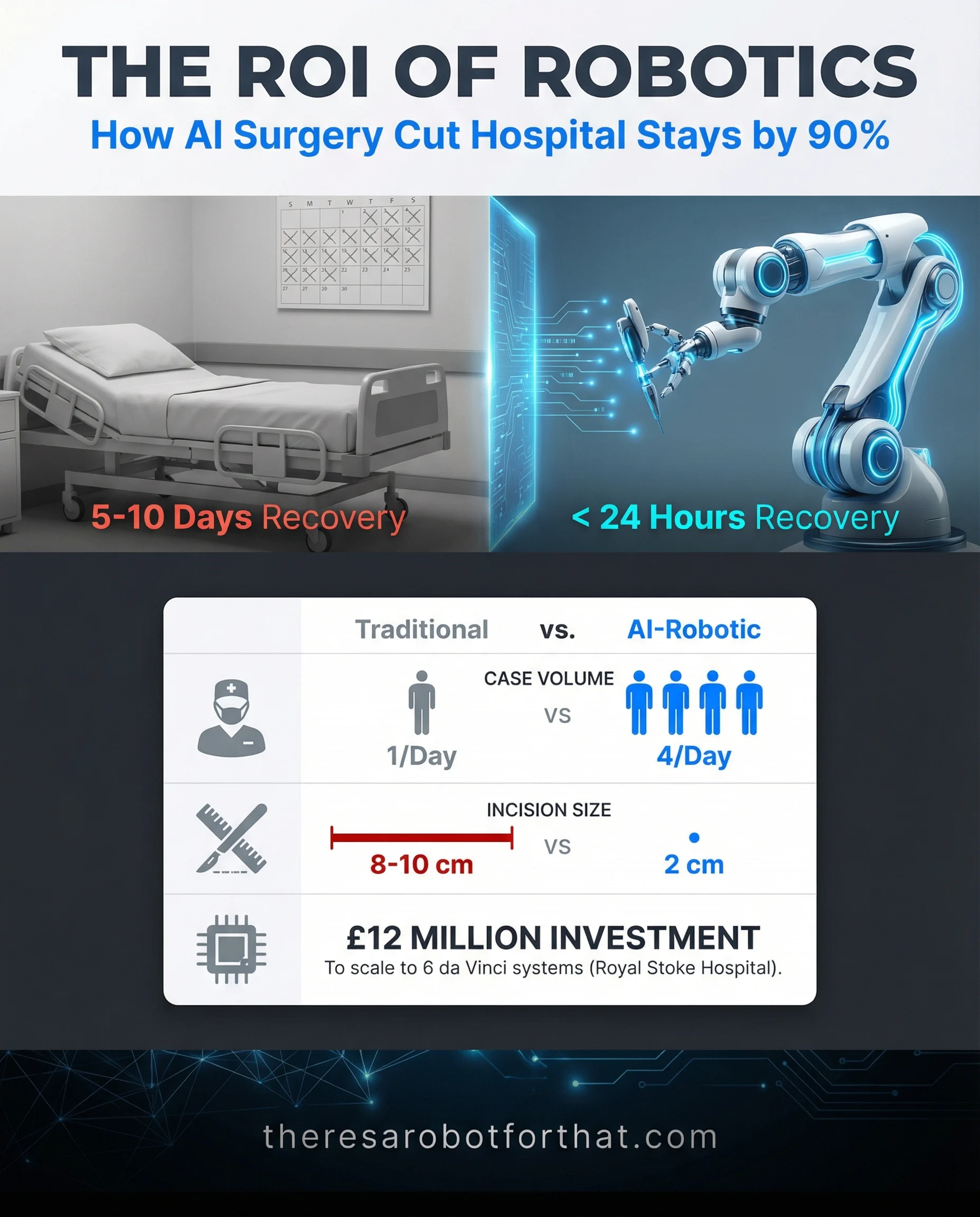
Image Source: There's A Robot For That
Snapshot: UK hospitals deploying the da Vinci 5 surgical robot are sending complex cancer surgery patients home in under 24 hours - down from 5-10 day stays - delivering the kind of measurable operational improvements that prove robotics ROI is real, not theoretical.
Breakdown:
Takeaway: Healthcare is providing the clearest proof yet that advanced robotics deliver immediate, measurable operational gains - the 23-hour discharge metric demolishes the "wait and see" argument. Executives in logistics, manufacturing, and other labor-intensive sectors should treat surgical robotics' documented productivity jumps as a preview of what's coming to their industries as the technology matures.
Ericsson hires humanoids for workforce engagement
Snapshot: Telecom giant Ericsson is deploying Realbotix humanoid robots at its Texas experience center to handle visitor engagement and employee training, marking a shift from factory floors to customer-facing roles that require emotional intelligence.
Breakdown:
Takeaway: Ericsson's deployment signals that humanoid robots are ready for roles requiring interpersonal skills, not just repetitive tasks. The focus on emotion detection and face recognition suggests companies see value in robots that can build relationships with visitors and employees, expanding the use case beyond warehouse automation.
Other Top Robot Stories
XPENG announced plans to enter mass production of IRON humanoid robots this year, marking one of the first major automotive manufacturers to move from prototype to volume manufacturing of general-purpose humanoids alongside their vehicle production lines.
Figure's Helix demonstrated using hip articulation to close drawers and kick up dishwasher doors, showing how humanoid robots are gaining the dynamic movement capabilities needed for household and commercial tasks that require whole-body coordination rather than just arm manipulation.
XPENG's IRON humanoid encountered operational issues during a public shopping mall demonstration, providing a real-world data point on deployment readiness that operations leaders should factor into timeline expectations for customer-facing humanoid applications.
🤖 Your robotics thought for today:
Apollo raised $400M from Google and Mercedes to work factory floors today while NASA plans to use the same robot for Mars infrastructure tomorrow—so if one humanoid design already works in both environments, why are earthbound companies still waiting for "space-grade" reliability before they'll pilot automation?
What am I missing?
Until tomorrow,
Uli


