
Applied Intuition moves AI into mines and farms
PLUS: Eclipse raises $1.3B for physical AI, NVIDIA opens Omniverse core, and Kia deploying Atlas humanoids by 2029
Welcome back to your Robot Briefing
Applied Intuition brought Marc Andreessen and the physical AI crowd together to show off autonomous systems running in mines, on farms, and across logistics networks. The message: AI is moving from screens to steering wheels, tractors, and excavators.
The question now is whether these systems can handle the chaos of dirt roads, underground tunnels, and unpredictable field conditions—or if the jump from chatbots to heavy machinery is harder than Silicon Valley thinks.
In today's Robot update:
Silicon Valley takes physical AI from chat to mines, farms, and factory floors
Snapshot: Applied Intuition hosted Physical AI Day with Marc Andreessen, showcasing autonomous systems for mining, agriculture, and logistics—pushing AI beyond virtual applications into physical-world machinery that must operate in high-uncertainty environments like freeways, fields, and underground sites.
Breakdown:
Takeaway: The shift from virtual to physical AI represents a clear timing signal: companies are actively deploying in operational environments now, not in pilot labs. Operations leaders in industries with mobile equipment or field operations should assess whether their competitors are already testing autonomous systems in similar applications.
Eclipse closes $1.3B war chest to build physical AI startup ecosystem
Snapshot: Palo Alto VC Eclipse raised $1.3 billion across early-stage and growth funds to back physical AI companies, with a strategy focused on building interconnected portfolio companies across transportation, energy, infrastructure, and defense that can partner for scale.
Breakdown:
Takeaway: When top-tier VCs deploy billion-dollar funds with explicit ecosystem-building strategies, it signals confidence in near-term commercial deployment timelines. The focus on cross-portfolio partnerships suggests that successful physical AI adoption will require coordination across multiple vendors rather than single-supplier solutions.
NVIDIA opens Omniverse core to developers as modular libraries
Snapshot: NVIDIA announced a modular, library-based architecture for Omniverse at GTC 2026, exposing RTX rendering, PhysX simulation, and data pipelines as standalone C APIs with Python bindings—enabling developers to integrate physical AI capabilities into existing industrial and robotics applications without adopting the full platform.
Breakdown:
Takeaway: NVIDIA's shift from platform-only to modular libraries removes a major adoption barrier for enterprises with established engineering toolchains. Companies already using Siemens, PTC, or similar industrial software can now access physical AI simulation capabilities without ripping out existing systems—accelerating the timeline for practical deployment.
Kia to deploy Boston Dynamics humanoids at US plant by 2029
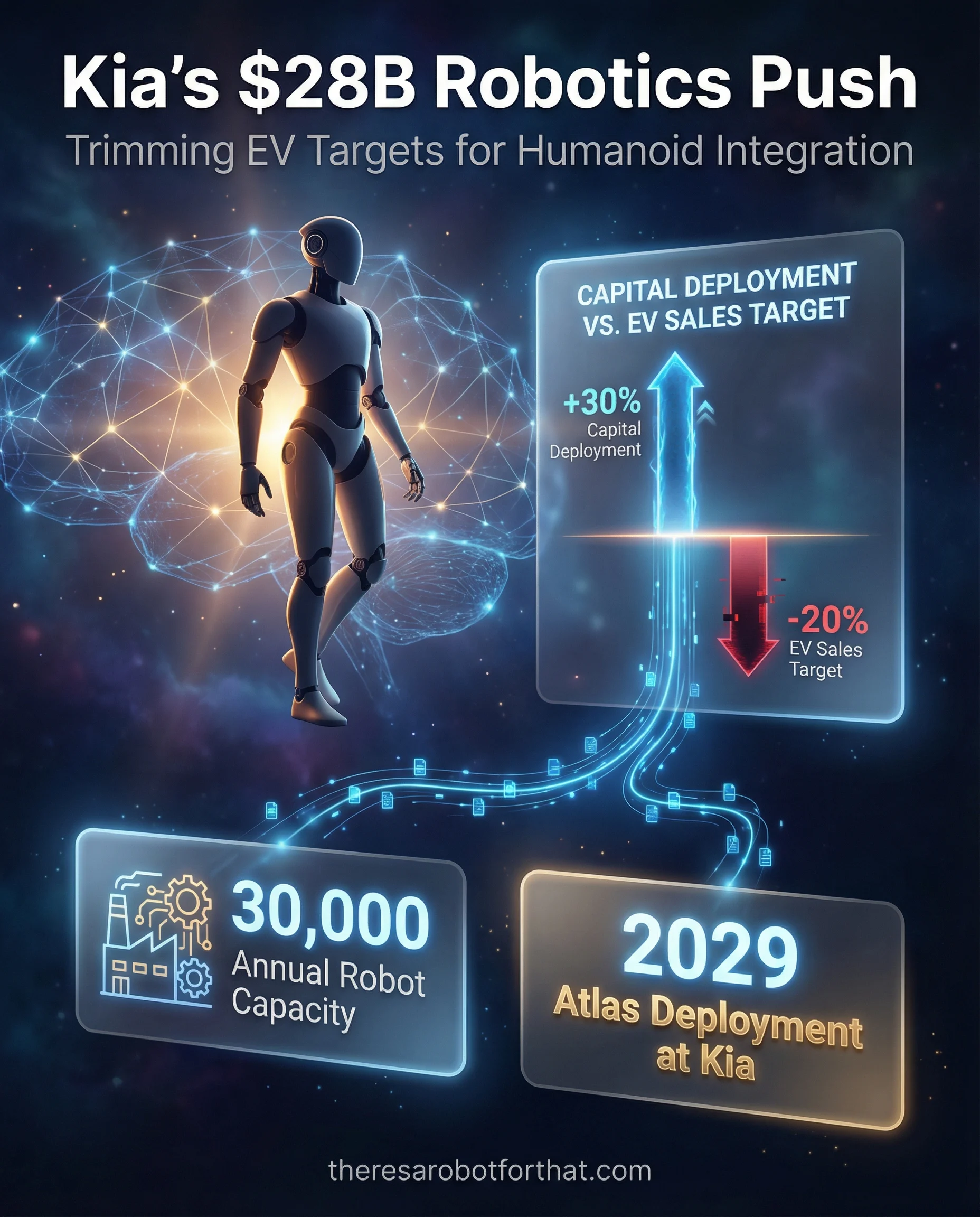
Image Source: There's A Robot For That
Snapshot: Kia announced plans to introduce Atlas humanoid robots developed by Boston Dynamics at its Georgia manufacturing facility starting in 2029, while cutting its 2030 EV sales target by over 20% and increasing total investment plans by 30% to $28 billion through 2029.
Breakdown:
Takeaway: A major automaker publicly committing to humanoid deployment with specific factory locations and dates provides the clearest timeline signal yet: 2028-2029 is when large manufacturers expect commercial humanoid operations to begin. The pairing of increased capital deployment with reduced EV targets suggests companies view physical AI as a more certain near-term investment than other emerging technologies.
Other Top Robot Stories
Asylon partnered with Thrive Logic to deploy autonomous robotic patrols integrated with AI-driven analytics for enterprise perimeter security, shifting from passive video recording to active physical AI that detects and responds to incidents in real-time across high-security exterior zones.
UBTech secured a $37M contract to deploy humanoid robots at China-Vietnam border crossings for guidance, inspections, and logistics tasks, following the company's $389M share placement in Hong Kong to fund expansion in real-world government and commercial deployments.
Maximo installed over 100MW of solar panels using AI-powered autonomous robots for AES Corporation, demonstrating how robotics automation is accelerating large-scale renewable energy infrastructure projects with improved speed and safety metrics.
Niantic Spatial launched a revamped Scaniverse platform and global visual positioning system trained on billions of crowdsourced Pokémon GO images, enabling robotics companies to achieve precise indoor and outdoor localization for physical AI applications including delivery robots and industrial automation.
🤖 Your robotics thought for today:
Eclipse just deployed $1.3 billion with an explicit strategy to connect physical AI companies across their portfolio. That's not speculative capital—that's infrastructure investment. When VCs build ecosystems instead of backing individual bets, they're pricing in commercial deployment within 24 months, not 10 years.
The math doesn't lie.
Enjoy your weekend,
Uli


