
Amazon and Berkeley teach Unitree G1 autonomous parkour
PLUS: BMW expands humanoid fleet, Ex-SpaceX engineers deploy industrial robots, robotic kidney transplant

Welcome back to your Robot Briefing
Amazon's research team just demonstrated a Unitree G1 humanoid executing autonomous parkour moves—vaulting obstacles and scaling walls using only vision sensors, no pre-mapped routes or external guidance systems required. The breakthrough isn't the athleticism itself, but the ability to navigate unpredictable terrain without environmental prep work.
For companies evaluating humanoid deployment, the question shifts from whether these machines can move to whether your facilities need expensive retrofitting before they arrive.
In today's Robot update:
Humanoid Robots Master Parkour
Snapshot: Amazon and UC Berkeley researchers have trained a humanoid robot to autonomously vault obstacles and climb walls using vision alone, marking a significant leap from basic walking to agile, parkour-like navigation.
Breakdown:
Takeaway: Amazon's investment in agile humanoid locomotion signals these robots are moving beyond controlled factory floors into dynamic environments now, not in three years. Operations leaders should watch this space closely as autonomous navigation capability directly impacts whether humanoids can handle real-world logistics and facility tasks without extensive environmental modification.
BMW Swaps Robots for Global Expansion
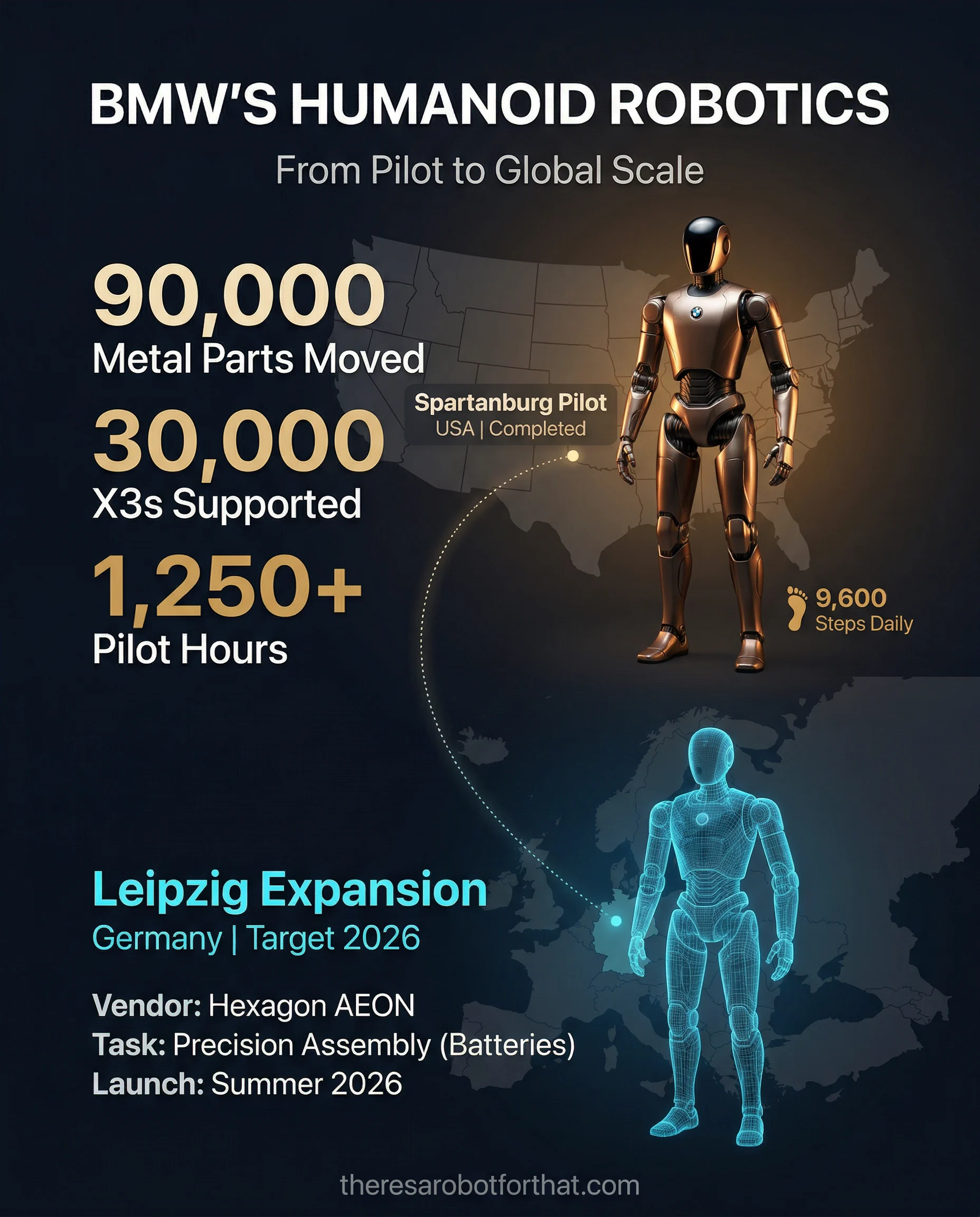
Image Source: There's A Robot For That
Snapshot: BMW is expanding its humanoid workforce to its Leipzig plant with Hexagon's AEON robot, following a successful pilot with Figure 02 in Spartanburg, signaling a multi-vendor strategy for its global production lines.
Breakdown:
Takeaway: BMW's expansion from one-plant pilot to multi-site deployment with different vendors marks the shift from experimentation to operational scaling in automotive humanoid robotics. The multi-vendor approach also creates a procurement playbook that other manufacturers will likely copy to avoid single-supplier risk in this emerging technology category.
Ex-SpaceX Engineers Reveal 'Noble Machines'
Snapshot: Noble Machines, founded by engineers from SpaceX, Apple, and NASA, deployed industrial robots to a Fortune Global 500 customer just 18 months after launching—signaling that serious industrial automation may arrive faster than many companies expect.
Breakdown:
Takeaway: The 18-month path from startup to Fortune 500 deployment suggests industrial robotics companies are compressing development cycles dramatically, which matters for operations leaders who've been told to expect 3-5 year automation timelines. Companies sitting on the sidelines waiting for the technology to mature may find their competitors already have working systems in place.
First Fully Robotic Kidney Transplant
Snapshot: Cedars-Sinai completed its first fully robotic kidney transplant, marking a shift toward minimally invasive procedures that cut recovery time and return employees to work faster—a development only a handful of US institutions have achieved.
Breakdown:
Takeaway: Surgical robotics has moved beyond routine procedures into complex transplant operations at leading medical centers. Companies evaluating healthcare benefits should watch how [transplant programs](https://www.cedars-sinai.org/programs/transplant/specialties/kidney-pancreas.html) adopt these techniques over the next 3-5 years, as faster employee recovery directly impacts productivity and healthcare costs.
Other Top Robot Stories
Golden Valley Memorial Healthcare completed the world's first surgery using THINK Surgical's TMINI miniature robotic system for knee replacement, marking a shift toward compact robotic platforms that support multiple implant brands and give surgeons more flexibility in joint replacement procedures.
Researchers identified viral videos claiming to show Chinese military training humanoid robot soldiers as AI-generated fakes, with anomalies including weapons ejection ports that never open and magazines appearing out of thin air, highlighting the challenge of distinguishing real robotics progress from manufactured hype.
🤖 Your robotics thought for today:
Amazon and UC Berkeley trained a Unitree G1 to climb obstacles 96% of its height and vault at 3 m/s using only vision, yet most facilities are still redesigning floor plans to accommodate robots that can barely navigate doorways—so if parkour-level agility already works, why are we still modifying buildings?
Enjoy your weekend,
Uli


