
Alibaba launches open-source brain for physical AI
PLUS: Waymo orders 50,000 AVs, Ambi licenses robot skills, Fauna’s soft humanoid

Welcome back to your Robot Briefing
Alibaba jumped into the physical AI infrastructure race with RynnBrain, an open-source model built to help robots understand and interact with the real world. The move puts China's tech giant directly alongside Nvidia, Google, and Tesla in a market where multiple heavyweights are now racing to own the software layer that powers tomorrow's autonomous machines.
With Alibaba releasing its model for free while competitors guard theirs, is open-source the wedge that lets smaller players build robotics applications without massive AI budgets — or just another front in the US-China tech competition?
In today's Robot update:
Alibaba Enters the Arena: 'RynnBrain' to Power Physical AI
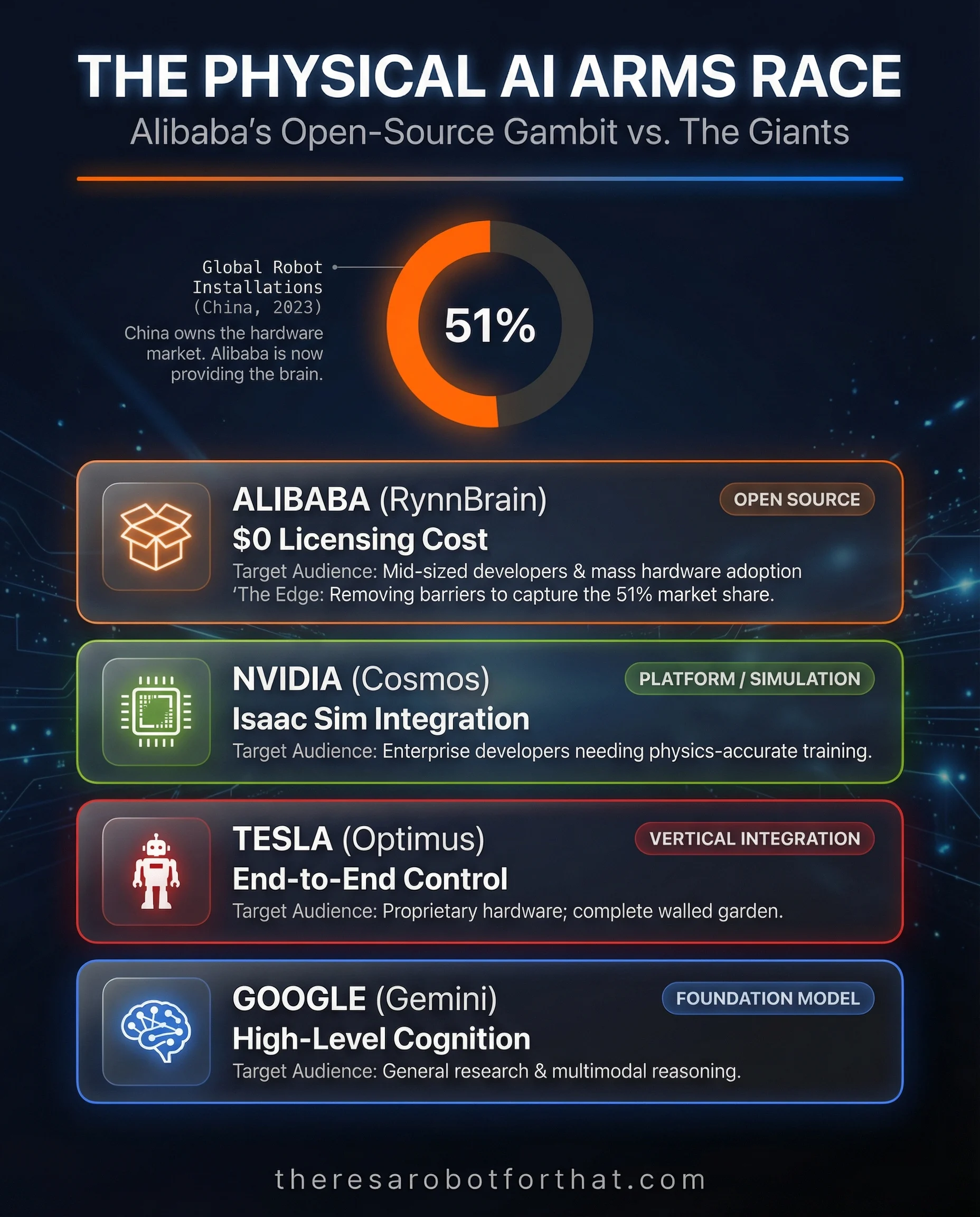
Image Source: There's A Robot For That
Snapshot: Tech giant Alibaba launched RynnBrain , an open-source AI model designed specifically to power robotics and help machines comprehend the physical world, joining Nvidia, Google, and Tesla in the race to commercialize physical AI.
Breakdown:
Takeaway: When multiple tech giants converge on the same infrastructure layer within months of each other, it signals near-term commercialization rather than distant R&D. Alibaba's open-source approach specifically lowers the barrier for mid-sized companies to experiment with robotic applications without massive upfront AI development costs.
Waymo's Massive Bet: Hyundai Partnership & Rapid Expansion
Snapshot: Hyundai Motor Group has partnered with Waymo to supply autonomous vehicles in what could become one of the largest AV manufacturing commitments to date, signaling that self-driving technology has moved from pilot projects to industrial-scale deployment.
Breakdown:
Takeaway: This isn't about robotaxis anymore—it's about whether your industry will face AV-enabled competitors in the next 3-5 years. When a traditional automaker commits to purpose-built autonomous vehicle production at industrial scale, it signals that logistics, delivery, and mobility services are entering a fundamentally different cost structure era.
The Anti-Industrial Humanoid: Fauna's 'Sprout' is Small, Soft, and Safe
Snapshot: Fauna Robotics has unveiled Sprout, a 3.5-foot tall, lightweight humanoid robot designed as a developer platform for homes and schools rather than factories.
Breakdown:
Takeaway: Sprout signals a fork in humanoid development between heavy industrial robots and lighter platforms built for human proximity. Companies watching the space should note that service industry applications may arrive on different timelines than factory automation, with safety and trust as the primary barriers rather than technical capability.
Skills for Sale: Ambi Robotics Opens Its 'Brain' to Third-Party Bots
Snapshot: Ambi Robotics is licensing its production-hardened warehouse robotics intelligence to third-party manufacturers through a new AI Skill Suite, marking a shift from hardware-only sales to software-as-a-service that could accelerate automation adoption across the logistics industry.
Breakdown:
Takeaway: This licensing model signals that warehouse robotics is maturing beyond custom deployments into standardized, plug-and-play intelligence. For operations leaders evaluating automation, it means faster time-to-value and lower risk, as you're buying skills proven across millions of real-world packages rather than experimental technology.
Other Top Robot Stories
Lithuania launched its fourth RADAROM fundraising campaign to procure AI-equipped combat robots for Ukraine's military, with fully equipped robotic units—including tracked platforms with machine-gun turrets and target recognition systems—costing up to €250,000 each, signaling defense sector validation of autonomous ground systems at scale.
OhioHealth deployed Mako orthopedic robots at Mansfield Hospital for joint replacement procedures, with surgeons reporting superior accuracy compared to manual techniques and patients experiencing faster recovery times, demonstrating surgical robotics' continued expansion beyond major metro markets into regional healthcare systems.
Carbon Robotics won Top 10 New Product recognition at World Ag Expo 2026 for its autonomous tractor kit alongside live demonstrations of the LaserWeeder G2, marking commercial traction for agricultural robotics as labor costs and availability pressures push farms toward automation solutions with measurable ROI.
Allen Control Systems highlighted autonomous drone swarms as a battlefield-defining technology requiring multiple counter-solutions including kinetic interceptors and electronic warfare systems, underscoring the emerging defense market for anti-drone robotics as unmanned aerial threats proliferate across military and infrastructure security applications.
🤖 Your robotics thought for today:
In 13 months we went from Nvidia's Cosmos (open-source) to Alibaba's RynnBrain (open-source), with Google's API-accessible model in between—but the question isn't just "open vs. closed" anymore. It's whether full open-source actually drives more mid-market deployments than API-gated access, or if the infrastructure moat has already moved to compute and data.
What's your take?
Until tomorrow,
Uli


