
Airbus taps UBTech humanoids for aircraft assembly
PLUS: Musk's 2027 Optimus target, robot replaces 6 workers, Gartner's reality check
Welcome back to your Robot Briefing
Airbus is bringing UBTech's Walker S2 humanoids into its aircraft manufacturing facilities for concept testing, giving the humanoid sector its first major validation from aerospace—an industry where precision tolerances are even tighter than automotive assembly. With aerospace now evaluating humanoids alongside automotive and electronics manufacturers, the question shifts from whether this technology works in controlled demos to which industries will actually deploy at scale.
If humanoids can prove themselves in aircraft assembly, where exactly does that leave companies still waiting for the business case to crystallize?
In today's Robot update:
Airbus taps UBTech's humanoids for aircraft assembly
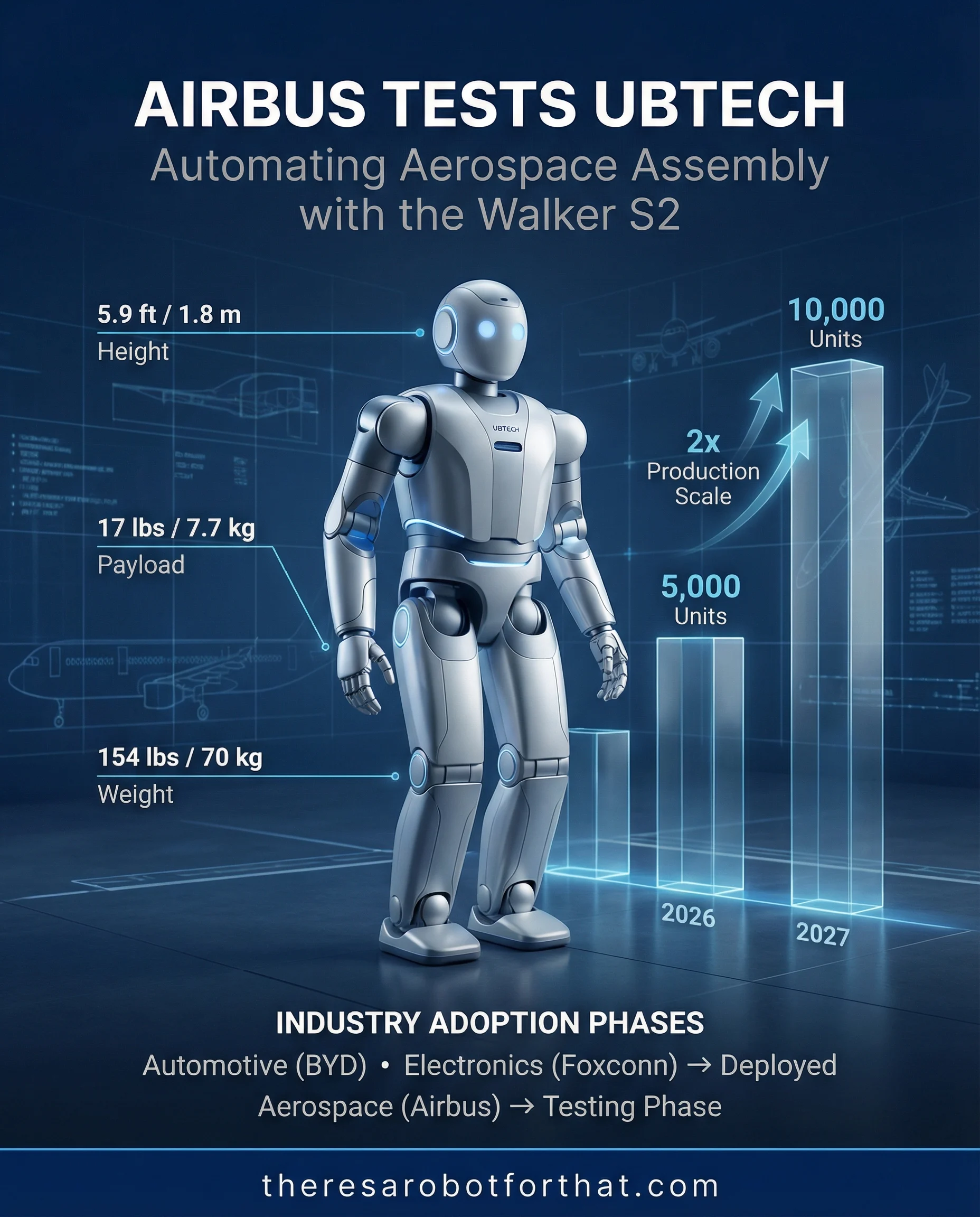
Image Source: Gemini / There's A Robot For That
Snapshot: Airbus has signed an agreement with UBTech to introduce Walker S2 humanoid robots into its aircraft manufacturing lines, marking a significant vote of confidence from a major aerospace manufacturer in humanoid technology's readiness for complex industrial environments.
Breakdown:
Takeaway: Airbus's move into humanoid testing represents aerospace's first major validation of the technology for high-precision manufacturing environments, suggesting the business case for humanoids extends beyond automotive assembly into industries with even tighter tolerances. Operations leaders should note this signals humanoids transitioning from experimental to evaluation phase at enterprise scale, though widespread adoption remains 2-3 years out based on Airbus's cautious testing approach.
Musk: Tesla Optimus sales to begin by 2027
Snapshot: Speaking at the World Economic Forum, Elon Musk confirmed Tesla plans to sell its Optimus humanoid robots to the public by the end of 2027, marking the first concrete timeline for when businesses could purchase Tesla's humanoid platform.
Breakdown:
Takeaway: The 2027 timeline gives companies a concrete planning horizon for when humanoid robots might become commercially available, but the gap between controlled demos and real-world utility remains substantial. Musk himself warned the production ramp will be agonizingly slow initially, suggesting early adopters should expect limited availability and high costs before the technology scales.
China's new 6-in-1 tomato robot replaces human crews
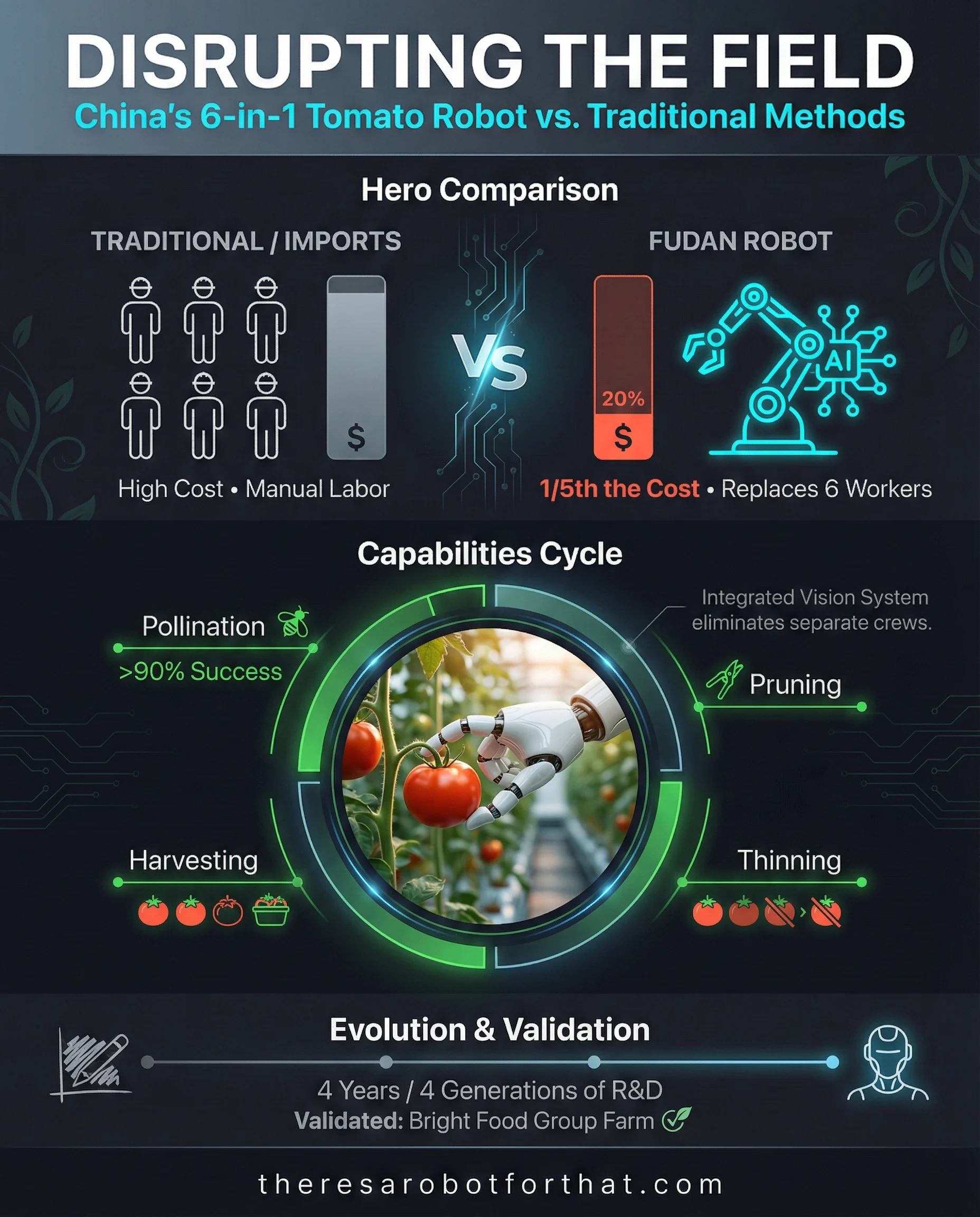
Image Source: Gemini / There's A Robot For That
Snapshot: Researchers at Fudan University developed an agricultural robot that handles pollination, pruning, thinning, and harvesting autonomously—claiming it can replace up to 6 workers while costing just 10-20% of foreign competitors.
Breakdown:
Takeaway: Agricultural automation is crossing the threshold from research curiosity to economically viable solution for labor-intensive crops. Operations managers in food production should monitor whether similar multi-task systems emerge for other high-value crops, as the economics of automation may shift faster than most mid-market companies anticipated.
Reality check: Humanoid robots stuck in 'pilot purgatory'
Snapshot: A new Gartner report predicts that fewer than 20 companies will successfully scale humanoid robots in production environments by 2028, citing technical immaturity and high costs as major hurdles.
Breakdown:
Takeaway: This report gives executives data-backed permission to resist the humanoid hype and focus automation budgets on proven, task-specific solutions that deliver ROI today. The handful of companies that do deploy humanoids successfully will likely confine them to tightly controlled environments rather than the dynamic, collaborative settings vendors promise.
Other Top Robot Stories
Eyou launched the world's first fully automated production line for humanoid robot joints in Shanghai's Zhangjiang Hi-Tech Park, with initial capacity of 100,000 units annually and plans to scale to 150,000, addressing the supply bottleneck as joints represent nearly half the total cost of a humanoid robot.
LivsMed raised $94 million in a Korean IPO that values the surgical robotics company at approximately $1 billion, making it a medical technology unicorn as it scales production of its STARK robot-assisted surgical system and expands its telesurgery capabilities demonstrated between California and Chicago.
🤖 Your robotics thought for today:
Airbus is testing UBTech's Walker S2 for aircraft assembly while automotive already deployed thousands at BYD and Foxconn—so if aerospace's "high-precision" requirements are just catching up to what car factories solved last year, are tolerances actually the barrier or just the excuse?
Until tomorrow,
Uli


