
Agibot ships 5,000 humanoids in 90 days
PLUS: Humanoid runs warehouse via cloud, Physical Intelligence eyes $11B valuation, and autonomous farming software lands €4M

Welcome back to your Robot Briefing
Chinese robotics maker Agibot just compressed three years of production into 90 days, shipping 5,000 humanoid robots in a single quarter. The company says the milestone proves commercial humanoids aren't a future promise — they're a current workforce option.
If a relatively unknown Chinese firm can scale this fast, what does that mean for Western manufacturers still running pilot programs? The gap between testing robots and deploying them at scale might be closing faster than most businesses realize.
In today's Robot update:
Chinese robotics firm ships 5,000 humanoids in 90 days — matching its prior 3-year total
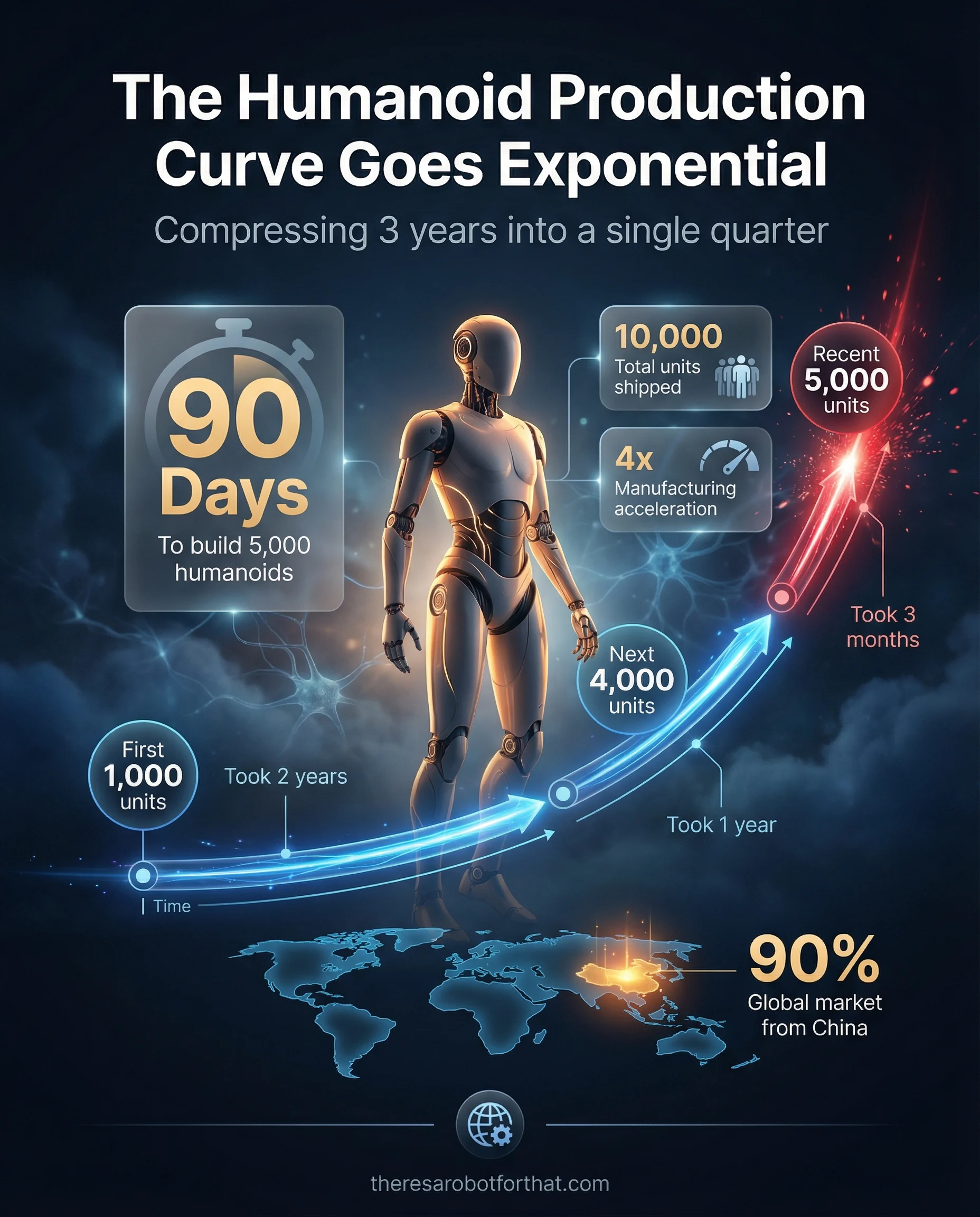
Image Source: There's A Robot For That
Snapshot: Agibot delivered 5,000 humanoid robots in three months, compressing what previously took three years into a single quarter and hitting 10,000 total units shipped. The Chinese manufacturer claims this acceleration proves humanoids are ready for workforce deployment today, not in some distant future.
Breakdown:
Takeaway: The production curve matters more than the absolute numbers — when a manufacturer can compress years of output into quarters, it signals supply chains and manufacturing processes have matured past the prototype phase. Operations leaders should watch whether these units stay deployed for 12+ months, which would indicate customers are finding actual ROI rather than running expensive experiments.
Humanoid robot executes warehouse tasks via cloud software at automotive plant
Snapshot: HMND's wheeled humanoid completed a live proof-of-concept at Martur Fompak, an automotive supplier, where it received task instructions from SAP's enterprise system over the internet and autonomously picked and delivered parts in an active warehouse. The robot worked within existing workflows, not in an isolated test environment.
Breakdown:
Takeaway: The business signal isn't the robot itself — it's that enterprise software vendors like SAP are building robot task management into their core platforms. When warehouse management systems can dispatch robots the same way they route human workers, the integration burden drops from months-long IT projects to configuration exercises, which changes deployment economics for mid-sized facilities.
Physical Intelligence in talks for $1B raise that would double valuation to $11B
Snapshot: The robotics foundation model startup is negotiating a funding round that would double its valuation to over $11 billion just months after raising more than $1 billion. Investors are showing increased appetite for companies building AI models that work in the physical world, with Physical Intelligence developing software that lets robots learn movements for tasks like folding clothes and assembling boxes.
Breakdown:
Takeaway: Foundation model companies are raising capital at software valuations while selling to a hardware market — that gap matters for buyers evaluating vendor stability. The strategic question for operations leaders is whether to wait for dominant platforms to emerge or deploy current-generation systems, knowing the software layer underneath may get commoditized by billion-dollar model providers in 18-24 months.
German ag-tech startup raises €4M to put autonomous farming software in tractors
Snapshot: Nature Robots closed a €4 million seed round led by Climentum Capital and Bayern Kapital to scale its modular autonomy platform that lets agricultural machinery manufacturers add self-driving capabilities without years of in-house development. The software enables equipment to operate autonomously across large fields, vineyards, and specialty crops.
Breakdown:
Takeaway: Ag equipment autonomy is following the same pattern as automotive — suppliers building the software layer so manufacturers can add autonomous features without becoming AI companies. For operations leaders in industries with specialized equipment, this signals that autonomous capabilities will likely arrive as vendor-supplied modules rather than requiring ground-up system replacements, which changes the capital planning conversation from "replace everything" to "upgrade existing."
Other Top Robot Stories
Amazon acquired Fauna Robotics two months after the New York startup launched Sprout, a 3.5-foot humanoid designed for homes and schools rather than warehouses — adding social robotics to Amazon's 1-million-robot logistics fleet.
LimX unveiled its Luna humanoid at China's Taobao Influencer Festival, performing a catwalk and illusion turn with 33 degrees of freedom — marking a strategic shift from its industrial OLI platform toward lifestyle-oriented robots for public interaction.
Sharpa demonstrated autonomous apple peeling using dual dexterous hands powered by its MoDE-VLA system, which combines vision, language, force, and touch sensing to control 22 active degrees of freedom per hand — tackling one of robotics' hardest manipulation challenges.
Unitree deployed its G1 humanoid at Brooklyn Bridge Park, where the 4'2" robot ran through crowds of children for two hours on a single charge — drawing mixed public reaction between entertainment value and dystopian concern over AI-human interaction.
🤖 Your robotics thought for today:
Agibot went from 5,000 units in three years to 5,000 units in 90 days. That's not incremental improvement — that's a manufacturing curve hitting escape velocity. Meanwhile, Physical Intelligence is chasing an $11B valuation selling software that's still folding laundry in labs.
I'm watching which model actually puts robots on factory floors at scale.
Until Friday,
Uli


